Interplanting lemons with passion fruit: good returns in both the short and long term
Original title: Beautiful Countryside Harvest Season - Interplanting lemons with passion fruit brings high returns
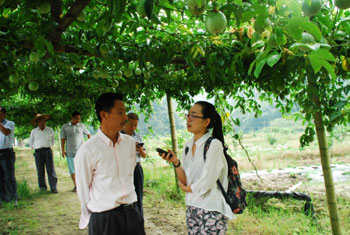
Inverted-V trellis for passion fruit
Most of the lemon trees in the thousand-mu lemon orchard are still relatively short
Some of the larger lemon trees have also begun to bear fruit
In golden autumn October, the reporters of the Fujian-Taiwan Village and Township Visit drove to Baoshan Village in the Shangping area of Shajian Town, where it is said there is a spectacular thousand-mu lemon orchard invested in by a Taiwanese businessman. What caught the eye most upon arriving at the lemon planting base was not the lemons at all, but a stretch of passion fruit trellises. Walking under the passion fruit trellises, one can see egg-shaped fruits hanging on the vines, green, red and purple, making the mouth water and showing us the charm of this autumn's beautiful countryside harvest season.
Yet the passion fruit, so lush with branches and leaves and laden with fruit, is not the main attraction of this planting base, but rather the product of making full use of space on the hillside plots. Guo Yaonan, the person in charge of this planting base and a local villager, said: "The ventilation conditions on the hillside plots are good. Interplanting passion fruit not only does not affect the growth of the lemons, but also achieves multiple benefits at once. For example, the land is not wasted; farm workers can make full use of their time to increase their income; the farm can also reduce investment risk; and the soil is loosened rather than hardened, and so on."
It is understood that passion fruit fruiting is limited only by temperature, not by time. It can bear fruit as soon as spring begins, and then can keep being harvested until frost in winter. "Normally, about 40 plants per mu, with an annual yield of 3,500 to 4,000 jin." Guo Yaonan introduced that the passion fruit trellises here are adapted to local conditions, including flat-top style, fence style, inverted-V shape and gate shape, and so on. They not only beautify the entire planting base, but also, on the premise of not affecting the growth of the lemons, make full use of the land between the lemon trees, increasing income in a short time and achieving the goal of using short-term harvests to support the long-term development of the lemons.
Compared with the immediate planting results of passion fruit, the cultivation cycle of lemons is relatively much longer. "These lemons were planted in May 2014, when they were only about 30 cm tall. Now the well-grown ones are about 2 m tall, taller than a person." Guo Yaonan told reporters, pointing to the stretches of lemon trees.
Guo Yaonan previously worked in the area of the Jiaomei Taiwanese Investment Zone, where he got to know quite a few Taiwanese friends. Later he returned to Baoshan Village and found that most of the land originally used for growing sugarcane had been abandoned because of poor returns, so he introduced his Taiwanese businessman friend Zheng Huaxin to Baoshan Village to find land for production. Previously, Zheng Huaxin's company headquarters was in Shanghai, and he had a 2,000-mu lemon base in Yunnan and Sichuan. Because the weather is relatively cold, in Sichuan it can produce only three seasons a year.
After visiting several villages here and learning about the altitude and climate, Zheng Huaxin considered the climate here mild, with lemons flowering in all four seasons and able to produce four seasons a year, one season more than in other provinces. So with the help of local villagers, Zheng Huaxin signed land lease contracts for a total of 800 mu across several nearby villages, at 500 yuan per mu, with a lease term of 15 years, paying 5 years of rent in a lump sum. The rent increases in cycles of every 5 years, by 50 yuan per mu.
It is understood that Zheng Huaxin often goes to the site to guide planting. From building tractor roads, laying water pipes, building water tanks, to installing automatic sprinkler irrigation... he carefully arranged everything. Guo Yaonan said: "He lived here for a long time. At the beginning he was even more diligent than an ordinary farm worker, working from morning till night. Only now that things have gradually gotten on track has he moved to activities on the marketing side, and in the future he should also come over often."
The Taiwanese enterprise focuses on organic planting. "The boss does not allow spraying pesticides, for fear of pesticide residues." Therefore, they adopt manual weeding. For better management, they have one section leader responsible for every 50 mu, with a monthly wage of 2,500 yuan, while also hiring two or three temporary workers. In the future, the company will set aside 10% of profits as a bonus, to be used as management wage expenses for these management personnel.
"The investment of the Taiwanese enterprise has solved the surplus labor problem here." Wu Qinyong, publicity committee member of Shajian Town, said that this lemon orchard base has also promoted the transfer and reuse of land; in addition, because the returns of lemons and passion fruit are good, it has also driven other surrounding people to plant them together, and the company will come to purchase every year, solving the farmers' sales problem and raising the local farmers' economic income.
It is understood that the company plans to plant 1,000 mu of lemons, with a total investment of more than 20 million yuan. Lemons can bear fruit in four years, and at the end of 2016 the company will also build a juice processing base here.
Guo Yaonan said that in addition, the company also established the Hua'an County Lühua Bao Fruit and Vegetable Professional Cooperative and the Hua'an County Tiandibao Chinese Herbal Medicine Professional Cooperative. At present, the cooperative is selecting Taiwanese varieties of Chinese herbal medicines and preparing to plant them after spring begins. (Reporter Hong Mei)