Targeting the hot pot market, specializing in side dishes does brisk business
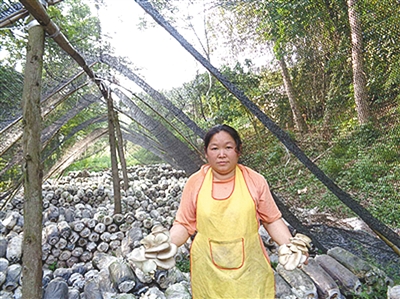
"The weather is gradually turning cold, and more and more people are eating hot pot. These days edible fungi sell very well, and prices have risen steadily." Recently, Li Yijuan, a villager from Miaoba Village, Sanyuan Town, Fengdu County, told this writer while picking enoki mushrooms in a greenhouse that as the main side dishes for hot pot, edible fungi such as enoki mushrooms, oyster mushrooms, king oyster mushrooms and straw mushrooms are very popular. With the help of the poverty alleviation village task force, she learned edible fungus cultivation techniques and can look forward to increasing her income.
Unable to afford it
Li Yijuan is 43 this year and has a son and a daughter. Her son is currently studying at Qingdao University in Shandong, and her daughter is studying at Chongqing Technology and Business University. "The tuition and living expenses for the two children come to thirty or forty thousand a year. My husband and I farm at home and simply cannot afford this expense." She said that in recent years her family has piled up debts and was listed by the town as a registered impoverished household.
To change the situation, two years earlier she and her husband tried growing vegetables and raising pigs. The couple worked from dawn to dusk, one managing the home and the other working outside. Although it was hard, there was joy in the hardship. But ordinary seasonal vegetables could not fetch a good price when they hit the market in concentrated batches, and the live pig market was also unstable, so they felt there was no way to get rich.
Planning to grow mushrooms
Just when she was very anxious, the village task force came to investigate and learn about her family's production and living conditions. After analyzing her family's situation and the market conditions of the catering industry in the county and town, the staff suggested that she use greenhouses to grow edible fungi and specialize in the side dish business for hot pot restaurants.
"My husband and I know how to grow vegetables and grain, and we also know how to raise pigs and cattle, but we have never grown edible fungi." Li Yijuan was very worried.
The task force promptly invited experts in edible fungus cultivation to their home, taught them techniques, and took the two of them to buy steel frames, plastic film and other materials to build a greenhouse covering about 700 sq m.
From material preparation, disinfection, fermentation, bagging and inoculation to steaming, setting up the greenhouse, putting things on shelves, and after mushrooms emerge, how to spray water, pick mushrooms, trim mushrooms and dry them in the sun... "The experts came personally to teach us these detailed tasks hand by hand." She said that each type of fungus has a different production cycle and cultivation method. "For example, enoki mushrooms are delicate by nature and must be carefully managed at all times." "Oyster mushrooms, for example, are relatively more likely to be eroded by diseases, so sterilization work in particular must be done well."
Paying off debts
Thanks to her strong skills, the enoki mushrooms Li Yijuan grew had good color, uniform size and proper taste, and sold for a good price. "These days the retail price is 5.2 yuan per jin. Many hot pot restaurant owners have established supply relationships with me, and I don't worry about selling the products." Li Yijuan said that by selling mushrooms she paid off her debts to relatives and friends. Next, she plans to base herself on the market, accurately grasp the best time to bring each variety to market, and ensure maximum benefits.