Migrant worker in Chaoyang County, Liaoning returns home to start a business and becomes a "chicken commander"
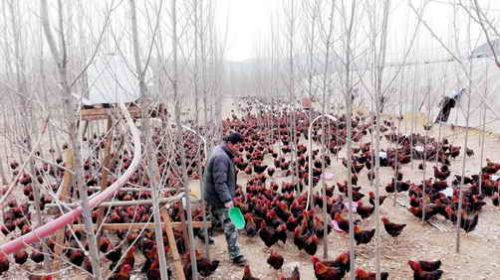
Every morning at dawn, he gets up, washes his face with cold water, then goes to the chicken coop to check on things, mix feed and feed the chickens. For Wang Yabin, who lives in Nandayingzi Village, Liucheng Town, Chaoyang County, Chaoyang City, Liaoning Province, this pace of life has already become the norm.
He used to drift from place to place working as a migrant worker, but now he has changed trades and become a "chicken commander." Under his careful raising, 3,000 Hongyu chickens are about to be ready for market.
"This is my first year raising chickens. I treat it as gaining experience. In the future I want to scale it up even more," Wang Yabin said.
Contracting woodland for farming: a migrant worker starts a business "at his doorstep"
Before this year, Wang Yabin was still a migrant worker shuttling between urban construction sites and sweating it out. Far from home, he worked alone in other places to earn money, and only during the Spring Festival each year, when construction sites shut down, could he return home to rest for a while. However, affected by the current overall situation of the real estate industry, at the beginning of this year many construction sites stopped hiring in large numbers, which left him, someone who made a living from this, so worried that he did not know what to do. The few mu of farmland at home could only barely get them by, but his child was still in university. What was he to do about the high annual tuition and living expenses? He began to think about whether he could find another path to prosperity.
"By chance, I learned that a friend of mine was raising chickens in Jinzhou. He told me this path might lead to prosperity and let me give it a try. He would provide me with chicks and technology," Wang Yabin recalled. For this reason, he deliberately went to nearby markets to investigate and found that raising chickens required little investment and brought quick returns, so it might really be possible to make money.
So, with the mindset of giving it a try, Wang Yabin discussed it with his wife, and the two took 100,000 yuan from their savings over many years. They first contracted a stretch of woodland near the village. Backed by hills and facing water, with good water quality and a good ecological environment, it was an excellent location for raising chickens. Then they quickly built chicken coops, purchased all the equipment, and ordered a batch of chicks from the friend.
"I raised 3,000 in total, all Hongyu chickens. This breed has strong disease resistance and good meat quality," Wang Yabin said. As a layman when it came to raising chickens, over the past half year he and his wife put considerable effort into the chicken farm. To save costs, they did everything themselves: "Whatever I did not understand, I called my friend to ask, or searched online for knowledge in this area. It was also a learning process. Fortunately, none of my chickens got sick, and they all grew very well."
3,000 Hongyu chickens about to be ready for market, hoping to scale up chicken farming
Wang Yabin said his batch of chickens had always been raised on corn and soybean cake. Their "size" was a bit smaller than chickens fed on commercial feed, but the meat was tender. Just the other day, when his father celebrated his birthday, he caught one of his own Hongyu chickens and brought it home to entertain guests. When everyone tried it, they were full of praise for the taste of the chicken.
With his family's approval, Wang Yabin gained more confidence. He told the reporter that these 3,000 Hongyu chickens would soon be ready for market. Some time ago, a slaughterhouse had approached him, but he could not bear to sell. He said he planned to sell these chickens at a fair price to customers who love chicken meat, around 40 to 50 yuan each, just to let everyone have a fresh taste: "It also counts as gaining a year of experience for myself. If the results are good this year, I will keep raising them."
Wang Yabin said that in the future, migrant workers returning home to start businesses will become a trend. He hopes his chicken-raising story can bring confidence and motivation to more migrant worker friends who are struggling to make a living, and he also hopes the government can provide them with more policy support in this regard.
"Only those who have experienced it know what the days of working away from home are like. From morning to night every day it is just work, enduring hardship and missing family," Wang Yabin said. Now, after a busy day, being able to return home at night, have a good reunion meal with family, and sleep soundly is something he could not have looked forward to more in the past: "My next goal is to scale up the chicken farm so more people can eat the chickens I raise."