Middle school girl weaves bamboo mats that sell as far as Europe and Japan
Original title: Small bamboo strips weave a dream of prosperity
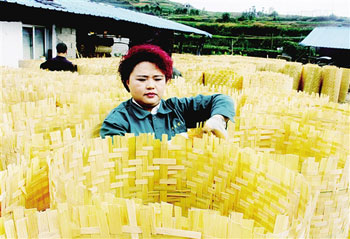
Xu Donglian drying bamboo mats. Photo by Liu Xing, our reporter
In early winter, the forests covering the hills and fields of Huatanshan Town, Shangrao County, Jiangxi, are ablaze with layered colors. In front of the simple factory building of Hengzhen Bamboo Industry Company, bamboo mats rolled into cylinders are lined up neatly in the sunlight. Inside the factory, thousands of moso bamboo poles are piled into a "bamboo mountain"; sawing the bamboo, splitting the strips, and weaving-every step proceeds in orderly fashion. Xu Donglian, the 45-year-old head of the company, is busy alongside the workers, and within a few minutes a new bamboo mat has been "spat out" from the "mouth" of the weaving machine.
Though Hengzhen Bamboo Industry is not large in scale, its output is by no means small. The company produces more than 6,000 bamboo mats every day, with an annual output value of more than 20 million yuan. "Drawing on the strength of large bamboo enterprises in Zhejiang, Anhui and other places, we have laid Shangrao's bamboo mats in cars and on high-speed trains, and also sold them to Japan and Europe," Xu Donglian said, not without pride.
Xu Donglian only has a middle school education. In 1989, with her family poor, she dropped out of school and went to Guangdong to work. Two years later, she took the 30,000 yuan she had saved by pinching pennies and opened a restaurant in Wenzhou, Zhejiang. "In Wenzhou, I saw that several local bamboo companies were doing especially good business." Xu Donglian is someone skilled at spotting business opportunities: the hills and fields of my hometown are covered with bamboo forests, so I can do a moso bamboo business too! She acted as soon as she made up her mind. In 1996, Xu Donglian made a special trip to Longyou, Zhejiang, to learn from a master, and mastered the harvesting of moso bamboo, visual grading, bamboo strip processing and weaving techniques. After that, she returned to Huatanshan and set up a bamboo processing factory, earning 30,000 yuan in the very first year. She then bought more than ten special processing machines, rapidly increasing output.
Because the product quality is good, more than ten large bamboo companies established cooperative relations with her one after another, and the company's sales volume kept growing. "Our bamboo mats are sent to upstream enterprises for secondary processing to make various high-grade recombinant panels, which are in short supply on domestic and international markets," Xu Donglian said.
To help her fellow villagers get rich together, with support from the local government, Xu Donglian founded the Shangrao County Fubang Moso Bamboo Professional Cooperative, which has absorbed more than 400 village households and poor residents from the local area and surrounding areas. Xu Donglian helps everyone choose and buy equipment, trains them in processing techniques, and unifies sales channels, making the local moso bamboo processing industry flourish. Under her leadership, Huatanshan Town has set up nearly 100 moso bamboo processing factories (workshops), and a group of bamboo industry "small bosses" and skilled craftsmen have emerged. Zheng Deyou, a disabled person, bought a weaving machine with Xu Donglian's financial help to process bamboo mats, and his family's monthly income exceeds 8,000 yuan; Xie Jishui, once a poor household, has a family workshop that processes 100,000 bamboo mats a year, with an annual income of nearly 200,000 yuan.
The rural tourism boom that has been rising in recent years has given Xu Donglian the idea of diversified operations. Processing bamboo handicrafts, opening a farmhouse restaurant, and developing the tourism specialties of her hometown are all included in her next development goals. "I just want to do what I can to help more of my fellow villagers become well-off," Xu Donglian said. (Author: Liu Xing)