Millet and Black Donkeys in a Circular Farming Model: Blood-Generating Poverty Alleviation Keeps Farmers Warm Through Winter
Original title: Jinan's "First Secretary" Leads Villagers in Heze to Explore the Path of Industrial "Blood-Generating" Poverty Alleviation
"Millet + Black Donkeys": Circular Farming and Breeding Industry Becomes a Chain
 Raising Donkeys" />
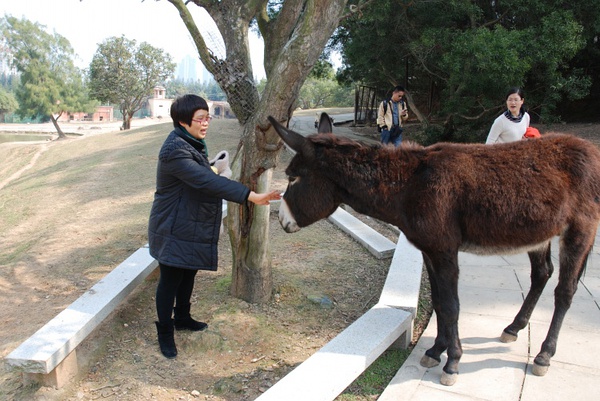
"Now that we have donkeys and a workshop, this circular industry chain is finally connected." On November 27, Zhang Meisheng stood beside a donkey trough at a villager's home in Xiaowangtang Village, stroking a black donkey and reflecting. Xiaowangtang is an ordinary village in Wenshangji Town, Chengwu County, Heze City. Of the village's 1,222 residents, 301 are impoverished, making it a typical economic "hollow village." Zhang Meisheng is a teacher at Shandong Jianzhu University and a First Secretary dispatched by the Organization Department of the Provincial Party Committee. After arriving at the village at the beginning of the year, he has been eating and living there ever since, leading the villagers to explore a "millet + black donkey" ecological circular industry chain.
[The Village Has Transformed] Dirt roads became concrete roads, old wires upgraded to a new power grid
On an afternoon in mid-October, at the entrance of Xiaowangtang Village, Zhang Meisheng was gathering freshly cut millet with the villagers. Dressed in old clothes and worn cloth shoes, he looked no different from the village men. Were it not for his glasses, it would be hard to believe he is a university teacher.
"The shoes are borrowed from a fellow villager." Zhang Meisheng said with a simple smile, "When I was a child in the Yimeng Mountain area, I had to walk 2 km of mountain road to school, and I wore these same kind of cloth shoes."
"Let's go, let's take a look at the newly repaired road." Zhang Meisheng led the reporter into the village. It used to be all mud paths and narrow winding trails, with not a single main road to be found. After multiple rounds of communication and coordination, Zhang Meisheng secured 700,000 yuan in provincial industry poverty alleviation funds and over 300,000 yuan in road construction funds from the local government, building 3.2 km of hardened concrete road, completely solving the villagers' travel difficulties.
"The village's old power grid was all degraded, it couldn't even power the corn threshing machines. This year Secretary Zhang led the effort to upgrade the electricity." said Grandpa Dong from the village. Zhang Meisheng led village officials in extensive coordination and communication, upgrading and renovating the village power grid to the highest standard.
[Industry Becomes a Chain] The "millet + black donkey" ecological circular industry takes shape
After nearly half a year of research, Zhang Meisheng established a "millet + black donkey" ecological circular industry poverty alleviation plan -- building on golden millet cultivation, he developed millet processing and black donkey breeding, forming a circular farming and breeding ecological industry chain. The stalks and bran of golden millet are excellent feed for black donkeys, and donkey manure is highly effective organic fertilizer for golden millet growth. Using idle old houses and sheds to raise black donkeys effectively utilizes the idle labor of left-behind elderly people and women.
After the plan was finalized, Zhang Meisheng led the villagers in purchasing screening machines, rice milling machines, polishing machines, grading machines, packaging machines and other equipment. Drawing on his professional background in electrical automation, he worked with manufacturer personnel to design and assemble a fully automated millet processing line. By studying county annals and uncovering history, he registered the trademark "Bole's Hometown Manor." Currently, preliminary purchase and sales intentions have been reached with multiple organizations, gradually forming a main sales channel.
"Ejiao (donkey-hide gelatin) prices are climbing, donkey hides are in short supply, and black donkey breeding offers considerable profit." Zhang Meisheng said. Currently, the village is purchasing black donkey foals in batches, and the "millet + black donkey" circular farming and breeding ecological industry chain has gradually taken shape.
[Exploration Never Stops] Both planting and breeding ventures explore "blood-generating" poverty alleviation
"Give a man a fish, and you feed him for a day; teach a man to fish, and you feed him for a lifetime." In Zhang Meisheng's view, industrial poverty alleviation aims to achieve rural self-"blood generation." He led the villagers to try multiple channels to find paths to prosperity and to stimulate the villagers' internal drive for development from multiple angles, increasing their income and productivity.
Using several abandoned kiln pits in the south of the village, a crayfish farming operation was developed. In mid-April, trial farming began, and now over 50 mu of crayfish are being farmed, with considerable expected economic benefits. Next, plans are underway to establish a crayfish farming cooperative for large-scale farming. In cooperation with a Yantai technology company, 2 mu of space-bred Salvia miltiorrhiza (red sage) were trial-planted; greening and economic nursery stock was introduced, and villagers were mobilized to develop courtyard economy using the spaces in front of and behind their houses and vacant homesteads.
On November 27, Zhang Meisheng, having just returned to the village from the town, wore a pair of leather shoes full of creases and dust. "I've been here over 9 months, and on the few times I went back to Jinan, I only brought two pairs of shoes. The villagers here aren't that particular about appearances."
In 9 months, Zhang Meisheng underwent a transformation from "scholar" to "countryman." In his own words, whether a scholar or a countryman, one must rely on solid, down-to-earth work to change the face of the countryside bit by bit. (Staff Reporter Lu Ming)