She crawls through the mud, and everything she touches turns to money
CCTV Highlights: She started her business two years ago and has savings of over 6 million. Yet she wants to do something that in others' eyes is as good as throwing money away. Burdened with tens of millions in debt, she built over 3,000 mu of tidal-flat ranch. She then found every way to uncover delicious food, finding rare ingredients in the tidal flats where every step is a struggle. Her ranch has helped over 100 nearby fishing households get rich through aquaculture; her farm restaurant attracts over a million tourists every year. Watch how Chen Limin on Snake Cove Island in Taizhou, Zhejiang, battles the sea and wins tens of millions in wealth.
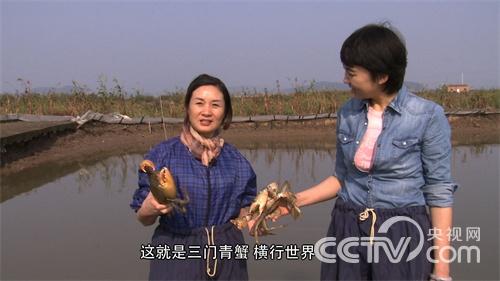
This is Sanmen Bay in eastern Zhejiang Province. The 23 mu of land before you is the farm restaurant Chen Limin built. Before coming, the reporter had heard that her farm restaurant receives over 100,000 tourists every year, and many people come specifically for a few rare ingredients.
On November 2, 2015, the reporter followed Chen Limin to find two tidal-flat harvesting masters to take us into the tidal flats to look for these ingredients.
Chen Limin: These two are the ones who supply all the ingredients for our restaurant. They are very professional.
Chen Limin said that finding ingredients in the tidal flats is called "gan xiao hai" (gleaning the small sea), and the ingredients found are called "small seafood." Finding small seafood requires not only physical strength but also skill.
As soon as the reporter stepped onto the tidal flat, the meaning of those words became clear.
Chen Limin: Don't follow his footprints. Find your own path. His footprints are too deep.
Walking in the tidal flat requires lifting your legs quickly, otherwise you will sink into the mud like this and be unable to pull your leg out. In a stretch of tidal flat less than 100 meters long, Chen Limin and the reporter took half an hour.
Just as we caught up with the two masters, they discovered the burrow of the first ingredient.
Chen Limin: A burrow like this is a mudskipper's burrow.
Reporter: Which one?
Chen Limin: This one.
Reporter: This is a mudskipper's burrow?
Chen Limin: See how it's a bit flattened?
Reporter: Is it the sloped one?
Chen Limin: The sloped one. A mudskipper doesn't lie flat like a person; it just goes in like this.
Reporter: It slides in?
Chen Limin: Right.
Reporter: So if you dig here, you can dig out a mudskipper?
Chen Limin: Right. Let this guy dig for you. See, inside there's water. Don't underestimate such a tiny hole. Actually, it's very big inside, like our houses. After you go in through one door, there are many rooms inside.
Reporter: I don't see any mudskipper in here. I don't see it.
Chen Limin: It probably went to visit relatives today.
Reporter: Out playing?
Chen Limin: Mm, out playing.
The two masters said that finding these ingredients all depends on luck. Sometimes you can turn over a whole patch of tidal flat and not find even a few.
We didn't see a mudskipper, but beside its burrow we found another kind of ingredient.
Chen Limin: These two holes, you insert two fingers like this, and you'll find a razor clam.
Reporter: These two holes?
Chen Limin: Right, you just go in like this, right, and then there's a razor clam.
Master: Slow down.
Reporter: I felt it.
Chen Limin: Right?
Reporter: I felt it
Chen Limin: This is a razor clam, wild, genuinely wild. Wild razor clams are smaller, so the meat is tenderer, very fine.
Just as we found the razor clam, the master called us over saying he'd dug up a mudskipper. He told the reporter to hurry and reach out to grab it.
Reporter: Done for, it got away.
Master: It got away.
Reporter: Wait, wait, this is too hard to catch.
Master: Right, too hard to catch.
Reporter: It's so small. Can you see it? This mudskipper has this kind of pattern on its back. Can you see it?
Chen Limin: Blue-and-white porcelain.
Reporter: A blue-and-white porcelain-like pattern, very beautiful.
Chen Limin: This is a true ingredient, so it's more natural and delicious, and the meat tastes tender.
One jin of wild mudskippers contains about 25 fish, and at Chen Limin's farm restaurant they sell for 80 to 90 yuan. But she says the most popular one right now is still this one.
Reporter: I see he's already dug this deep.
Chen Limin: Right, its legs are very strong. It burrows down into the silt.
Reporter: As you grab it, it keeps drilling downward.
Chen Limin: Right.
Master: Let me dig again.
Reporter: It's inked.
Chen Limin: Right, the burrow of a wangchao octopus is like this.
Reporter: It sprayed a lot of ink, and it's still spraying. That's it, the wangchao.
Chen Limin: Right.
Reporter: It's stuck to my hand.
Chen Limin: Right.
Reporter: Is this considered big? This wangchao octopus.
Master: Yes.
Reporter: This counts as big.
Chen Limin: Big. Locals braise small ones in a wangchao pot, one by one, very delicious. Big ones can be stir-fried and so on.
Reporter: How much per jin for this now?
Chen Limin: Over ten yuan each. It's sold by the piece, not by weight.
Reporter: So are the prices the same for big and small ones?
Chen Limin: All the same. This season is wangchao season, so they're all big.
Wangchao, whose scientific name is Octopus ocellatus, is a small species of octopus, about 20 cm long each, and is very popular in the Jiangsu-Zhejiang region.
Besides wangchao octopus and mudskippers, the resource-rich Sanmen Bay also hides various small fish and shellfish. Every day, the tidal-flat gleaners deliver their daily harvest to Chen Limin's farm restaurant, and Chen Limin uses these small seafoods to attract customers. On holidays, her farm restaurant is packed with people.
But Chen Limin's wealth goes far beyond this. The 3,000 mu of land before you is her tidal-flat ranch. Chen Limin, who just turned 40 this year, can reach annual sales of 80 million yuan from the ranch and farm restaurant combined.
But behind her wealth lies considerable controversy, all because she wants to do something no one thinks is reliable.