The secret to a bountiful grain harvest is hidden in the soil, says Shanghai's foreign vegetable farmer Lang Jieshi
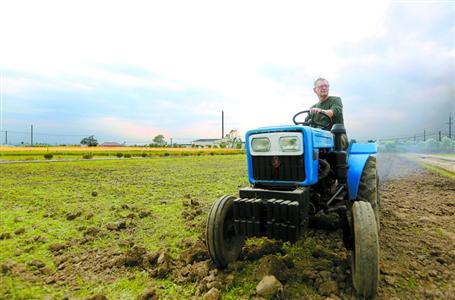
Lang Jieshi, an American, began contracting and operating a farm in the suburbs of Shanghai in 1992, introducing more than 500 new varieties of European and American vegetables and becoming Shanghai's first "foreign vegetable farmer" engaged in vegetable cultivation research. A few years ago, he was also specially appointed as a senior advisor by the Songjiang District Agricultural Commission. "To grow the best vegetables at the lowest chemical cost, while protecting the local soil and water environment" is Lang Jieshi's cultivation philosophy.
"The secret to a bountiful grain harvest lies deep in the soil." Not long after sitting down, "foreign vegetable farmer" Lang Jieshi solemnly handed a small note to the reporter, on which this sentence was written in English.
Lang Jieshi, from the United States, is a well-known "foreign vegetable farmer" in Shanghai. He has been engaged in vegetable cultivation research in Shanghai for more than 20 years, introducing more than 500 new varieties of European and American vegetables. His farm, with an almost miserly model of frugality, vividly demonstrates a sample of high-end ecological agriculture. Not long ago, the 71-year-old Lang Jieshi also received the 2015 Shanghai Magnolia Memorial Award.
Old Lang is now no longer able to manage a farm of two to three hundred mu. He spends most of his time at his home at the foot of Sheshan, writing a memoir of his agricultural practice in China. He has always paid close attention to Shanghai's agriculture and farmers. For this reason, he even renewed the lease on a few mu of land to carry out some soil experiments in vegetable cultivation, and sometimes he still drives a tractor to plow the fields.
"In recent years, the ecological function of Shanghai's agriculture has become increasingly prominent, and more and more attention has been paid to the protection of water, soil and air. Farmers have also been organized in a more scientific way, establishing appropriately scaled family farms and obtaining more respectable returns. This was hard for me to imagine before." Lang Jieshi said that with the guidance of scientific concepts, agriculture and farmers will not be marginalized, but will have an increasingly promising future.
In 1988, Lang Jieshi came to China for business reasons to promote fertilizers and began cooperating with the Shanghai Soil and Fertilizer Station to carry out soil experiments.
At that time, the nitrogen, phosphorus and potassium nutrients in the soil of Shanghai's suburbs were extremely unbalanced, and crop yields therefore could not be effectively increased. Later, farmers gradually recognized the importance of nitrogen fertilizer and potassium fertilizer, but then overapplied them, causing harm to the soil once again. In 1992, Lang Jieshi began farming practice in Pudong to explore how to repair and balance the soil. For a fairly long period, he was a lonely demonstrator.
Now, he is delighted to see that neighboring farmers have begun to understand how to care for the soil. Throughout Songjiang District, the "one-third system" has become an agricultural institution: each year, one third of all grain fields are planted with crops, one third are planted with green manure, and one third are left fallow to recuperate. Combining cultivation with soil nourishment can both increase grain output and protect the soil from being overdrawn.
Lang Jieshi's observations have been confirmed by Sun Lei, director of the Municipal Agricultural Commission. During the "12th Five-Year Plan" period, Shanghai's urban agriculture adhered to the direction of green and ecological development, promoted the comprehensive utilization of agricultural waste, controlled and reduced agricultural non-point source pollution, improved the rural ecological environment, and achieved sustainable agricultural development. Last year, the city's comprehensive utilization rate of agricultural waste reached 91%, basically achieving a ban on straw burning. In the functional positioning of Shanghai's urban modern agriculture, the ecological function has been placed first, followed by production function, leisure function, and so on.
The changes among farmers, the main actors in agricultural operations, surprised Lang Jieshi even more. Regarding the family farm model that Songjiang took the lead in exploring, he talked about it with great relish: "Organize farmers scientifically and in an orderly way, with each household cultivating one or two hundred mu of grain fields. While obtaining relatively high income returns, they also treat the land and agriculture with even more dedication..."
Lang Jieshi believes that one key to the family farm model is that it has cultivated a new generation of farmers with technical skills, ideals and a spirit of dedication, and Chinese agriculture therefore has prospects for sustainable development.
Indeed, over the past five years, the level of industrialized operation of Shanghai's agriculture has continued to improve, and various new types of operating entities have continued to emerge. By the end of last year, the city had 2,787 grain-producing family farms, 3,192 farmer cooperatives with a certain operating capacity, and 386 leading enterprises in agricultural industrialization. Farmers' incomes have also risen steadily. Last year, the per capita disposable income of Shanghai's rural residents reached 21,192 yuan, an increase of 35% over 2011. The real growth rate of Shanghai rural residents' income has been faster than the growth of urban residents' income for 7 consecutive years.
Lang Jieshi said he hopes to stay in Shanghai all along and personally witness Chinese agriculture, farmers and rural areas becoming better and better.