Zengcheng vegetable farmers exposed by CCTV for using poison to kill pests
CCTV exposes vegetables in Zengcheng, Guangzhou sprayed with highly toxic pesticides
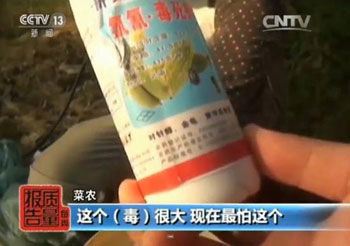
Vegetables in Zengcheng, Guangzhou sprayed with highly toxic pesticides (video screenshot)
At present, China has gradually become the world's largest vegetable producer and consumer. In 2013, the national vegetable planting area reached about 200 million mu. In addition to large-scale vegetable base cultivation, there are more than 50 million small-scale scattered vegetable farmers engaged in commercial vegetable production across the country, among which farmers with a production scale of less than 5 mu account for about 98%. So, what exactly is the food safety situation of vegetables grown by these scattered small-scale farmers?
When reporters conducted investigations in Zengcheng, Guangzhou and other places, they found that vegetable farmers mix their own pesticides and spray them on vegetables, and many of them are highly toxic pesticides! Just thinking about it is terrifying...
Scattered vegetable farmers do all the fertilizing and spraying themselves
Zengcheng District is located in the outer suburbs of Guangzhou and is one of the important vegetable production areas in South China. Through visits, reporters found that local vegetable planting mainly follows two models: one is large-scale vegetable bases, where spraying and fertilizing are entirely managed by the company; the other is scattered planting dominated by individual vegetable farmers, spread across multiple townships in Zengcheng District, and these scattered vegetable farmers do all the spraying and fertilizing themselves.
In the scattered vegetable planting area in Baijiang Village, Shitan Town, reporters met a vegetable farmer who was spraying pesticides on vegetables and witnessed the entire process of this farmer mixing pesticides. He poured several pesticides into a plastic bucket and mixed them together. When one of the bottles of pesticide was opened, the reporter smelled a pungent odor. On the packaging of this bottle of pesticide, the words "chlorpyrifos" were printed.
To protect the harvest, pesticides are used regardless of toxicity level
Chlorpyrifos is a moderately toxic insecticide. Because pesticide residue verification test results showed that even when chlorpyrifos is used according to the prescribed method and dosage, there is still a risk of excessive pesticide residues, the Ministry of Agriculture issued Announcement No. 2032 in 2013, deciding that starting from December 31, 2014, the registration of chlorpyrifos on vegetables would be revoked. Article 36 of China's "Regulations on Pesticide Administration" stipulates: no unit or individual may produce, operate or use pesticides whose production is explicitly prohibited by the state or whose registration has been revoked.
However, this chlorpyrifos pesticide, whose registration on vegetables had already been revoked, was still frequently and repeatedly used by some scattered vegetable farmers, and the used pesticide packaging was almost always casually thrown away by the farmers.
Subsequently, reporters investigated the entire nearby scattered vegetable planting area and found more discarded pesticide packaging, many of which were printed with the words "furadan" or "carbofuran" and "phorate." These all belong to highly toxic pesticides. As early as 2002, the Ministry of Agriculture issued Announcement No. 199, explicitly stipulating that they must not be used on vegetables.
Some vegetable farmers admitted that open-air vegetable cultivation mainly depends on the weather. Due to objective reasons such as the local climate and soil, they have to fight pests and diseases almost every day, so regardless of whether the pesticide is low-toxicity or highly toxic, in order to eradicate pests and diseases and ensure the harvest, they have no choice.
Regulation becomes a blind spot, leading to widespread use of highly toxic pesticides
From June to October this year, reporters also conducted multiple investigations into vegetable cultivation in Shandong, Henan, Hebei and other places, and found that in the vegetable planting areas of some scattered vegetable farmers in these regions, various used pesticide packaging could be seen everywhere, many of which were moderately toxic pesticides with restricted use and prohibited highly toxic pesticides. These regions all shared a common phenomenon: the regulatory focus of some local regulatory authorities was mainly placed on large-scale vegetable planting bases, while some scattered vegetable planting areas had almost become regulatory blind spots.
At agricultural product markets, only fee collectors are seen, not pesticide residue inspectors
Vegetables grown by such scattered farmers are generally sold externally through local agricultural product markets. China's "Law on the Quality and Safety of Agricultural Products" clearly stipulates that wholesale markets for agricultural products shall establish or entrust agricultural product quality and safety testing institutions to conduct spot-check testing on the quality and safety status of agricultural products sold in the market. If any are found not to meet agricultural product quality and safety standards, the seller shall be required to immediately stop sales and report to the competent department.
However, reporters kept watch from after 2 a.m. until after 5 a.m. at the Qixing Agricultural Products Trading Market in Conghua District, Guangzhou, and witnessed the entire vegetable trading process. They found that apart from two staff members busy collecting market management fees from vegetable farmers and vendors, no testing personnel were seen conducting spot checks on pesticide residues in the vegetables being sold. A security guard at the market revealed to reporters that they generally conducted very few spot checks there.
After dawn, when reporters arrived at the agricultural product quality and safety testing room specially set up by the market management office, they found it empty, with not only some testing reagents still unused, but also no vegetable samples for spot checks or relevant testing data to be seen.
Agricultural product quality and safety testing institutions exist in name only
The person in charge of this market finally admitted that the daily vegetable trading volume in their market reached as high as tens of thousands of kilograms, and many of these vegetables indeed had not undergone spot checks for pesticide residues during the sales process of entering and leaving the market. The phenomenon of safety testing institutions existing in name only was not an isolated case in some agricultural product markets selling vegetables in Guangdong, Shandong, Hebei and other places. "Only when the higher-ups are strict does everything below get checked casually," said a market worker.
Relevant departments strengthening monitoring and testing of large-scale bases is of course part of their duty, but "small and scattered" is an unavoidable reality in China's vegetable production. "Use the most rigorous standards, the strictest supervision, the severest punishment and the most serious accountability to accelerate the establishment of a scientific and complete food and drug safety governance system, persist in placing equal importance on production and management, and strictly guard every line of defense from farmland to dining table and from laboratory to hospital." This is both a requirement of the Party and the government and the expectation of consumers.