Ningde finds the right development path, achieving the transformation from extreme poverty to prosperity
Original title: Writing the "from extreme poverty to prosperity" catch-up model
-- A look at how Ningde City, Fujian Province, escaped poverty
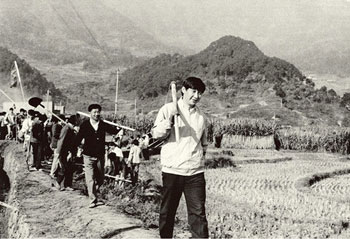
In 1988, Xi Jinping, then Secretary of the Ningde Prefectural Party Committee in Fujian, joined the masses in labor during a rural inspection. Photo by Xinhua News Agency (file photo)
"Twenty-five years ago, I worked in the Ningde region of Fujian Province, China, and I remembered a saying of the ancient Chinese: 'One who is good at governing the state should treat the people as parents love their children and as elder brothers love their younger brothers; hearing of their hunger and cold, he grieves for them; seeing their toil and hardship, he sorrows for them.' To this day, these words remain in my heart."
-- On October 16, General Secretary Xi Jinping attended the 2015 Global Poverty Reduction and Development Forum and delivered a keynote speech, in which he said this.
"Eastern Fujian, with its blocked transportation and scarce information, was a domain ruled entirely by the small-peasant economy. The development of the commodity economy was even more arduous here than in other impoverished areas. When people spoke of Eastern Fujian, it was in five words: old, minority, border, island, poor.
There is no doubt that in the vast expanse of developing the commodity economy, the currently very poor Eastern Fujian was indeed a 'weak bird.'"
-- In September 1988, Xi Jinping, then Secretary of the Ningde Prefectural Party Committee, after conducting in-depth research in the nine counties of Eastern Fujian, wrote this in his reflection "How Can a Weak Bird Fly First."
Ningde, commonly known as Eastern Fujian, is located on the northeastern wing of Fujian, facing Taiwan, China across the East China Sea.
By reason, located in the open and affluent southeastern coastal region, Ningde City should have had nothing to do with isolation and poverty. But in fact, due to its special historical circumstances and complex natural conditions, this place was once one of the poorest areas in China, which some called the "economic fracture zone" on China's golden coastline.
In the late 1980s, Xi Jinping, then Secretary of the Ningde Prefectural Party Committee, began to make poverty alleviation and development the central work of Eastern Fujian. Over the years, Ningde has always taken eliminating poverty and improving people's livelihoods as its main line of work, carrying on from one administration to the next.
Relying on the Eastern Fujian spirit of "dripping water piercing through stone" and the enterprising awareness of "the weak bird flies first," today, the painstaking efforts of several generations of Eastern Fujian people have earned a "beautiful" answer sheet for Ningde's poverty alleviation and development -- the impoverished population dropped from 775,000 in the mid-1980s to the current low-income population of 145,000, the poverty rate fell from 37.8% to 4.26%, and in 2014 the city's per capita disposable income of farmers reached 11,302 yuan.
How did dripping water pierce through the hard rock of poverty? How did the "weak bird" grow full feathers? Drawing lessons from the past to understand the future, with these questions in mind, the reporter came to Ningde to seek the answer to "escaping poverty."
A weak bird must fly first; extreme poverty can become prosperity
Driving through the green foothills of Taimu Mountain, following the winding, clear Jiuli Stream upstream, Chixi Village in Panxi Town, Fuding City soon appeared beside the smooth highway. White walls and black tiles, tidy village houses -- it is hard to imagine that this was once a poor mountain village where "one stretch of land and water could hardly support its people."
"Do you still remember how poor the village used to be?" Seeing elderly people chatting on the fitness square at the village entrance, the reporter stepped forward and asked.
"Back then, children had no shoes to wear, and a mother-in-law and daughter-in-law had only one pair of trousers between them, taking turns to wear them." The village elders still clearly remember the hard life of more than 20 years ago.
Not just Chixi Village -- the huge hat of poverty once covered the entire Ningde City.
The common people were truly poor then, living in thatched huts and eating sweet potato rice; in many places villagers did not recognize a 100-yuan renminbi note. Ningde was truly backward, with high mountains and dangerous roads and poor transportation; investors came and left, leaving behind only four phrases: water stops, electricity stops, roads are uneven, people are no good.
Until the mid-1980s, Ningde was still one of the 18 contiguous poverty-stricken areas in the country. Of its 9 counties, 6 were recognized as national-level poverty-stricken counties; of its 120 townships, 52 were listed as provincial-level poverty-stricken townships; and one-third of the rural population of the entire prefecture lived on the edge of subsistence.
In 1984, a report titled "A Poor Mountain Village Hopes to Implement Special Policies to Overcome Poverty and Achieve Prosperity" showed Chixi Village's poverty to the whole society and drew great attention from the Party Central Committee. The magnificent cause of China's anti-poverty effort raised its curtain, and the story of Ningde people "pulling out the roots of poverty and moving out of the poor nest" began from there.
In the 1980s they filled their stomachs, in the 1990s they took off the hat of poverty, and since the new century they have taken great strides toward comprehensive moderate prosperity. Over the past 30 years, Ningde has undergone earth-shaking changes, escaping poverty step by step. What did it rely on?
To fill their stomachs, Ningde relied on finding the right path of development. In July 1988, Xi Jinping came to Eastern Fujian. In just 1 month, he traveled to all 9 counties of Eastern Fujian, and on the basis of detailed research proposed organizing a "grand chorus of economic development," vigorously pursuing the "classic of mountains, seas, and fields," promoting "planting, breeding, and processing," and turning the two wheels of agriculture and industry together. In 1989, the per capita net income of farmers in the whole prefecture was 554 yuan, an increase of 224 yuan over 1985, with an average annual growth rate of 13.8%, basically solving the subsistence problem of the vast majority of poor households.
To take off the hat, Ningde's key was seizing policy opportunities. In the 1990s, the State Council approved Eastern Fujian as an "experimental zone for comprehensive reform of poverty alleviation through opening-up and development." (Our reporter Zhong Xin, Li Fei)