Big data helps standardize resource sharing for food safety
Original title: Safe or not, the data makes it "visible"
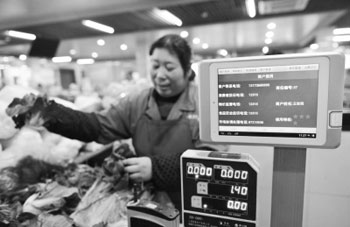
Recently, Hangzhou's first Hangzhou Hanlin Farmers Market to adopt an information supervision cloud terminal system was put into use. This information supervision cloud terminal system displays 7 items of content, including vendors' business licenses, product prices, testing reports, vendor commitments, vendor credit, responsibility management, and consumer reviews. Consumers can click on the content on the screen to view it and leave reviews. The photo shows a tablet in front of a vendor at Hangzhou Hanlin Farmers Market displaying that vendor's credit rating. Photo by Long Wei, Xinhua News Agency
Agricultural product traceability, soil testing and analysis, production monitoring and management - with the rapid development of internet technology, the supervision of agricultural product quality and safety has entered an unprecedented "big data era." Based on big data technology, more precise data and accurate information are making it possible for producers to promptly correct deviations in the production process and for regulators to achieve seamless supervision throughout the entire process. Today this section publishes a set of reports sent back by our newspaper's reporters and expert articles on "big data + food safety" for readers' reference.
Pujiang, Sichuan: Soil indices endorse good quality
As the saying goes, Granny Wang sells melons and praises her own wares. However, even Granny Wang's clever tongue would probably now find it hard to compete with the quality endorsement provided by a sheet of big data. In Pujiang County, Sichuan Province, a soil big data platform built using data collection systems and multi-information sensor equipment technology is making this possible.
At the Pujiang County Cultivated Land Quality Service Center, the reporter saw the "nerve center" of this Internet of Things system. "Soil temperature, humidity, pH value... even the PM2.5 content in the air - through data collection equipment in the major orchards, all of this is continuously gathered at the center, forming soil big data." When center director Ma Chao switched the collection equipment among the major orchards, more than ten indicators for the corresponding plot of land immediately popped up on the large screen.
What exactly is the significance of this soil big data platform? "Through long-term data accumulation, a chart of the relationship between soil indices and agricultural product quality will be formed, thereby endorsing the quality of agricultural products and truly achieving high quality at a high price." said Zhao Wubin, director of the Pujiang County Agriculture and Forestry Bureau. This year Pujiang began implementing a 3-year plan to improve the quality of 250,000 mu of cultivated land. However, because soil improvement requires large investment and produces slow results, and especially because market information is asymmetric, the difficulty of achieving high prices for high-quality products has become the biggest obstacle to farmers' voluntary participation in improvement.
Changing the fertilization structure and applying more organic fertilizer is the only way to increase soil organic matter and improve soil compaction. However, the additional investment involved is considerable. Xu Jian, president of the Pujiang County Changqiu Mountain Fruit Association, calculated an account for the reporter: applying organic fertilizer requires additional investment per mu of about 400 yuan in labor costs and 800 yuan in organic fertilizer, totaling 1,200 yuan. The corresponding chemical fertilizer use is reduced by 1/3, saving about 300 yuan in chemical fertilizer input. This means an increase of about 900 yuan in investment per mu.
"Although the investment increases greatly, judging only by appearance, ordinary consumers find it very difficult to identify the quality of the fruit. This soil big data system attempts to use scientifically proven data to provide credit endorsement for good products and good prices, and to provide buyers with early decision-making guidance." Ma Chao said.
Chen Jinfu, a villager from Shima Village, Changqiu Township, who has already carried out soil improvement for 2 consecutive years, has tasted the benefits. This year, most of his late-maturing citrus "Buzhihuo" was presold just as the fruit set, and buyers were precisely attracted by its good soil data. "If the purchase price per jin of citrus increases by 1 yuan, estimating a yield of 4,000 jin per mu, the increase in income per mu would reach 4,000 yuan." Xu Jian said that as the chart of the relationship between soil data and agricultural product quality takes shape and truly promotes high quality at a high price, more and more fruit growers will be willing to invest. (Our newspaper's reporter Zhang Yanling)
Lanling, Shandong: What pesticide was used and where it came from can be found with one scan
On December 3, at the Yongming Agricultural Materials Business Department in Lanling County, Shandong Province, the reporter saw that each bottle of pesticide had a QR code label with traceability functions affixed to its individual packaging. "In our pesticide business here, every bottle has to have this QR code affixed. Scan this QR code, and for this bottle of pesticide, where it was produced and how it circulated can all be known. When farmers come to buy pesticides, their real-name information also has to be entered. Where it is used afterward and how it is used must all be accounted for. Once a problem arises, one scan can trace it." Li Yongming, manager of the Yongming Agricultural Materials Business Department, told the reporter.
Guo Zaili, director of the Lanling County Agriculture Bureau, introduced that this QR code label, which is unique and authoritatively certified, is the pesticide's "identity card." Through the QR code, Lanling can realize full-process dynamic "barcode-based management" of pesticide operations, achieving "records in production, traceable flow, queryable information, and traceable quality."
What supports the operation behind this is the pesticide registration and filing hall and database built by Lanling with an investment of 300,000 yuan. Here, Lanling implements secondary review and barcode supervision for pesticide registration and filing work. On the basis of one filing with the Linyi City Agriculture Bureau, pesticide products entering the Lanling market are re-reviewed and filed, and specially made barcodes are issued. These barcodes, like "identity cards," contain dealer information, pesticide product information, and a set of dynamic hidden codes. Without a barcode, sale is strictly prohibited.
"If any agricultural product has a problem, testing can reveal the illegally used drug ingredient and then identify the drug. Through the QR code on the drug and the database in the filing hall, all information on that pesticide from production to use can be obtained, realizing traceability and controllability of pesticide operations." said Zhang Guibin, director of the county's Agricultural Product Quality and Safety Supervision Office.
According to reports, Lanling is a major vegetable-producing county, with a year-round vegetable planting area of more than 1 million mu, and enjoys the reputation of "Shandong's Southern Vegetable Garden." In recent years, in order to ensure vegetable quality and safety at the source and build the Lanling vegetable brand, the county has implemented a system-wide prohibition on the production, sale, and use of highly toxic pesticides banned or restricted by the state, as well as a pesticide operation notification system, and has carried out operation notification for pesticide products entering the Lanling market. This not only prevents highly toxic pesticides banned or restricted by the state from being sold within the county, but also, supported by big data, realizes information-based management of pesticide operations. Up to now, Lanling has received operation notifications for 1,756 pesticide products from 915 manufacturers, issued more than 11 million barcodes, and achieved full coverage of pesticide operation notification within its jurisdiction and traceable management of pesticide products. (Our newspaper's reporter Lu Bingbing)
Heilongjiang: How rice-duck rice grows - consumers here know it all
"This stack of express delivery forms has 300 sheets, and one day is not even enough." said a worker at the Hongxiang Henry Rice Production and Marketing Cooperative in Baiquan County, Heilongjiang Province, who was sitting by a computer printing express delivery forms while busy, telling this writer. Orders on the computer kept updating, the printer kept clattering, and the room was filled with several hundred packaged duck-rice orders to be sent out that day.
Duck-rice is the abbreviated name of a cultivation model for ecologically organic rice. When rice seedlings put out their fifth leaf, duck breeds with strong wildness, a love of eating grass, and no ability to fly are selected, and when they are about 20 days old they are put into the rice paddies, with ducks and rice living together. These ducks "serve" in the rice paddies for about two months, and leave the paddies when the rice begins to head. In duck-rice paddies it is hard to see particularly neatly arranged rice, because some small and weak rice seedlings are trampled down by the ducks. In the end, those that survive the survival of the fittest are all rice plants with excellent genes and vigorous growth. The rice produced is rich in selenium, amino acids, double-chain sugars, and elements such as iron, calcium, and zinc. The grains are slender, crystal-clear in color, smooth as oil, and have the natural fragrance of native rice. It is a natural, ecological, nutritious, and healthy high-quality green organic rice.