Remote sensing monitoring technology made in China: crop conditions may soon be reported in real time
Original title: Crop condition monitoring may soon be reported in real time
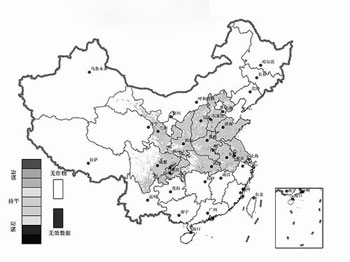
Image source: CropWatch
This is a story from a long time ago.
In 2003, China's dependence on foreign soybeans was already very high, and it had to import large quantities of soybeans from the United States, Brazil, Argentina and other countries every year. At that time, China's international influence was not what it is today. That year, the "authoritative" baseline data released by the US Department of Agriculture showed a sharp reduction in soybean production in the United States and even globally, causing soybean futures and spot prices to soar at the time. Because domestic soybean supply was in urgent shortage, China still imported large quantities of soybeans from the United States at high prices. Later facts proved, however, that US soybean production was basically on par with previous years. China had thus been trapped, and this became a pain that could not be smoothed over for many years.
"Something similar also happened in 2008." Dr. Zeng Hongwei of the Institute of Remote Sensing and Digital Earth, Chinese Academy of Sciences, told a reporter from China Science Daily. In fact, by 2003 China already had its own crop condition remote sensing rapid reporting system (CropWatch), but at the time CropWatch's influence was still not high. "If we had believed only our own information at the time, we could actually have blocked (the news of the soybean production cut)."
Since then, the CropWatch team led by Wu Bingfang, a researcher at the Institute of Remote Sensing and Digital Earth, has held firmly to the conviction of raising the level of crop condition remote sensing monitoring and improving the transparency of global crop condition monitoring reports.
A crop condition remote sensing monitoring report from China
Crop condition monitoring reports are an important basis for assessing key information such as current crop growth and yield at the scale of a country, a region and even the globe. According to Zeng Hongwei, China's first crop condition remote sensing rapid report did not come late. After the Institute of Remote Sensing and Digital Earth, Chinese Academy of Sciences, initially built China's CropWatch system in 1998, the first issue of China's crop condition remote sensing rapid report was released in August of that year. At the time, however, monitoring was still limited to China's main grain-producing areas.
This situation changed in 2002. Starting in 2002, CropWatch's monitoring scope expanded to the globe, and by 2005 it had gradually expanded to 27 countries worldwide. By 2013, crop condition information for 31 major grain-producing countries worldwide was fully under CropWatch's monitoring. To date, CropWatch has cumulatively released 99 issues of the Global Crop Condition Remote Sensing Rapid Report.
The reporter opened CropWatch's global website, selected "Chinese" from six languages and clicked to enter, and the most recent crop condition remote sensing rapid report came into view: in early November 2015, China's winter wheat growth was at the average level of the past 5 years. Among this, the situation in the previous monitoring period in which winter wheat growth in east-central Henan Province had been poor due to precipitation deficit had been alleviated...
The CropWatch team promptly submits accurate grain yield monitoring information to relevant national departments every year, providing decision-making support for China to grasp global grain yield information, and the monitoring results have also been adopted by departments such as the General Office of the CPC Central Committee and the General Office of the State Council on multiple occasions.
IP shows that since 2013, when the bilingual Chinese-English Global Crop Condition Remote Sensing Rapid Report was first released free online to the world, the global crop condition monitoring reports from China have been viewed and downloaded more than 30,000 times, with audiences in more than 110 countries worldwide.
"Especially the vast number of Third World countries, after obtaining the information, they have a very good understanding of their own country's grain situation." Zeng Hongwei said that today CropWatch's international influence has surpassed that of the European Union, becoming the world's second most influential crop condition remote sensing monitoring system after the US Department of Agriculture, markedly improving the transparency of global crop condition remote sensing monitoring.
Greater goals and challenges
The CropWatch scientific team is still not satisfied. According to another team member, Dr. Zhang Miao, they want to make crop condition monitoring at the global scale more refined. At present, the grid resolution of remote sensing monitoring at the global scale is measured in kilometers; they hope to refine the grid to 100 meters in the future. In terms of temporal resolution, they want to increase the monitoring time frequency from 1 ten-day period to 5 days.
"From 1 ten-day period to 5 days, from 1 kilometer to 100 meters, this is very helpful for us to accurately grasp global crop condition information." Zeng Hongwei told the reporter that refined monitoring results mean users can make more refined decisions and solve agricultural production problems in a more targeted way.
The significance of improving resolution is undoubtedly positive, but it also means greater challenges. In addition to requiring higher-resolution remote sensing satellites, the monitoring model's algorithms, data storage and transmission, and computational load all mean enormous pressure.
With the continuous progress of remote sensing monitoring technology, high-resolution data covering the globe is becoming more and more abundant, and remote sensing data is no longer the bottleneck. Monitoring model algorithms are also not a problem for team members cooperating globally. It is just that this computing system has always been a lingering worry for the CropWatch team.
In Zeng Hongwei's words, the servers currently used by the CropWatch system "can still meet our current needs," except that when large-scale computation is needed, "after running it on Friday, you have to wait until the next week to see the calculation results."
However, once precision is improved, this awkwardness will intensify. Zhang Miao said that improvements in spatial and temporal precision globally and even within China will bring a sudden surge in the scale of data and imagery, and for servers that are already stretched, "the processors just won't do."
"We have very high requirements for computing, and in terms of the time cost of scientific research it is also very necessary. But look at our current office environment," Zeng Hongwei said, pointing to the cramped office. "We don't want to go buy an even bigger computing system. Quite apart from the expense, it also needs dedicated maintenance."
So when they heard the news this year that the Institute of Atmospheric Physics, Chinese Academy of Sciences, together with Sugon and other units had jointly developed and released the prototype system of the "Earth Numerical Simulation Device" - this high-performance computing system dedicated to Earth system science computing - the CropWatch team was very excited: "Great, with this, the problem of computing needs is solved."
"This is our urgent need." Zeng Hongwei told the reporter that at present the CropWatch team has become a user unit of the device. Once the "Earth Numerical Simulation Device" project is truly approved, global crop condition monitoring data will no longer be updated once every four months, and there is hope it can be updated in real time.
"We hope the crop condition information display of the CropWatch system can be updated in real time. If the computation can be completed quickly, then it can be done. By then, the significance will certainly be different." Zeng Hongwei said. (Reporter Zhao Guangli)