Rice grown on transferred land makes it into major supermarkets through blind taste tests
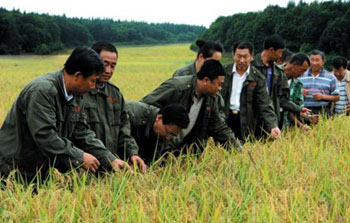
Li Xiuchen (second from left) and technicians instruct planting techniques in the rice field.
A view of the rice fields at the Xingda Rice Industry planting base.
In winter along the banks of the Huifa River, rime ice glistens and sparkles in the sunlight. Li Xiuchen, chairman of Xingda Rice Industry, brought his rice from here to 16 provinces and cities across the country including Beijing, Shanghai and Tianjin, becoming a supplier to more than 30 large domestic and international supermarket chains such as Walmart, Carrefour, Metro and Hualian, and cooperation with several major online shopping platforms is also in full swing.
Xingda Rice Industry Co., Ltd. (hereinafter referred to as Xingda Rice Industry) is located in Meihekou City, Jilin Province. Its predecessor was a military grain processing plant built in Meihekou in 1947 by the Northeast Field Army, and after the founding of the People's Republic of China it became the city's only grain processing enterprise. In 2003, the enterprise was restructured to form Xingda Rice Industry Co., Ltd.
"Meihe rice is good, but the planting methods at the time were backward, excessive application of pesticides and chemical fertilizers endangered product safety, and the market price could not be raised." Li Xiuchen believed that to open up the market, product quality must first be excellent, and one should start with planting.
The first step in doing a good job of planting is to achieve land transfer. At the time, many employees in the enterprise did not understand: in the past we only produced rice products, so how would we plant this transferred land? The difficulty was too great! In this situation, Li Xiuchen held firm to his conviction. He told everyone that land is the prerequisite for everything; only when we have land can we do a good job in the planting stage, and then truly control product quality at the source and create a brand to enter the market.
In 2009, with the support of the Meihekou City government, Li Xiuchen and his staff went from household to household, persuading family after family and explaining the benefits of land transfer to farmers door to door, resolving farmers' concerns with all their hearts. After more than 3 months of effort, land transfer of 12,000 mu was finally achieved.
"Through land transfer, some farmers are freed from the land. In addition to the land transfer fees allocated to farmers, we organize the surplus labor from land transfer for training, assign them to various positions in enterprise production and agricultural product processing, and establish a modern agricultural production professional cooperative that gives dividends to farmer shareholders, achieving diversified income for farmers." At present, Xingda Rice Industry has helped more than 4,000 farming households participating in land transfer increase their incomes.
After the planting base was completed, Li Xiuchen led employees to start with nourishing the land, using biological organic technology to improve the soil, adopting the ecological organic planting model of "three cleans, two noes, one symbiosis," and hiring enterprise science and technology leaders to focus on developing fine rice varieties.
"Good rice is grown, not made. Prepare a good 'nutritional recipe' for the land; only in a high-quality planting ecological environment can good seeds grow good grain." At Li Xiuchen's request, Xingda Rice Industry strictly controls the environment and cultivation process of rice planting. The planting base must meet the environmental requirements of "clean water, clean soil and clean air" under original ecological conditions; during cultivation, no chemical fertilizers or pesticides are applied, and no harmful elements are allowed to remain in the rice.
Plump and translucent, grain after grain of rice with a clear white color, once steamed and cooked and placed on the dining table, provides people with energy for a day's work. This is a kind of happiness for those in the grain industry. "I am just a farmer, and in this life I only love studying how to grow rice and sell rice." Li Xiuchen's ideals and pursuits were thus "planted" together with rice.
In 2003, when the enterprise was first established, in order to open up sales channels for its products, Li Xiuchen and his employees brought samples to Beijing, Shenzhen and other places, inquiring in supermarket after supermarket and promoting in store after store. When hungry, they bought boxed meals by the roadside; when tired, they could fall asleep on a newspaper spread on the grass.
"At the beginning, market recognition was low, and the success rate of promotion in supermarkets was not even one in ten. The customer service phone number of a large supermarket in Shenzhen could never be reached. Why? They had many customers and broad supply channels, so why would they want your product?"
Facing the "test questions" given by the market, Li Xiuchen came up with a "strange method." On the one hand, he contacted supermarket managers to introduce the advantages of Meihekou rice; on the other hand, he had employees randomly buy ten brands of rice from the market, paste brand and place-of-origin labels on the bottoms of cooking pots, and cook rice on site for the audience to taste. As a result, 24 of the 26 tasters agreed that the rice in one of the pots tasted the best. Li Xiuchen turned over the bottom of the pot, and the label read Meihekou rice.
Continuously forging ahead and persisting in seeking truth and innovation, Li Xiuchen and Xingda Rice Industry overcame one predicament after another in enterprise development. Now it has established branch companies in Beijing, Shanghai, Tianjin, Shijiazhuang and other places, become a supplier to more than 30 large supermarket chains at home and abroad, and sells products in more than 2,000 supermarket stores nationwide. The enterprise's three trademark brands, "Shuaimao," "Meixue" and "Yulongtian," have respectively passed 100% organic food certification in China, the United States, Japan and the European Union, and A-level green food certification by the China Green Food Development Center, and all have been approved as geographical indication protected products, with trademark value of 120 million yuan.
From a county-level city state-owned enterprise facing restructuring and reorganization, it has developed into a joint-stock company with 2 fine rice processing production lines, 1 dedicated railway line, 10 large-capacity steel plate silos of 1,000-ton class, annual collection, storage and processing capacity of 100,000 tons, and annual sales revenue of 240 million yuan. Under Li Xiuchen's leadership, Xingda Rice Industry grew from nothing and became strong from weak, and has successively won honors such as one of China's top 50 rice processing enterprises, a key leading enterprise in agricultural industrialization in Jilin Province, and one of the top 100 agricultural product processing enterprises in Jilin Province.
"Persisting in relying on scientific and technological progress, focusing on new product research and development and the development strategy of creating famous brand products, and following the enterprise purpose of 'create famous brand products, strive for first-class performance, serve agriculture, rural areas and farmers, and repay society' and the business philosophy of 'emphasize quality, reputation, service and efficiency' - this is the development path of our Xingda Rice Industry." Li Xiuchen said.