Two years of raising earthworms, three years of growing vegetables: crop-livestock rotation boosts income fast
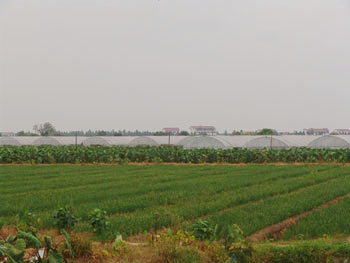
Heshengshou Agricultural Production Base
Walking into the Heshengshou Agricultural Production Base in Huangdu Village, Nanxin Township, Nanchang County, most of the vegetable fields, totaling more than 500 mu, "show no green." When the reporter walked into the fields, some ridges were found covered with a layer of yellow rice straw. Lifting it up revealed swarms of wriggling red earthworms underneath!
As a leading enterprise in agricultural industrialization whose main business is vegetable cultivation, why would Heshengshou neglect its "proper business" of vegetable growing, let large tracts of farmland lie idle, and even start raising earthworms? Xu Yunshan, the person in charge of the company, explained the reasons to the reporter.
Xu Yunshan is a native of Huangdu Village, Nanxin Township. In 2011, he returned to his hometown and registered Nanchang County Heshengshou Agriculture Co., Ltd. to engage in vegetable cultivation. Xu Yunshan wanted to follow a path of pollution-free vegetable cultivation, using no chemical fertilizers and no pesticides. For this reason, when choosing vegetable varieties to grow, he tried to avoid varieties prone to pests such as cowpeas and greens, and instead chose vegetables with strong disease resistance such as garlic, chives, and celery, applying organic fertilizer and using biological pest control techniques.
Vegetables grown without chemical fertilizers or pesticides are not only safer but also taste better. Because of this, Heshengshou's vegetables sold well all the way through the Shenzhen Agricultural Products Central Wholesale Market and major supermarkets in the city, and its vegetable base area expanded from the initial 35 mu to the current 510 mu.
The enterprise developed itself and also helped farmers get rich. By all accounts, Heshengshou, now on the right track, should have been sailing smoothly with nothing to worry about. But in 2014, Xu Yunshan had a new worry. He found that the vegetables grown in the fields were increasingly poor in appearance and gradually declining in taste. Testing of the soil revealed that trace elements such as selenium and boron were gradually decreasing, while the content of heavy metals such as copper, iron, and zinc was increasing. Only after consulting a professor at Jiangxi Agricultural University did Xu Yunshan understand that this was related to fertilization habits. Over the years, to solve the problem that organic fertilizer on the market was not high in purity and not sufficient in fertility, Heshengshou had been directly applying duck manure and pig manure purchased from surrounding livestock enterprises. Over time, the heavy metals in the livestock and poultry manure remained in the vegetable fields.
"The heavy metal content in the soil rises year by year, directly threatening vegetable quality and disrupting all my plans." However, Xu Yunshan found a way to improve the soil from the professor at Jiangxi Agricultural University: raise earthworms and let the earthworms carry away the heavy metal elements in the soil.
At the beginning of this year, Xu Yunshan decisively halted vegetable cultivation on more than 300 mu of vegetable fields and began asking technicians to cultivate earthworm seedlings. In September this year, Heshengshou raised earthworms on the first batch of 30 mu of vegetable fields. After only 2 months of raising them, the fields had changed from the previous hard, compacted earthy yellow to soft, breathable black.
In addition to improving the soil's ecological benefits, raising earthworms also brought Xu Yunshan substantial economic benefits. In November this year, Xu Yunshan sold earthworms for the first time, selling more than 7,000 yuan worth from 1.8 mu of land. Calculating on the basis that earthworm farming sells 8 times per mu each year, the average annual gross income per mu from earthworm farming is more than 30,000 yuan, with a net profit of more than 20,000 yuan, far higher than the average annual vegetable-growing profit of seven to eight thousand yuan per mu.
If raising earthworms is more profitable than growing vegetables, does that mean he will simply switch to raising earthworms in the future and stop growing vegetables? Xu Yunshan said: "My original intention was to engage in vegetable cultivation, and that idea will not change in the future either."
The reporter learned that in the future Heshengshou will adopt a crop-livestock rotation model of growing vegetables for 3 years and raising earthworms for 2 years, thoroughly improving the soil of the vegetable base, ensuring ecological benefits, and enhancing vegetable quality. "After the earthworm seedlings are cultivated in March next year, all these vegetable fields that have lain idle for a year will be used to raise earthworms," Xu Yunshan said. "After completing soil improvement, we will apply for organic vegetable certification. Organic vegetables are the highest level of vegetable cultivation, with the best benefits, and that is our ultimate goal!"
At the end of the interview, Xu Yunshan told the reporter that Heshengshou is currently making plans to raise wild geese and wild ducks next year. The manure of the wild geese and wild ducks will be used to raise earthworms, the earthworm manure will be used to grow vegetables, and the leftovers and leaves after harvesting will be used to feed the wild geese and wild ducks... ultimately establishing a closed crop-livestock industry loop.