A new revolution in simplified cultivation, with "happy farming" offering big advantages
Original title: A "simplified and lightened" cultivation revolution is rising - see how the Shandong Academy of Agricultural Sciences enables farmers to achieve "happy farming"
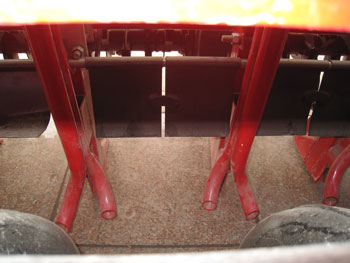
Fixed-path subsoiling, layered fertilization, no-till seeder
Schematic diagram one of the fixed-path subsoiling, layered fertilization, no-till seeder
Schematic diagram two of the fixed-path subsoiling, layered fertilization, no-till seeder
As rural labor shifts away in large numbers, "who will farm the land" and "how to farm the land" have become urgent problems to solve. In the final analysis, farming must still rely on science and technology. In recent years, the Shandong Academy of Agricultural Sciences has achieved important breakthroughs in research on high-yield creation and key technologies for integrating agricultural machinery with agronomy, and a batch of simplified and lightened cultivation techniques that save labor and effort and reduce costs while increasing efficiency have emerged, enabling farmers to achieve "happy farming."
Clothing: simplified cotton planting reduces labor by 3/4
In mid-to-late October this year, at the 60-mu simplified high-yield cultivation technology demonstration base on saline-alkali land in the Agricultural High-tech Zone of Dongying City, a large cotton picker sped across the field, and wherever it passed, the originally snow-white cotton lint was harvested completely clean. In the past, for hard work like cotton harvesting, it was difficult to hire workers even with money.
"Harvesting is the last step in the cotton planting process, and also the step where mechanization is hardest to achieve," said Dong Hezhong, director of the Cotton Research Center of the Shandong Academy of Agricultural Sciences. Previously, cotton had to go through more than 40 procedures from planting to harvest, and each mu of cotton field required at least 25 workers. Now, after achieving full mechanization, sowing, herbicide spraying and film mulching are completed in one pass, there is no thinning or singling of seedlings after emergence, pruning is simplified, fertilizer is applied once, and a cotton picker harvests the cotton, reducing labor to about 6 workers.
Shandong is the country's second-largest cotton-producing province after **, and also the largest province in raw cotton consumption. For a long time, cotton, as a major cash crop, has been one of the important sources of farmers' income, and the province's cotton planting area reached as much as 25.6 million mu at its peak. However, traditional cotton planting requires much labor. In recent years, due to lower cotton-growing returns, the cotton area has declined for 7 consecutive years since 2008, and by 2015 only 7.5 million mu of cotton remained in the province.
"On the premise of ensuring that yield does not decline, reducing labor is an inevitable requirement for the development of the cotton industry." Dong Hezhong has a profound understanding of "simplified and lightened": "Light" means replacing manual labor with machinery to reduce labor intensity; "simplified" means reducing operation steps and frequency and simplifying management; "ized" means the organic integration of agricultural mechanization and agronomy to promote sustainable development of crop production.
In recent years, they have researched and established simplified and lightened cultivation techniques with key measures such as precision sowing to reduce or eliminate thinning and singling of seedlings, rational close planting combined with chemical regulation to achieve simplified pruning, and controlled-release fertilizer combined with quick-acting fertilizer to achieve one-time fertilization. These were designated by the Ministry of Agriculture as nationally promoted techniques and have been widely applied in cotton-producing provinces such as Shandong and Hebei. On this basis, they also made a breakthrough in the most critical mechanized harvesting step, breeding machine-picked cotton varieties (lines) such as Lumianyan 36, Lumianyan 37, K836 and Lumian 522, and establishing machine-picked cotton agronomic techniques centered on precision sowing and concentrated boll setting.
On November 14, 2015, two local standards compiled by the Shandong Cotton Research Center, the "Technical Regulations for Simplified and Lightened Cotton Cultivation" and the "Technical Regulations for Machine-Picked Cotton Agronomy," passed review by the Shandong Provincial Agricultural Standardization Technical Committee.
Food: Wheat "two deep, one shallow" simplified cultivation saves costs and increases efficiency by 200 yuan per mu
On October 15, at the sowing observation meeting for the Shandong Academy of Agricultural Sciences' wheat "two deep, one shallow" simplified and lightened cultivation technique held in Xiaokangsi Village, Matou Town, Dongming County, Heze City, in a 600-mu field covered with crushed corn straw, more than 20 wheat seeders began demonstration operations, completing plowing, sowing, fertilizing and compacting in one continuous action. Farmers watching crowded forward to push aside the soil layer and inspect sowing quality. So many operation procedures could actually be completed in one pass, which was an eye-opener.
Today, under the pressure of low global grain prices, how can our country's grain be competitive? Relying on science and technology to save costs and increase efficiency is undoubtedly the most effective means. Reducing grain-growing costs and improving grain-growing efficiency have been key priorities of the Shandong Academy of Agricultural Sciences in recent years, and thus the integrated innovative wheat "two deep, one shallow" technique was born.
"Two deep" refers to subsoiling operations to break the plow pan and deep fertilization to improve fertilizer use efficiency. "One shallow" refers to appropriately shallow sowing to ensure wheat sowing quality and cultivate strong seedlings. "Compared with traditional techniques, sowing per mu is reduced by half from the original, down to 15-20 jin, fertilizer application is reduced by 15%-20%, yet wheat yield increases by about 10%." According to Wang Fahong, a researcher at the Crop Research Institute of the Shandong Academy of Agricultural Sciences and an expert in the wheat cultivation post of the National Industrial Technology System, because operation procedures are reduced, seed and chemical fertilizer use is saved, and yield per unit area is increased, costs are reduced and efficiency increased by about 200 yuan per mu.
"At present, excessive sowing and fertilization are common in wheat production, and consecutive years of rotary tillage have led to shallower soil plow layers and reduced water storage and moisture retention capacity. Targeting these factors constraining yield increases, we innovated and integrated this simplified and highly efficient wheat cultivation technique through improvements in cultivation technology and machinery research and development." Wang Fahong further explained.
Having introduced the wheat "two deep, one shallow" simplified cultivation technique, from trying it on a small plot to promoting it across ten thousand mu, Ma Guoxing, chairman of the Dongming County Maifeng Wheat Planting Professional Cooperative, has tasted the sweetness of science and technology. "In the first year I bought 1 seeder and planted 150 mu; last year I bought 10 more and planted 13,000 mu; this year our cooperative bought 25 and will plant 26,000 mu! This technique has increased my income by an average of 100 jin per mu and saved 70-80 yuan in operation costs. Calculated according to the just-announced 2016 minimum purchase price for wheat of 1.18 yuan per jin, overall this can save costs and increase efficiency by 5 million yuan!"
The machine that made great contributions for chairman Ma Guoxing is this "fixed-path subsoiling, layered fertilization, no-till seeder." This seeder was jointly developed by the Crop Research Institute of the Shandong Academy of Agricultural Sciences and the Shandong Agricultural Machinery Technology Extension Station. Its sowing speed reaches 15 mu per hour, and multiple steps such as seedling-band rotary tillage, vibratory subsoiling, layered fertilizer placement, concentrated deep application, double-row sowing and post-sowing compaction are completed in one pass. "For a new technology to be promoted on a large scale, the key lies in achieving the integration of agricultural machinery and agronomy." Wang Fahong said with deep feeling.