Tu Youyou's 46 Years of Perseverance Finally Win Her the Nobel Prize
Original title: Forty-six years of perseverance, she won the world's applause
- A profile of Nobel laureate researcher Tu Youyou
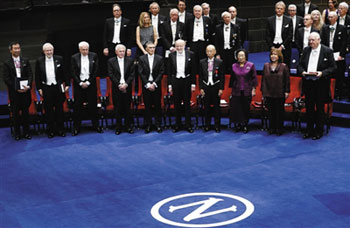
On December 10, at the Stockholm Concert Hall in the Swedish capital, the 10 winners of the 2015 Nobel Prize (front row) pose for a group photo at the end of the award ceremony. Photo by Xinhua News Agency reporter Ye Pingfan
On December 10, at the 2015 Nobel Prize award ceremony held at the Stockholm Concert Hall in the Swedish capital, Chinese scientist Tu Youyou (left) receives the Nobel Prize in Physiology or Medicine from King Carl XVI Gustaf of Sweden.
After the 2015 Nobel Prize award ceremony, Chinese scientist Tu Youyou displays the medal she received. Tu Youyou won this year's Nobel Prize in Physiology or Medicine for her pioneering isolation of artemisinin from traditional Chinese medicinal herbs for use in the treatment of malaria. This is the first Nobel Science Prize won by a Chinese scientist for scientific research carried out on Chinese soil, the highest award the Chinese medical field has received to date, and also the highest award won by an achievement of traditional Chinese medicine. Photo by Xinhua News Agency reporter Ye Pingfan
At 4:30 pm local time in Sweden on December 10, the eyes of the whole world began to "focus" on the Stockholm Concert Hall from that moment on. When Chinese scientist and researcher Tu Youyou, dressed in a purple formal gown, received the Nobel medal and certificate from King Carl XVI Gustaf of Sweden, applause in the solemn hall went on and on.
Forty-six years of perseverance have earned this 85-year-old woman the world's respect for China. Three days earlier, when Tu Youyou attended the Nobel Prize in Physiology or Medicine winners' lecture held by the Karolinska Institute, a Xinhua News Agency reporter captured a moving scene: the host of the Nobel keynote lecture, Professor Jan Andersson of Infectious Diseases at the Karolinska Institute, kept kneeling on the ground throughout Tu Youyou's lecture, supporting the 85-year-old woman from behind with one hand and holding the microphone for her with the other, maintaining this posture without moving for the entire 30 minutes.
At the Nobel laureates' lecture, when mentioning that "battle" of 46 years ago, the 85-year-old Tu Youyou still remembered it vividly: in 1969, the Institute of Chinese Materia Medica of the China Academy of Chinese Medical Sciences joined the national "523" project, and she was designated as the head of the research group, undertaking the research and development of anti-malarial traditional Chinese medicines. After accepting the task, Tu Youyou began to collect and organize traditional Chinese medical texts from successive dynasties, visited famous veteran traditional Chinese medicine practitioners, and at the same time consulted a large number of folk prescriptions and medicines, compiling A Collection of Single and Proven Prescriptions for Malaria based mainly on 640 kinds of Chinese medicinal herbs. Tu Youyou said: "It was precisely the collection and analysis of this information that laid the foundation for the discovery of artemisinin, and this is also where research on new traditional Chinese medicines differs from general research and development of plant-based medicines."
Although they had such a "collection of proven prescriptions," the difficulty of screening out the medicines truly effective against malaria from 640 kinds of drugs can well be imagined. Tu Youyou and her teammates had once fallen into the "mire" of research, unable to find an ideal way out. Faced with setbacks, Tu Youyou also felt depressed. She later recalled: "I also doubted whether I was on the right path, but I did not want to give up." When she once again carefully read through the historical literature on several medicines that had shown early signs of anti-malarial activity, the description recorded in A Handbook of Prescriptions for Emergencies by Ge Hong of the Eastern Jin dynasty - "Take one handful of qinghao, steep it in one sheng of water, wring out the juice, and take it all" - gave her new inspiration and also marked a key step toward the successful extraction of artemisinin.
However, in the early 1970s, China was experiencing the unprecedented Cultural Revolution, scientific research work in most work units was at a standstill, and there were simply no good experimental conditions. Tu Youyou's colleague at the time, Jiang Tingliang, a researcher at the Institute of Chinese Materia Medica of the China Academy of Chinese Medical Sciences, told the Science and Technology Daily reporter: "At that time the laboratory did not even have basic ventilation facilities, but the task deadline was very tight. In order to speed up the purification rate, Tu Youyou urgently needed to find suitable vessels that could hold large amounts of solvent and experimental samples. However, the tight funding left them at a loss. In a flash of inspiration, Tu Youyou thought of the earthenware vats used at home for pickling salted vegetables, and used such vats as vessels for purifying the drug. In the end, with these vats they successfully purified 100 grams of artemisinin crystals. But Tu Youyou developed toxic hepatitis from long-term exposure to such an environment, and other members also showed different symptoms of poisoning."
But these did not shake Tu Youyou's determination. As soon as her condition improved, she hurried back to the laboratory to continue her research. In order to get artemisinin into clinical use as quickly as possible, on the basis of animal safety evaluation, she and the members of the research team took the active fraction extract themselves; when the clinical trial effect of artemisinin tablets was unsatisfactory, they tried switching to single-compound capsules...
Recalling the experimental scenes of Tu Youyou's research team back then, Jiang Tingliang said with deep emotion: "She possesses a perseverance beyond that of ordinary people. This is the most important quality of a scientist." Jiang Tingliang revealed that before artemisinin, Tu Youyou had also screened many kinds of substances, "for example, pepper, whose anti-malarial results in the laboratory were quite impressive, with an inhibition rate against Plasmodium of more than 90 percent, but it had no effect clinically. The artemisinin extract in the early experiments had an inhibition rate against Plasmodium of at most only 68 percent, and at the lowest just over ten percent, far inferior to pepper. If not for her perseverance and determination, the research on artemisinin would have been very difficult to bring to success."
"Perseverance" was the word reporters heard most often when interviewing Tu Youyou's colleagues to describe her. Relying on this perseverance, Tu Youyou found artemisinin in ancient medical texts and, with this seemingly ordinary little plant, saved countless lives around the world. According to a report by the World Health Organization (WHO), 3.3 billion people in 97 countries and regions around the world are still threatened by malaria, of whom 1.2 billion live in high-risk areas, where the prevalence rate may be higher than 1/1000. Statistics show that in 2013 there were about 198 million malaria patients worldwide and about 580,000 deaths. As the Nobel Committee pointed out, "artemisinin, this major discovery in the history of medical development, saves the lives of millions of malaria patients every year around the world, especially in developing countries."
Although Tu Youyou has kept her usual low profile after winning the prize, saying very little to the public and the media, at a media meeting in Sweden, regarding the artemisinin resistance of falciparum malaria parasites appearing in the Greater Mekong region and a few areas of Africa, she called out loudly: the task of containing artemisinin resistance is extremely urgent!