When will China's genetically modified carp see a commercial breakthrough
Original title: When will the genetically modified Yellow River carp "leap over the Dragon Gate"
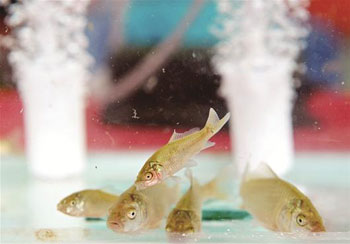
Genetically modified carp fry cultivated by the Institute of Hydrobiology, Chinese Academy of Sciences (Image source: Yicai.com)
Recently, the U.S. Food and Drug Administration (FDA) formally approved the marketing of genetically modified salmon, making the United States the first country to "eat the crab" in the field of genetically modified animal consumption.
However, many people do not know that in the path to market for genetically modified fish, the United States is actually a latecomer.
In 1990, a report about the world's first genetically modified fish was published in The New York Times. The "owner" of this fish was Zhu Zuoyan, an academician of the Chinese Academy of Sciences and a researcher at the Institute of Hydrobiology, Chinese Academy of Sciences. At that time, this technology was 3 years ahead of American counterparts.
Unfortunately, 25 years later, the United States achieved the world's first commercialization of genetically modified fish, while the pioneering technology of Chinese scientists in this field is still wandering within the besieged city.
The helplessness of the front-runner
In 1983, a team led by Zhu Zuoyan successfully introduced recombinant human growth hormone genes into fertilized crucian carp eggs through "microinjection technology," obtaining fast-growing genetically modified fish.
"When we produced the first genetically modified fish, many people abroad were very surprised." Zhu Zuoyan told a reporter from China Science Daily that the idea of genetically modified fish was inspired by the famous biologist Mr. Tong Dizhou. "But with the technical level at the time, it was impossible for us to obtain the fish's gene, so we could only transfer the overall DNA in."
After this initial trial, Zhu Zuoyan's confidence increased greatly. In 1991, he "modified" the Yellow River carp again. "We cloned the grass carp growth gene and replaced it with the carp's own actin gene promoter, then transferred it into the fertilized eggs of the Yellow River carp, so that the Yellow River carp carried a protein that promotes the growth function of grass carp."
Research shows that under the same farming conditions, the average growth rate of the genetically modified carp is 52.93%-114.92% faster than that of ordinary Yellow River carp. After multiple generations of screening, researchers obtained a stable "all-fish growth gene transferred Yellow River carp" strain. This technology can shorten the farming cycle by half, not only reducing farming costs and risks, but also greatly reducing labor intensity. "China's annual carp output is more than 5 million tons, with great application potential." Zhu Zuoyan said.
American businessmen with keen instincts quickly realized that this might be a rare business opportunity. In 2000, Elliot Entis, the first president of AquaBounty Technologies, the American company that cultivated genetically modified salmon, made a special trip to Wuhan to seek possible cooperation with Zhu Zuoyan.
"They were very interested in our research, but because carp do not have much of a market in the United States, the matter came to nothing. If what we had worked on back then had been salmon, it very likely would have been the first to reach market." Zhu Zuoyan said.
So why was the world's first genetically modified fish unable to be commercialized in China itself?
"This matter is hard to explain clearly." Zhu Zuoyan said. "Although we were in a leading position in research, I did not have confidence about being the first to enter the market, and the government would not have had the courage either, especially in the face of public opinion in which genetically modified organisms have long been misunderstood."
Scientific significance far greater than practical significance
Although it did not ultimately cross the finish line, Zhu Zuoyan still felt gratified by the marketing of genetically modified salmon in the United States.
"This is a good thing." In Zhu Zuoyan's view, the significance of the marketing of genetically modified salmon lies not only in the event itself. "It has opened the door for genetically modified animals to enter the market and has a great promoting effect on edible genetically modified agricultural products. Its scientific significance is far greater than its practical significance."
In fact, in the process of bringing genetically modified salmon to market, the United States could also be described as advancing step by step. The FDA did not complete its food safety assessment until 2010 and issued an environmental impact assessment in 2012. "The reason it took so long to finally reach market is that, on the one hand, public reaction was taken into account, and there was also pressure from the traditional salmon industry." Luo Yunbo, dean of the College of Food Science and Nutritional Engineering at China Agricultural University, told a reporter from China Science Daily that the final marketing was the result of multiple factors working together.
"The government's decision is crucial. It shows that it can judge that this matter represents future productivity and the direction of development." Zhu Zuoyan emphasized.
Not only that, scientists also have a clear understanding of their own functions. "American scientists are very clear about how far they should go and who should take over the baton, unlike our scientists, who have to complete everything from research to commercialization themselves." Zhu Zuoyan said.
Such confidence comes from the powerful research and development transformation mechanism in American society. "For a new scientific discovery, there is no need for scientists to communicate with society; companies with strong market awareness will automatically come to find them." Zhu Zuoyan was filled with emotion at the persistence of American companies in dealing with the government. "AquaBounty Technologies continued to persist in its application even when it had been dragged to the brink of bankruptcy by the approval process, while we had no experience and no confidence at the time. On this point, we bear responsibility."
More reflection is needed
In genetically modified research, what China has lost may be more than just one "fish."
"Mr. Zhu Zuoyan's genetically modified Yellow River carp is a case I often mention." Luo Yunbo said that such regret will leave China passive in its genetically modified strategy. "In the future, our research in the fields of health, environment, pharmaceuticals and nutrition will all be constrained by others. This is by no means only a matter of genetically modified food."
In Luo Yunbo's view, the public's understanding of genetically modified organisms may contain a certain deviation. "Many people do not know that our insulin is genetically modified, and the hepatitis B vaccine is also genetically modified."
The government's attitude also leaves scholars feeling helpless. "In the major research program on genetically modified organisms, as long as the content involves science popularization, it is either cut by government departments or its funding is compressed. They find it hard to understand why science popularization needs so much money." Previously, Luo Yunbo applied for 5 million yuan in funding to make some genetically modified documentaries with the Agricultural Film and Television Center, but after layers of approval, only 1 million yuan remained. "In this way, what can be done becomes very limited." "The government's attitude toward innovation cannot be merely adding flowers to brocade; it should be sending charcoal in snowy weather." Zhu Zuoyan said that the government's task is to identify and remove any obstacles that may arise in innovation-driven development, and to guide and support when help is most needed. "In the national major research program on genetically modified organisms, research like genetically modified fish, which has advantages and application prospects, was not included."
Zhu Zuoyan called for China to definitely form a complete research and development transformation mechanism in the future. If enterprises cannot become the main body of innovation, then no matter how many achievements scientists produce, it will be of no avail. "Our genetically modified Yellow River carp has long been ready. Now all that is missing is the final kick of government decision-making on market access." (Reporter Li Yu)