Non-GMO cold-hardy niche crops have great development potential
Original question: Why exactly are they not afraid of the cold?
Who says winter is the slack farming season? In Zichuan, Shandong, Shenyang, Liaoning, and Lijiang, Yunnan, fruit growers are busy thinning flowers, picking fruit and pruning branches, and their snow pears, snow peaches and Hanfu apples are both high-yielding and high-quality.
So why are melons, fruits, pears and peaches that were originally intolerant of low temperatures not afraid of the cold? It turns out that frost resistance and cold hardiness are the shared varietal "temperament" of these crops. From then on, fresh fruit in all four seasons no longer depends solely on protected agriculture.
Below, let us appreciate the elegance of a batch of delicious, beautiful and precious "cold-defying" fruits that researchers have carefully optimized and cultivated over several years, using the superior natural, ecological and climatic conditions of various places.
Snow pears and snow peaches
Fearless in freezing weather
File photo
Yan Shengting, our reporter Lu Bingbing
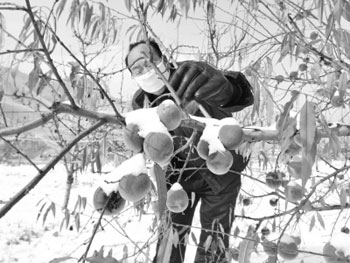
On November 26, in Zichuan District, Zibo City, Shandong Province, the first snow of 2015 arrived as expected. Three consecutive days of snowfall brought the local nighttime minimum temperature down to -13°C. Yet in the orchard of Jiao Yuliang, a farmer in Xiangquan Village, Taihe Town, two fruits, "Xiaoxue honey peach" and "Chuanshan snow pear", still hung high on the branches, as fresh as ever, forming a charming contrast with the pure white snow and becoming a beautiful winter scene. You can still pick peaches and pears in the snow? That's right, this is a new achievement Jiao Yuliang developed over 10 years.
Xiangquan Village is located within the E'zhuang Ancient Village National Forest Park, with dense forest resources, four distinct seasons and a large temperature difference between day and night, forming a unique "microclimate". The Xiangquan Grand Canyon, at an altitude of more than 800 m, has steep terrain. Walking along the rope into the valley leads to Jiao Yuliang's 80-mu orchard, which mainly grows pears, peaches, kiwifruit and other fruit trees.
Jiao Yuliang recalled that an early heavy snow in 2005 caught him before he could finish picking the golden pears in the trees, causing heavy losses. But this disaster left him an unexpected delight. The following spring, while pruning branches, he was astonished to find that two bagged golden pears were still on the tree after a whole winter without dropping, and were still fresh and golden yellow. "At the time, aside from being surprised, I felt there must be something special about this. Was it a bud mutation, a branch mutation or a seed mutation? So I treated these two pears as experimental subjects, cultivated dozens of original seedlings, began grafting with rootstock, and at the same time consulted experts everywhere and experimented repeatedly," Jiao Yuliang said.
In order to breed a frost-resistant, cold-hardy snow pear, Jiao Yuliang went into the mountains every day in winter wearing cotton clothes and cotton boots to study. He did not even have time to visit relatives and friends during the Spring Festival, and went up the mountain on the second day of the new year to check the seedlings. It can truly be said that he endured great hardships, and who knows how many times he failed... Through his unremitting efforts, after 8 years he finally bred the cold-hardy snow pear.
At first, because the pear grew as big as a small watermelon, he named it "watermelon pear". Because it could only be picked after Minor Snow, under expert guidance the new variety was named "Chuanshan snow pear". This achievement won the second prize in the 2014 Zibo City Agricultural Entrepreneurship and Creativity Competition.
Since 2012, following the principles used to breed "Chuanshan snow pear", Jiao Yuliang spent 3 years breeding a new cold-hardy variety, "Xiaoxue honey peach". According to reports, "Xiaoxue honey peach" has the characteristics of a late maturity period, high sugar content, high nutritional value, drought resistance, no conflict with the farming season and no need for storage. Seven or eight make one jin, and it begins to ripen after Minor Snow, so it can be sold fresh right after picking. For this reason, Jiao Yuliang composed an amusing doggerel poem: The Queen Mother of Heaven bestowed a treasure, sent down to the mortal world, laughing proudly at ice and snow, content and at ease.
After the first snow of winter, snow pears and snow peaches set each other off beautifully. Moreover, because snow pears and snow peaches have a long growth cycle and late maturity, after being tempered by frost and snow their sugar-acid ratio is especially high, they are rich in nutrients and their taste is excellent, making them very popular with consumers. This keeps Jiao Yuliang especially busy even in the coldest winter months. "I planted a few mu of snow pears this year, and even at 10 yuan per jin they are in great demand. Just now, Manager Sun from Linzi asked for 10,000 yuan worth of goods, but our supply is insufficient, so I can only provide him with 3,000 yuan worth," Jiao Yuliang said.
Speaking of future development, as the Party branch secretary of Xiangquan Village and chairman of the Zichuan District Xiangquan Grand Canyon Rural Tourism Cooperative, Jiao Yuliang said he plans to build a planting base next year, planting 12 mu of "Chuanshan snow pear" and 6 mu of "Xiaoxue honey peach". On that basis, he will promote planting on a large scale among the people and provide technical guidance free of charge, truly turning the slack farming season into a busy one and fattening the "wallets" of mountain fruit growers.
Hanfu apple
Pushed 200 km northward
File photo
Our reporters Yu Xianfeng and Zhang Renjun
The Liaodong Peninsula is a high-quality apple cultivation area, mainly referring to southern Liaoning. In the past, no trace of apples could be seen in Shenyang and areas further north. However, in recent years, apple planting in the Shenyang area has been widely promoted, mainly because of the existence of the cold-resistant variety "Hanfu".
Breeding cold-resistant large apples has been a research topic for countless scientists around the world. People have long believed that in areas where the average January temperature is below -12°C, large apples find it difficult to overwinter. The fruit tree cultivation and physiological ecology innovation team at Shenyang Agricultural University has worked hard to explore and solve major problems facing scientific and technological development.
After 15 years of effort, they broke through the bottleneck of low temperature limiting the large apple cultivation area, formed an efficient apple industry in the northern margin of China's traditional large apple cultivation zone and the vast cool areas further north, and pushed the high-quality large apple cultivation area 200 km northward, nearly 2 geographic latitudes.
World major large apple varieties such as the Delicious series and Fuji series have relatively weak cold resistance and are all distributed in ecologically suitable areas with an annual average temperature of 8.5°C to 14°C and a minimum monthly average temperature of -9°C to 8°C. The vast cool areas north of 40°N in China are rich in land and light resources and possess many conditions for developing the apple industry, but are restricted by conditions such as an average January temperature below -10°C and therefore cannot cultivate traditional large apples such as Fuji.
The cold-resistant high-quality variety bred by Shenyang Agricultural University in 1997 broke through this limitation, but in the initial stage of introduction and trial planting, because understanding of the characteristics and growth and development traits of each variety (line) was not deep enough, the propagated nursery stock had many mixed lines. In addition, fruit growers lacked sufficient awareness of limitations such as low temperatures and other natural conditions and blindly expanded the cultivation area northward. These areas were also new apple cultivation areas, where fruit growers had no production experience and lacked a supporting cultivation technology system, resulting in frequent freezing damage to branches and trunks and buds as well as frequent pests and diseases, uneven orchard appearance, low yield and poor quality, and no large-scale production was formed.
For this reason, the fruit tree innovation team of Shenyang Agricultural University screened and evaluated varieties such as "Ningfeng", "Ningsu", "Hanfu" and "Hanguang", which had been filed with the Liaoning Provincial Seed Administration, as well as other mixed Hanfu sister lines, from multiple perspectives including physiology and anatomy, and developed corresponding nursery stock propagation techniques.
Team leader Lü Deguo told reporters that their research results for the first time clarified that "Hanfu", compared with major apple varieties cultivated in China such as "Fuji", has stronger comprehensive resistance including cold resistance, drought resistance and disease resistance, and has characteristics such as self-pollination fruit set, high fruit-setting rate, easy flower formation from axillary buds, the ability to still meet fruiting needs after terminal flower buds are frozen, regular fruit shape, excellent quality, storability and easy early fruiting and high yield. They revealed the biological and physiological mechanisms by which it can be cultivated with high quality in the northern margin of the traditional large apple cultivation zone and in areas further north with an average January temperature of -12°C to -10°C, laying the theoretical foundation for developing a supporting cultivation technology system. And according to the natural resources of cool areas and the current layout of fruit tree belts, they carried out multi-regional trial planting sites and finally completed the cultivation regionalization of "Hanfu" apple, providing a scientific basis for the development of China's cold-resistant high-quality apple industry.