A fish that can walk is a good money-maker, with considerable farming profits
For a magical fish, he started his business from the more than ten square meter rooftop of his own home. To explore the secret of how the fish grows up, he moved away from people and relocated his farm to the border, only to run into a crisis of trust. The wild fish is only two fingers wide, yet he raised it to the size of a palm; even the fish scales and fish bones that nobody wanted became hot commodities in his hands. See how Yan Kanfan, who takes the road less traveled, digs gold out of a fish that can walk and builds a successful business.
Beautiful Xishuangbanna holds many unknown secrets, and in this fish pond before our eyes, the farmers are here today to catch a very special kind of fish. It is called special because, in the eyes of the locals, this fish is truly magical.
Farmer: It can climb mountains, and it can even climb trees.
Farmer Sun Jianlun: We grab it and smash it hard against the ground, and it still won't die. It's pretty magical.
His name is Yan Kanfan, a young Dai man. When the reporter came to interview him, Yan Kanfan took us to a farmer's home to buy this fish that had already been raised for four months. As soon as we arrived at the pond, the reporter saw the young men casting nets to catch fish, while the Dai girls waited anxiously on the bank, putting on gloves and carrying fish baskets, waiting to go into the pond to grab fish after the nets were pulled in. Just how magical this fish is, the reporter was very curious too. After more than 20 minutes, the first batch of fish finally came ashore. They sat in the bamboo baskets, not behaving at all, every one of them trying to jump out, and the reporter witnessed a truly astonishing scene.
Yan Kanfan: Look how magical our fish is. It can walk, and so fast.
Reporter: Oh my, it runs so fast.
Yan Kanfan: Too fast. Look, it knows which side the water is on. Once it smells the water, it heads off in that direction.
Just as the locals say, after leaving the water this fish keeps crawling through the grass, as if it were walking. Yan Kanfan says that although this fish is small, it is very fierce. Other fish can be grabbed directly by the back, but when this fish is nervous or angry, its fins all spread out, and if you don't grab it his way, you can easily get hurt.
Reporter: Is it easy for me to grab the fish?
Yan Kanfan: I'll teach you. Like this. First you have to press down the (gill covers). See, (this way) there's no problem.
Reporter: You have to grab it from the head end, the opposite way. Let me try. First pinch the gills on both sides. It keeps running. Let's try again. Grabbing this fish is really not simple. You have to do it like this, grab the gills on both sides first, and then it works. This fish is so strong.
Yan Kanfan: It's docile now. You've subdued it.
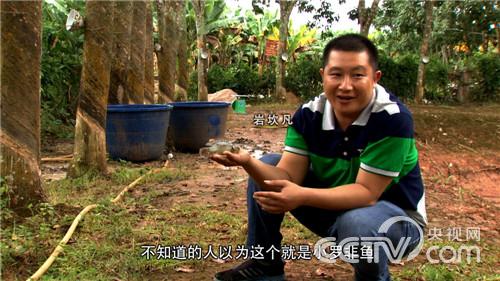
It is over twenty centimeters long, yet it is a fish that has been raised for more than four months. Yan Kanfan says this walking fish is called Baxili locally, and it is a native fish of Xishuangbanna.
Yan Kanfan: People who don't know think this is just a small tilapia. It looks very ordinary, but it has its features. There's a spot here at the tail, and a spot on the gills. It's a variety from our Xishuangbanna area.
Yan Kanfan buys them from farmers at 20 yuan per kilogram, raises them at his own farm for another four months, then brings them to market at 50 yuan per kilogram. Locally, when people mention young Yan and his fish, everyone gives a thumbs-up.
Farmer Yan Yan: Our big brother, the big brother who leads us to wealth.
Farmer Wu Yingguo: Without him, nobody would have developed artificial farming of Baxili, so he is the one who created it.
Fisheries station head: This fish is already on the verge of extinction. Nobody used to farm this fish. After 2010, Yan Kanfan led everyone to start developing this farming. As people say, he is the first person, the father of Baxili.
In 2010, Yan Kanfan achieved artificial breeding of Baxili. Now, many locals want to farm it, and locally only Yan Kanfan has this kind of fry. Starting every June, Yan Kanfan gives fry free of charge to the cooperative's farmers, and the fry he breeds are what everyone scrambles for.
Farmer Sun Jianlun: Scramble for them. Lots of people didn't get any. I was pretty lucky, I got four thousand fry.
Wu Yingguo: He decides when the fry are handed out. If he didn't set the rule, you wouldn't get any. We also want to raise more and earn more.
Yan Kanfan: I've been secretly laughing to myself. I'm about to get rich soon.
Just how capable is Yan Kanfan, and will raising the fry he breeds definitely make money? What exactly is this strange fish that can run and jump and that everyone scrambles for? And how did Yan Kanfan build a successful business on this fish? The next day, Yan Kanfan took the reporter to a place. He said this place means a great deal to him, because it was here that he made a major discovery.
Reporter: So this counts as one of your secret bases?
Yan Kanfan: That's right. The fish I collect all go up here.
Reporter: Slow down. It's not easy to get up there. You climbed like this every day back then?
Yan Kanfan: Yes, climbed like this every day.
This place is on the roof of a three-story building, a space of less than ten square meters, and it is where Yan Kanfan's fish farming began.
Yan Kanfan: My first pond, my first base, was right here, such a small space, up on the roof. The first year I didn't dare tell anyone. Only very good friends knew I was doing trial farming. I was afraid others would find out, afraid others would farm it first.
In 2009, Yan Kanfan, who was running a hotel and a gas station in Mengla County, spotted a business opportunity. He wanted to farm a fish that nobody locally had farmed, and he used his own rooftop as a fish pond, wanting to start farming in secret. At that time, this fish was hard to find on the market. When Yan Kanfan was a child, it only appeared in river ditches and small streams. Because it was small and full of bones, the locals just treated this fish as a trash fish and threw it away. No dealer would buy it, and his family opposed the idea too.
Brother-in-law: In our area, tilapia, grass carp, and common carp are farmed so big, and this fish isn't big. Why would you farm it? I did have doubts.
Dealer: It's just worthless. Even when people see it, they don't want to catch it.
Yan Kanfan: My mom and dad said, son, is your brain waterlogged? Such a bony fish, so small, who's going to eat it? And besides, how would you even farm it?
Everyone looked down on this fish and was unwilling to farm it, but Yan Kanfan felt he had picked up a treasure. It turned out that in 2009, Yan Kanfan had seen a fish in Yunnan that sold for three thousand yuan per kilogram.
Yan Kanfan: I saw that even at three thousand yuan a kilogram, people would eat it. The business opportunity is huge, isn't it? If I also had this fish, and didn't sell it that expensive, our Xishuangbanna Prefecture is quite rich in aquatic resources, it's just that nobody has developed it, nobody has discovered it.
A fish worth more than 3000 yuan gave Yan Kanfan an idea. He set his sights on a native fish on the verge of disappearing. He felt this fish had Yunnan characteristics, and it could be tasted and taken away, so he decided to be the first locally to farm it at scale. He asked relatives and friends to collect it in Yunnan, Guangxi and other places. In order to get broodstock quickly for breeding, he and his brother-in-law kept watch at the farmers' market every day, buying back every single one that appeared, whatever the cost.