Post-80s Armed Police Veteran Returns Home to Farm, Fulfilling His Entrepreneurial Dream on Abandoned Land
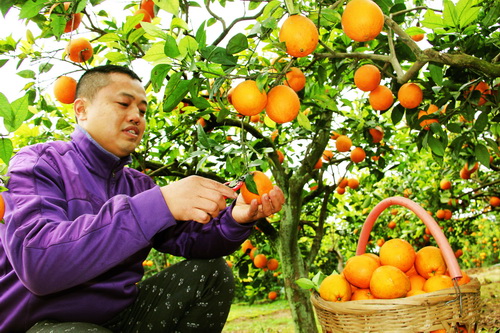
Gazing at the mountains covered in golden, fruit-laden branches; watching truck after truck loaded with navel oranges drive away from the orchard; counting the thick wads of cash going into his pocket, Pang Sheng was overwhelmed with emotion. Having gotten his first taste of success, he felt even more confident about building his own "sweet" enterprise on the abandoned rural land.
This former Armed Police "soldier boy," attached to his native soil, gave up a highly profitable medicinal herb business to return to his hometown and contract 300 mu of abandoned land, becoming a genuine "tiller of the soil" who works alongside the earth. His "digging gold from the soil" venture nearly cost him his entire investment of 700,000 yuan, and his entrepreneurial journey was full of twists and turns. This year, the "Xifeng navel orange" made his entrepreneurial dream come true.
Choosing the Wrong Crop Nearly Sent His Early Investment "Down the Drain"
Pang Sheng, 35 years old this year, is a villager of Rongping Village, Fenghe Township, Xichong County. At the age of 19, he left his parents to become an Armed Police soldier. He was discharged in the winter of 2004 and then went to work in the coastal areas.
He had been an Armed Police soldier, a security guard, an electrician, and also engaged in the medicinal herb business... Through 7 years of hard work, he returned to his hometown with over 700,000 yuan in cash and a passion for his native soil, to build his own enterprise.
"When I was working as a security guard, a boss thought highly of me and taught me the medicinal herb business," Pang Sheng said. In 2024, he went alone to Guangzhou, and relying on the skills he had honed in the military and his own honesty, he won the boss's trust and accumulated his first fortune in less than a year.
Pang Sheng clearly remembers that when he first started in the medicinal herb business, sometimes he would travel to many places in a single day -- selecting, transporting, stocking, and selling -- often so exhausted that his legs felt weak and he would fall asleep the moment he got home. At first he dealt in finished medicinal herbs, then gradually moved into semi-finished products and raw material processing. To save costs, earn more money, and ensure quality, Pang Sheng always did his utmost in whatever he could handle himself, even personally doing the slicing, air-drying, and oven-drying of the herbs.
"Very few people farm the land, and lots of fields are overgrown with weeds, so I decided to come back and farm," Pang Sheng said. During the 2011 Spring Festival, when he came home, he saw more and more rural land lying abandoned and felt very uneasy about it. Without getting his family's consent, he partnered with someone to contract 300 mu of abandoned village land and started a farming operation.
"At first I didn't know what was best to plant," Pang Sheng said. He hadn't farmed for many years and didn't know what would be profitable. Drawing on his experience in the medicinal herb business, he mainly planted Chinese medicinal herbs such as Polygonatum (Huangjing), honeysuckle, and Forsythia on different plots, and also grew conventional crops like radishes. "I ran a diversified operation -- the radish output paid for expenses, and the medicinal herb output was pure profit," he said. His initial investment in land rent, agricultural supplies, and labor came to nearly 300,000 yuan. Plans can't keep up with changes. Just as Pang Sheng was dreaming of success, ruthless reality dealt him a "blow to the head," shattering his dream to pieces.
Recalling the early days of his venture, Pang Sheng could no longer hide his inner pain, tears welling up in his eyes. In a choked voice he said: "I never imagined that the Forsythia wouldn't bear fruit at all, that the honeysuckle seedlings would nearly all wither and die, and that the radishes I was counting on to sell would be stolen, leaving barely any by the time they ripened."
Pang Sheng, deeply attached to his native soil, had wanted to accomplish something on the land, but now he was in trouble. His family, who had not supported him to begin with, strongly demanded that he give up, and even his partner wanted to withdraw his investment. Blow after blow left this taciturn man shutting himself in a room for a full month. Afterward, he still didn't give up, and busied himself alone in the 300 mu of fields -- weeding, loosening the soil, fertilizing...
"Seeing how hard he worked and how he persevered, I had no choice but to support him," said Pang Sheng's wife, Ma Lingli. At first she hadn't supported Pang Sheng's farming and worked away from home alone. When she heard that Pang Sheng's venture had failed, she called many times, but Pang Sheng didn't answer. Worried something had happened to him, Ma Lingli made a special trip back to see him. Seeing Pang Sheng in the fields, dark and thin with calloused hands, the couple embraced in the empty valley and wept bitterly.
With his family's support, Pang Sheng worked even harder. Over these 5 years, he invested nearly 700,000 yuan in total. The earlier projects -- medicinal herbs and conventional crops -- failed one after another. Only the Xifeng navel orange brought him hope.
300 mu of Xifeng Navel Oranges Nurture the Hope of Prosperity
Row after row of neat, lush navel orange trees, with golden, plump, enticing navel oranges beneath the leaves, and a dozen or so workers busy under the trees picking fruit, sorting, and packing boxes... Recently, a reporter visited Pang Sheng's Xifeng navel orange base and saw a scene of abundant harvest. Through planting Xifeng navel oranges, Pang Sheng turned a weedy patch of barren hills into a "treasure basin" of increased income.
"It was the navel oranges that restored my confidence in farming. Otherwise, how could I face my family who supported me?" Pang Sheng said with some relief. On a morning in the summer of 2012, he had already decided to give up his rural venture and go back to his old trade in the medicinal herb business. Just before leaving, he wanted to walk around the 300 mu of land one more time. "The little navel orange saplings gave me hope." Pang Sheng clearly remembers that the small navel orange saplings were almost hidden by the surrounding weeds, but the dewdrops on their leaves were crystal clear, and several navel orange trees had already begun to bear fruit. Combined with his family's support, Pang Sheng said, "Whose life doesn't have some setbacks? Worst case, I start over from scratch."
Starting in 2012, Pang Sheng and his mother worked from dawn to dusk, breaking rocks and clearing stones in the rubble heaps, building stone terraces and digging planting pits. The once handsome young man became dark and thin, his hands covered in cracks and even traces of blood. They ignored the freezing cold of deep winter. To make working easier, he built a few shacks on the hill and crawled in to rest when tired. At the hardest times, the family could barely put food on the table and couldn't even afford the electricity bill. Yet he and his mother cleared the 300 mu of thorns and thatch, one cut and one hoe at a time, chose the Xifeng navel orange as their crop, improved and grafted the existing large navel orange trees, dug over 15,000 standard planting pits, bought Xifeng navel orange seedlings, and planted them pit by pit.
At first, growing navel oranges was not as easy as imagined. Pang Sheng had never specifically studied knowledge in this area and had neither technique nor experience. For a "layman" in navel orange cultivation, it was truly an uphill struggle. But he was not afraid; instead, he threw himself wholeheartedly into the orchard, learning weeding, fertilizing, pruning, and disease-prevention spraying from experienced local growers. By day he labored in the orchard; by night, when free, he studied fruit-growing techniques. He never missed a single session of the fruit industry technical training classes held by the county, and he filled pages with dense notes. Day after day, month after month, he mastered techniques such as flower and fruit preservation and integrated biological pest and disease control through his diligent study.
Because of the hardship of navel orange cultivation, a few days ago he found that his old clothes had "grown bigger," and only then realized he had lost another size. He said that even if things get harder and more tiring, as long as his labor and hardship are rewarded, he feels an indescribable joy. Moreover, the navel oranges he produces are well-proportioned and attractive in appearance, and he believes they will surely win customers' favor.
"This year 5,000 trees have borne fruit, with an output of 150,000 jin. Finally there's profit," Pang Sheng said happily. Next year, all the trees will bear fruit, and some navel oranges will enter their peak production period, with output increasing year by year. "If all goes well, next year I'll pay off all my debts and still have a surplus."
Through these 5 years of exploration, he developed an under-forest economy on the 300 mu of navel orange trees according to the plots, intercropping Chinese medicinal herbs such as Pinellia (Banxia) and Polygonatum (Huangjing) beneath the navel orange trees. "These medicinal herbs can reduce pests and diseases on the navel oranges, save on labor for weeding and spraying, and raise the land's output value," Pang Sheng said. He had already trial-planted this intercropping, and the results were very clear: intercropping Pinellia per mu will add 5,000 yuan, and intercropping Polygonatum per mu will add 10,000 yuan. This not only improves the quality of the navel oranges but also reduces costs, thereby raising the land utilization rate.