Qixia apples are ripe, and fruit growers meet fresh food e-commerce
It seems unrealistic for Qixia apples to fully replicate the production and marketing model of Chu Orange, but the success of Chu Orange gave Qixia, which is rich in apples, the idea of branding agricultural products, and fruit growers and distributors also hope this can make things different.
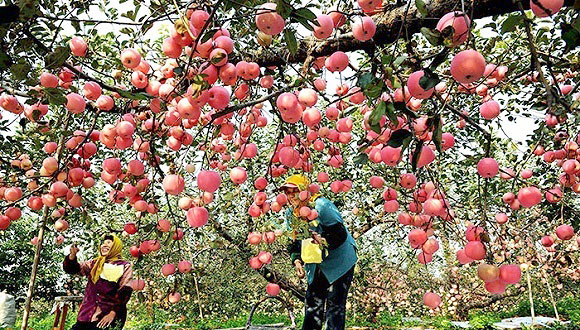
The blizzard brought by the cold wave in late November made Wang Lejiang, a post-80s Shandong native, a little annoyed. Because of the accumulated snow, the expressway in and out of Yantai was closed, and the apples from the online store "Wang Xiao'er Orchard" that Wang Lejiang runs were stranded at a courier transfer station. He anxiously made phone calls, asking customer service and logistics companies about the highway traffic conditions.
"Double Eleven has just ended." Wang Lejiang told Jiemian News reporters. "Now we are starting on the Double Twelve activities. Busy, really busy."
Wang Lejiang's apples come from Qixia, a county-level city under the administration of Yantai. In the second half of the 19th century, American missionaries introduced North American apple seedlings to Qixia. Through grafting and crossbreeding with local varieties, they produced a famous high-quality variety that is sweet, tart, and juicy.
Apples are not only the pillar industry of this inland Shandong city dominated by hills and mountains, but also a calling card for the city. In 2014, Qixia's apple output reached 2.6 million tons, and Qixia people call their hometown the "Apple Capital of China."
In the streets and alleys of Qixia, the image of apples is everywhere: an abstract apple-themed sculpture stands in the civic square; at the entrances of courts, police stations, and all kinds of government departments, posters reading "Yantai apples, Qixia flavor" are plastered everywhere; bus stops, traffic separation railings, streetlight poles, and even manhole covers are decorated with all kinds of apples.
Every year in late October, the local area holds the "Qixia Apple Art Festival," and 2015 was already the 14th year. Whenever this time comes, the streets are full of farmers selling apples and traders buying apples. However, like most agricultural products, apples also have so-called good years and poor years. Qixia apples ripen once a year, fruit growers have relatively little understanding of market information, and together with a single industrial structure, this further amplifies the impact of cyclical fluctuations in market prices on the local economy.
"When prices are good, people always feel they can rise further, so they hoard and do not sell. Once prices fall, distributors feel there is no profit in selling apples, so they stop buying. If apples do not sell, then the losses are huge." Wang Hengqi, secretary of the Communist Youth League Qixia Municipal Committee, said. "Growing apples and selling apples is the most important thing for most Qixia fruit growers each year. If apples do not sell well, people's lives will be greatly affected, and it may even trigger social problems."
In the winter of 2012, the orchard of Wang Lejiang's father-in-law fell into the predicament of a "limit-down" unsold stock. This "Qixia son-in-law," who was then working at a software company, simply opened an online store on Taobao called "Wang Xiao'er Orchard" to help his father-in-law sell apples. "Unexpectedly, they sold quickly," and afterward Wang Lejiang simply told relatives and friends that apples they could not sell could be given to "Wang Xiao'er" to sell.
In the years since, more and more local fruit growers and cooperatives began cooperating with "Wang Xiao'er Orchard." Today this online seller has more than 70 employees, 3 packaging bases, and 4 partner cold storages, and last year's revenue reached 70 million yuan. In addition to Taobao, Wang Lejiang also began opening online stores on e-commerce platforms such as Yihaodian and JD.com.
The success of "Wang Xiao'er" aroused the interest of the local government. Xicheng Town, a main production area of Qixia apples, quickly became a testing ground for the development of apple e-commerce. In the past two years, the town government organized 5 large-scale training courses, inviting relatively mature online sellers and supporting enterprises such as logistics and cold storage companies to popularize e-commerce business knowledge among fruit growers.
After a period of relatively extensive growth, Xicheng has more than 140 online sellers, large and small. Like Wang Lejiang, most of the newly started online store owners are also using Taobao and WeChat to sell apples for their own or their relatives' and friends' orchards. In April 2015, the Xicheng area also established an e-commerce service center, hiring college graduates who returned home to answer questions for fruit growers who were "getting online."
The booming Qixia apples are also a microcosm of China's fresh food e-commerce.
Since 2014, the fresh food e-commerce sector, once regarded as the last blue ocean of e-commerce, has shown rapid growth in both capital investment and transaction volume. Comprehensive e-commerce players such as JD.com, Tmall, Amazon, and Yihaodian were all present, and vertical fresh food e-commerce companies such as Benlai Life, Womai, and Fruitday also attracted capital attention.
Among fresh food categories, fruit is one of the products most welcomed by consumers.
The "White Paper on the Development of China's Fresh Food E-commerce Industry" released by market research company Nielsen in 2015 pointed out that the penetration rate of fruit among online fresh food buyers reached 51%, second only to dairy products. These consumers keen on online shopping bought fruit 1.36 times per week on average, with an average order value of about 93 yuan, and virtual online channels became the second choice after supermarkets and hypermarkets.
However, fresh food e-commerce must penetrate planting bases upstream, control logistics in the middle, and capture consumer users at the end, while also trying to reduce losses, improve service experience, and control costs. It is a very complex business. For Qixia fruit growers, who are still in the primitive state of "shop in front, field behind," the talk by tech elites and capital tycoons of "integrating the entire industry chain ecosystem" seems like a term that is too distant.
"You have to collect fruit, ship goods, and act as customer service. It is really especially hard. Some fruit growers cannot even use smartphones very well. When they see that the boss of Wang Xiao'er opened a Taobao store, made money, and bought a BMW, they also prepare to roll up their sleeves and open an online store." Xu Haiyong said.
On Double Eleven last month, Taobao's apple sales volume reached 642,000 kg, setting a new Guinness World Record.
In the view of local government officials, the strong sales of apples on Taobao on Double Eleven also owed something to the Qixia Apple Online Goods Festival one month earlier. From October 16 to 18, 2015, Taobao held the first "Qixia Apple Online Goods Festival," with 11 relatively large Qixia online sellers, including "Wang Xiao'er Orchard," participating. On the afternoon of the first day, Xu Haiyong, party secretary of Xicheng Town and organizer of the online goods festival, received a phone call saying that backend data showed sales had already reached 1.6 million yuan, breaking Taobao Fresh's previous single-day record for apple sales across the entire network - previously, Taobao's total single-day apple sales across the entire network had never exceeded 1 million yuan.
"Taobao also needs social effects, to tell consumers that you can also buy apples on Taobao." Wang Lejiang said that repeat customers had always been an important source of customers for "Wang Xiao'er Orchard," and the exposure during the online goods festival helped these online sellers bring in several times the traffic.
On the other hand, during the Qixia Apple Online Goods Festival, Taobao's single-day apple sales across the entire network were once raised to nearly 5 million yuan. This means that in addition to Qixia apples, consumers would also order apples from Shaanxi, **, or imported from abroad among "similar products."
"The competition is brutal." Wang Hengqi visited several wholesalers in Beijing last week and felt this deeply. "Especially in the cold price winter of 2015, the wholesale market can only engage in a price war. Ordinary people do not know what difference there is between Shandong apples and Shaanxi apples. They look about the same, so in the end they pick the cheaper ones."
Competition among production areas is equally fierce in online channels. Peng Yu, general manager of marketing at fresh food e-commerce platform Benlai Life, told Jiemian News reporters that at present Luochuan apples from Shaanxi and wild apples from Yunnan are the two main apple categories that Benlai Life is promoting.
Yin Hui, head of Benlai Life's South China fruit department, told Jiemian News reporters that in addition to price advantages, Benlai Life's strong marketing capability is also an important factor attracting suppliers. "On the one hand, Benlai Life will agree with farmers that for organically grown green fruit produced according to regulations, we will buy it back at harvest season at a price above the market. On the other hand, Benlai Life has very good market resources. With our support, good agricultural products can build a brand."