Li Dapeng: The Closest and Most Caring Friend in Farmers' Hearts
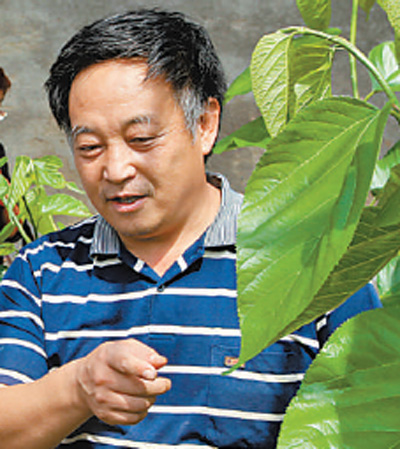
Li Chunsheng providing technical guidance inside a greenhouse.
Out of 12 months in a year, he spends 10 living in the countryside, helping farmers build greenhouses and teaching them vegetable growing hand by hand; in the early 1990s, when households with ten thousand yuan were still rare, the vegetable greenhouses he guided could bring an annual income of 15,000 yuan per greenhouse. The farmers affectionately called him "Li Dapeng," and in the rural areas of Jixian County, a saying even spread: "For greenhouse building, find 'Li Dapeng.'"
He is Li Chunsheng, deputy director of the Vegetable Station of the Jixian County Agriculture Bureau in Tianjin, who has been working on the front line of vegetable technology research, promotion, and service for over 30 years. He has successively won the first prize of the Ministry of Agriculture's Harvest Award for Agriculture, Animal Husbandry, and Fisheries, the second and third prizes of the Tianjin Science and Technology Progress Award, and in 2012, he also received the "Special Government Allowance of the State Council." Under his and his colleagues' efforts, Jixian County's vegetable industry has developed into a characteristic industry, with facility vegetable area accounting for 1/5 of Tianjin's total, and Jixian County's cucumbers, green beans, and other varieties supplying a large amount to the Beijing market.
For greenhouse building, find "Li Dapeng"
Speaking of the nickname "Li Dapeng," one must trace back over 20 years. That was in 1993, when Tianjin's Jixian County introduced high-efficiency energy-saving solar greenhouse technology, ending the local history of being unable to produce warm-loving vegetables in winter, and the ones who brought this technology were actually 3 farmers from Shandong. At 30 years old, Li Chunsheng had already been an agricultural technician at the vegetable station for many years. Upon hearing this news, he was both surprised and unconvinced: "Shandong farmers can do it, why can't I?" Subsequently, he made a bold decision: stay in the village to learn the technology and help farmers build greenhouses.
In 1994, the Shandong masters left, and Li Chunsheng began independent village-based guidance, responsible for the construction of 24 greenhouses and vegetable production in Linzhuanghu Village. Li Chunsheng guarded the greenhouse construction site day and night, and after 3 months, the greenhouses were finally built. Next came vegetable planting and management. As a technician by background, Li Chunsheng was not at all intimidated; he went around from greenhouse to greenhouse every day, guiding farmers in vegetable seedling cultivation and cultivation management.
After a year, each greenhouse brought in an income of 15,000 yuan. The farmers smiled, and a stone was lifted from Li Chunsheng's heart. "Previously, in Tianjin's winter, people couldn't eat fresh cucumbers or tomatoes. That Spring Festival, cucumbers were 10 yuan for 3 jin, and on ordinary days just over 1 yuan per jin. Farmers growing in greenhouses suddenly became rich."
With one success, Li Chunsheng was affectionately called "Li Dapeng" by the farmers, but he did not retire after his achievement; he stayed for 8 years, guiding 630 households in 28 villages across 6 townships in Jixian County to build 3,650 mu of vegetable greenhouses, cycling over 30,000 kilometers.
Not Staying at Imitation and Borrowing
Li Chunsheng's greenhouse path did not stay at imitation and borrowing; instead, he delved deeply into research, promoting the leapfrog development of China's facility agriculture technology.
"Previously, greenhouses were externally insulated. When it snowed, farmers had to climb up to clear it, and when it rained, the straw mats couldn't be pulled up. If the insulating straw mats were inside the greenhouse, it would be better." After over 4 years of research, in 2005, Li Chunsheng completed the structural design of a new type of solar greenhouse for the first time and built China's first internally insulated solar greenhouse.
The successful development of the high-efficiency energy-saving internally insulated solar greenhouse structure created a new history for China's solar greenhouse structures. The minimum temperature inside the greenhouse is 3-5°C higher than ordinary second-generation energy-saving greenhouses, vegetable yield increases by over 30%, and labor resources are saved by over 20%. In 2008, this greenhouse was named "Jichun-type Built-in Insulation Quilt Solar Greenhouse" by Professor Chen Qingyun of China Agricultural University.
"Internally insulated greenhouses save us a lot of trouble, and the insulation and yield increase effects are good. With two greenhouses per family, it's easy to earn over a hundred thousand yuan a year," said Li Shuangliang, a farmer in Tangtuozhuang Village. In recent years, Li Chunsheng has also promoted his independent innovation technology to 9 provinces and cities including Beijing, Jilin, Liaoning, and Ningxia, with a cumulative promotion of 120,000 mu, driving farmers' income increases of over 600 million yuan.
In 2012, Li Chunsheng led the construction of the Jixian County Modern Agricultural Science and Technology Demonstration Park, and afterward, he moved his workplace here, "carefully tending" 63 modern greenhouses. Colleague Wang Hongyun said: "When the park was building greenhouses, Li Chunsheng didn't trust hiring people; he did the greenhouse positioning, drafting, and measuring himself."
In the cold winter season, the greenhouses are as refreshing as spring, with greenery everywhere. On the path of leading the county's farmers to prosperity, Li Chunsheng's dreams are also constantly upgrading. "Jixian County has unique location advantages and rich tourism resources. We need to vigorously develop characteristic agriculture. Recently, we just introduced facility fruit trees like long mulberry and pineapple, with good ornamental effects and economic returns. Next, we will go to the introduction site to study management and cultivation techniques, so these fruit trees can become the next support for farmers' prosperity," said Li Chunsheng.