Everyone fears citrus greening disease, but he insists on growing citrus and stands firm
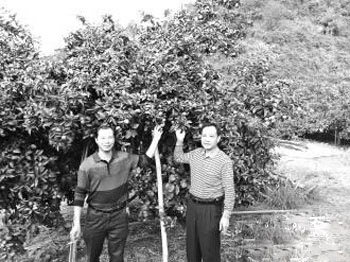
Li Zugan and He Jianzhou are determined to keep growing citrus, upgrading their cultivation model and improving their sales strategy.
As sugar mandarins from some production areas in Guangdong gradually hit the market, this year's sugar mandarin sales battle has officially begun. As an important main producing area for sugar mandarins in China, Guangdong's sugar mandarin industry has gone through a path from growth and expansion to shrinkage and weakening, and now to recovery and development. But it cannot be denied that Guangdong's current sugar mandarin industry is still seriously threatened by citrus yellowing and citrus greening disease. Sihui, once the "spiritual homeland" of the industry, has seen its planting scale plummet from a peak of 240,000 mu to less than 20,000 mu.
However, many citrus growers in Guangdong still have not given up on this endeavor. They persistently innovate in technology, pioneer new approaches in sales, and keep their citrus trees evergreen...
In Yingde, an old sugar mandarin growing area, compared with major production areas such as Jiulong, Xiniu and Lixi, the sugar mandarin industry in Shihuipu Town is not large in scale, but Xiangsheng Farm here is well known far and wide.
Xiangsheng Farm is located in a deep mountain area less than 10 li from Shihuipu Town. It currently covers more than 200 mu and has nearly 20,000 sugar mandarin trees.
Due to blind planting and unreasonable development, Yingde's sugar mandarin trees have continuously yellowed, and many citrus trees have been severely attacked by citrus greening disease. At a time when people are cutting down trees and switching to other crops, a farm of this scale still stands today, which seems miraculous to outsiders.
Today's Xiangsheng Farm is a model that many large growers flock to learn from. Although people see its current strength, in fact, it was once on the verge of bankruptcy.
Newcomers take many detours
Selling land to repay debt yet still holding on
In 2003, during the golden period of Guangdong's sugar mandarin industry, He Jianzhou and Li Zugan also spotted the potential opportunity. They found an uncultivated wasteland in Shihuipu Town, invested hundreds of thousands of yuan as partners, and contracted more than 300 mu of farmland to start growing sugar mandarins.
"At that time we basically knew nothing about cultivation techniques, we just had drive. So although we worked very hard to develop the farm, in the end our efforts were not put in the right places, and we took many detours," He Jianzhou recalled. In early spring 2004, they found that the tender branches of some newly planted saplings were somewhat yellow. At first they thought there was a problem with the seedlings, but after careful thought they realized that the fertilizer had not dissolved sufficiently and had been applied in excessive amounts, causing fertilizer burn to the seedlings.
Just after the "man-made disaster" came a natural disaster. After several years of exploration, He Jianzhou and Li Zugan's orchard had begun to take shape, and many fruit trees gradually bore fruit. But in 2008, a large-scale snow disaster occurred in southern China. Heavy snow blocked transport roads, making it impossible to ship the fruit out, and it basically rotted on the trees. Many fruit growers suffered heavy losses.
"That year we really lost a lot. At the time, the pressure from family and friends around us was enormous, and we even thought about giving up. But then we thought, when everyone else has given up, if we are still holding on, then we must be something special," Li Zugan said.
After the snow disaster, the farm's operations the following year were extremely difficult. After discussion, Li Zugan and He Jianzhou decided to sell 100 mu of orchard to ease the financial pressure.
"At our peak we owed more than 8 million yuan, and we had to borrow and owe money everywhere for agricultural supplies," He Jianzhou said. Under enormous pressure, the two began to become calm and focused, thinking about the next way out. They decided to start with the most fundamental aspect: cultivation management.
Upgrading the cultivation model
Applying organic fertilizer precisely makes old trees spring back to life
In recent years, the market for sugar mandarins has continued to improve, which strengthened He Jianzhou and Li Zugan's determination to keep growing them. However, at this time they discovered that a small number of trees in the orchard were beginning to show yellowing, which aroused their vigilance.
After much consultation, exploration and summarization, Li Zugan had someone test the soil and found that because only chemical fertilizers had been broadcast in the past, the content of organic matter and medium and trace elements in the soil was now too low to meet the growth needs of sugar mandarins.
As the saying goes, to make the soil better, you must apply good base fertilizer. "Just like food for humans, fertilizer is food for trees. If we are hungry, eating meat for one or two meals is fine, but eating only meat without rice and vegetables is definitely not okay. For sugar mandarin trees, compound fertilizer is equivalent to pork, beef and mutton, while organic fertilizer is equivalent to vegetables and rice, which can supplement various medium and trace elements and organic matter," Li Zugan said by way of analogy.
Starting in 2011, Xiangsheng Farm began using an excavator to dig deep around the roots of the fruit trees to improve the soil, and consciously increased the amount of organic fertilizer, using fermented peanut bran and dehumidified pig manure to supplement organic matter for the fruit trees and soil.
In addition, the orchard began using water-soluble fertilizer drenching in daily management, which not only improved nutrient utilization but also achieved the simultaneous application of water and fertilizer.
Under a series of improvements, the more than 10,000 sugar mandarin trees around 13 years old in the orchard grew vigorously, with basically no signs of yellowing to be seen, making it a rare large-scale sugar mandarin orchard in Yingde today.
In this regard, Ye Tianquan, head of the Yingde Agricultural Technology Station, could not help but sigh when recalling: "Back then, large sugar mandarin growers in Yingde were everywhere, but now yellowing is basically everywhere. Growing a few dozen mu already counts as a large grower, and those with a scale of over 100 mu can be counted on one hand."
Sales strategy
Sell early to recover costs, then follow the market later
Starting in 2012, the farm's operating conditions began to improve substantially. On the one hand, this was because the farm upgraded its traditional cultivation model; on the other hand, it was driven by positive price trends and the adoption of appropriate sales strategies.
According to He Jianzhou's estimate, the orchard's more than 10,000 fruit trees can supply about 2 million jin of fruit each year. At a purchase price of 4 yuan/jin, the output value of the entire orchard would be about 8 million yuan.
"However, 4 yuan/jin is an ideal price, and the market is different every year, so in the actual sales process you cannot hold too firmly to a price, otherwise fruit really will rot on the trees," He Jianzhou said.
How exactly to sell so much fruit is also a skill. After years of hard knocks, the farm developed a mature sales model: sell early to recover costs, then follow the market later.
"Specifically, we have fixed cooperation with several purchasing bosses. They basically contract about 500,000 jin of fruit every year, and after this portion is sold, we can basically recover our investment for the year," Li Zugan explained. On this basis, when other bosses come to buy goods later, as long as there is profit to be made, they will sell even if the price is 0.2 yuan/jin lower.
In recent years, the sugar mandarin market has tended to stabilize and gradually improve, and coupled with the increase in yield and fruit quality brought by the upgraded cultivation model, since 2012 the orchard has been able to repay a large amount of debt every year. "Although we still owe several hundred thousand now, as long as the market remains stable this year, by the end of the year we will have no problem achieving a full turnaround after more than ten years," He Jianzhou said.
"The disappointments of the past made us feel despair, but we held on, and now it seems that all the persistence was worth it. We will continue to grow them," Li Zugan said with emotion.