Raise cattle without hiring help; one family can raise 60 head of cattle well
Original title: She is the best at scientific cattle raising -- remembering Lei Daigui, head of the Daigui Breeding Farm in Kaixian
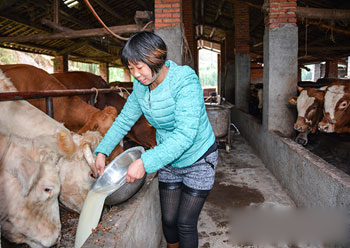
Lei Daigui feeding the cattle
Recently, the reporter came to the Daigui Breeding Farm in Group 5, Tuanbao Village, Guojia Town, where the person in charge, Lei Daigui, was feeding the cattle in the cattle pen.
Lei Daigui pushed a large bucket filled with forage into the cattle pen. Dozens of plump, strong cattle poked their heads out one after another, lowing "moo moo," while several calves only a month or so old bounced around lively.
By this year, Lei Daigui's family had been raising cattle for 6 years, with income rising year after year, and they had also gained some fame in the beef cattle breeding industry in Kaixian and surrounding districts and counties.
Raising the best beef cattle
In 2009, Lei Daigui's family began raising cattle.
"In the past, the whole family relied on working for others to earn money, but working for others means being managed by others, while starting a business means managing yourself." Lei Daigui said that after discussion, the family decided to use their savings from working to develop beef cattle breeding.
"If you raise cattle, raise the best; don't raise those local cattle with poor meat quality and slow growth." Lei Daigui said that before starting to raise cattle, she looked up information online, selected good beef cattle breeds, and then went to surrounding districts and counties or places such as Hebei and Jilin to buy breeding cattle or calves to raise.
"First, choose the best breed; second, choose the cattle with the best growth and health in the group." The task of going out to buy cattle was generally handled by Lei Daigui's father-in-law, Hou Renquan. In order to buy the ideal cows or calves, they were willing to spend money. Apart from building the cattle pen, the family used all their savings to buy cattle.
At first they only raised more than 10 cattle. Now, Lei Daigui's breeding farm has more than 40 commercial cattle and more than 20 cows, mainly beef cattle breeds such as Charolais, Simmental, and Hereford, which grow quickly, have good meat quality, and have a high meat yield. Each year, more than 40 commercial cattle are marketed, and dozens of calves are also sold.
"All the commercial cattle are sold within the county. Compared with surrounding places, the price of beef cattle in Kaixian is the highest, because people in Kaixian love fresh beef and do not mind a slightly higher price." Lei Daigui said that because her family's beef cattle are of good breed and good meat quality, both commercial cattle and calves are in short supply. Not long ago, some breeders from Guang'an in Sichuan and Guizhou bought dozens of calves.
"Commercial cattle fed to about one year old weigh at least 1000 jin. The current market price in Kaixian is 12 yuan/jin. After deducting costs, one cow can earn at least 3000 yuan a year. A calf fed to five or six months can sell for at least 6000 yuan." Lei Daigui said that the annual net income is at least 200,000 yuan.
Clear division of labor for the whole family
Lei Daigui's breeding farm has more than 60 cattle on hand year-round, but they have not hired a single worker.
In order to raise the cattle well, Lei Daigui's family made a clear division of labor. Her father-in-law Hou Renquan is experienced in selecting cattle and is mainly responsible for buying and selling cattle. She and her mother-in-law Cheng Jingju are responsible for feeding the cattle. Her husband Hou Xiangjun is young and strong and is mainly responsible for the physical labor on the farm.
"His main job is carrying cattle manure. This morning alone he carried 11 loads." Lei Daigui said with a smile that raising cattle is simpler than raising pigs or sheep. Processing forage does not take much time. The hardest work is carrying cattle manure. Her husband is responsible for carrying the cattle manure out of the pen every day and dumping it into the biogas digester. The biogas produced can replace at least one canister of liquefied gas a month. After the cattle manure is decomposed, it is carried to the fields to grow king grass, vegetables, or corn for feeding the cattle.
"We have a reasonable division of labor, so raising cattle is relatively easy, and we do not need to hire workers." Lei Daigui said that workers' wages are high now, and hiring workers to raise cattle is not cost-effective. As long as the whole family works together, it is enough. "Of course, family harmony is the key. Harmony brings wealth!"
Providing sufficient forage
When talking about why they chose to raise cattle and what tricks there are in cattle raising, Lei Daigui said that the beef market in Kaixian has always been good, but the overall scale of beef cattle breeding is not large, and it is often in short supply.
"In recent years, the prices of pigs and sheep have risen and fallen from time to time, and the market has not been very stable, while the price of beef cattle has always been relatively high and very stable." Lei Daigui said that in Kaixian there is no worry about selling cattle.
"With a market, as long as the cattle are raised well, there is money to be made." Lei Daigui said that cattle are large livestock with relatively strong adaptability and disease resistance, and are easy to raise. "Actually, the trick is very simple: they must have something to eat."
Having something to eat is enough. It sounds very simple, but it is actually not simple. Lei Daigui explained that although cattle are not picky eaters, they have a large appetite. One cow eats at least 5000 yuan worth of feed a year, so finding enough forage every day to fill dozens of cattle is also a very heavy burden.
"We did not buy special feed. First, the cost is high; second, the beef quality from feeding feed is not as good as from feeding forage and grain." Lei Daigui said that an important reason her family's beef has good quality is that they insist on feeding forage and grain.
"We crush king grass, vegetables, corn stalks, and so on, then mix them with cornmeal to feed." Lei Daigui said that king grass has high yield and high protein content. Now her family has planted more than 8 mu of king grass and also grows some vegetables and corn.
"Of course, what we grow ourselves alone is not enough to feed dozens of cattle." Lei Daigui said that every year when harvesting corn, her father-in-law and husband drive a vehicle to nearby farmers' homes to cut corn stalks. "As long as nearby farmers' homes are close to the road, all their corn stalks are cut by us to feed the cattle."
"As long as the cattle are full, a big problem is solved." Hou Renquan said that another key issue is doing a good job in disease prevention and treatment. As soon as they see cattle with a runny nose or other symptoms, they immediately buy medicine. For some common cattle diseases, he can handle them and generally does not need to call a veterinarian.
"Also, the staff at the town animal husbandry and veterinary station are very responsible. Every month they come to the breeding farm on time to give preventive injections and guide us in carrying out epidemic prevention work." Lei Daigui said that since they began raising cattle, not one of her family's cattle has died from disease.
Expanding scale after renovation
Last year, Lei Daigui participated in micro-enterprise training organized by the county industry and commerce bureau and learned a lot of management experience.
"Later, we invested more than 40,000 yuan to carry out standardized renovation of the breeding farm, bringing the pens, environmental protection, epidemic prevention, and other aspects up to higher requirements." Lei Daigui said that after renovating the breeding farm, she registered a micro-enterprise and therefore also received more than 20,000 yuan in micro-enterprise subsidy.
"More than 20,000 yuan also helped us solve an urgent need." Lei Daigui said that cattle raising requires relatively large capital investment. She had always wanted to expand the scale further, but lacked working capital.
"I hope the government can provide more support in financing for the breeding industry. As long as the capital bottleneck is solved, it will be easy to turn a small enterprise into a big enterprise." Lei Daigui said with a smile. (Reporter Zhou Shurun, text/photos)