Typhoon Melor hits Guangdong, cold wave to be even fiercer tomorrow and the day after
Original headline: 57 cities and counties in Guangdong issue cold warnings; minimum temperatures in the Pearl River Delta to reach 4-10°C tomorrow and the day after
Affected by cold air, 57 cities and counties in Guangdong have issued cold warning signals. The Guangdong Provincial Meteorological Bureau predicts that from the 17th to the 19th, cold air will continue to supplement its influence, most of Guangdong will be clear, cold and dry, most cities and counties in northern Guangdong will see low temperatures of 2-5°C, and high-altitude mountainous areas will see frost and localized freezing. In addition, Typhoon Melor has entered the southern part of the South China Sea, and the sea surface is rough with large waves.
At 17:33 yesterday (the 15th), the Guangzhou Municipal Meteorological Bureau issued the first yellow cold warning signal since the start of winter this year, reminding the public to take precautions against the cold and keep warm. As of 10:35 on the 16th, a total of 56 yellow cold warning signals (daily average temperature maintained below 12°C) were in effect across Guangdong, and Lianzhou in northern Guangdong issued an orange cold warning signal (minimum temperature to drop below 5°C).
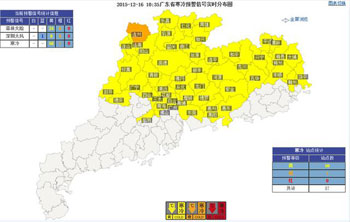
Distribution map of cold warning signals in Guangdong at 10:35 on December 16
This year's No. 27 typhoon Melor (typhoon level) was located at 8 a.m. on the 16th on the sea surface 155 km west-southwest of Manila, Philippines, with maximum winds near its center reaching force 13 (38 m/s).
Cold air is a high-pressure system, and a typhoon is a low-pressure system. As the saying goes, water flows to low places, and wind also blows from high pressure to low pressure. Guided by Typhoon Melor, from the 16th to the 17th, the Taiwan Strait, the northeastern sea surface of the South China Sea and the Bashi Channel will see force 8 to 9 winds with gusts of force 10, and the coastal sea surface of Guangdong will see force 6 to 8 winds.
Surface wind field map at 10:40 on December 16
Affected by the wind and waves at sea, flights between Zhuhai Xiangzhou Wharf and various islands were suspended on December 16. It is expected that Melor will gradually weaken and have no direct impact on China.
Specific forecast:
On the 16th, cities and counties in western Guangdong will be cloudy, while the remaining cities and counties will be mainly sunny.
On the 17th, most areas will be generally sunny, with low temperatures of 2-5°C in cities and counties in northern Guangdong in the morning, 1-2°C in high-altitude mountainous areas, and frost; minimum temperature distribution: 2-6°C in cities and counties in northern Guangdong, 4-10°C in cities and counties in the Pearl River Delta, and 6-11°C in the remaining cities and counties.
On the 18th, most areas will be generally sunny, with low temperatures of 1-4°C in most cities and counties in northern Guangdong in the morning, around -1-0°C in high-altitude mountainous areas, with frost and localized freezing, and low temperatures of around 5°C in cities and counties in northern Pearl River Delta and northeastern Guangdong; minimum temperature distribution: 1-5°C in cities and counties in northern Guangdong, 4-10°C in cities and counties in the Pearl River Delta, and 6-11°C in the remaining cities and counties.
On the 19th, the south will turn from sunny to cloudy, while the remaining cities and counties will be generally sunny, with low temperatures of 3-5°C in most cities and counties in northern Guangdong in the morning, around 2°C in high-altitude mountainous areas, with frost, and low temperatures of around 5°C in cities and counties in northern Pearl River Delta and northeastern Guangdong; minimum temperature distribution: 2-5°C in cities and counties in northern Guangdong, 3-8°C in most cities and counties in the Pearl River Delta, and 6-11°C in the remaining cities and counties.
Weather forecast table for some cities in the Pearl River Delta over the next three days
Agricultural recommendations
According to tips from China Xingnong Network, rain and snow are gradually diminishing, and clear cold weather has spread across most areas. Therefore, the following recommendations are specifically given for vegetable cultivation:
1. Strengthen covering to keep warm and prevent freezing. Open-field vegetables can be covered with straw or shade nets, plastic film, etc., to block frost, raise soil temperature and prevent freezing damage. For example, cover lettuce, spinach, bok choy bolts, red choy sum bolts, celery, garlic, spring cabbage, Chinese cabbage, etc. in the field with greenhouse film or shade nets.
2. In greenhouse vegetable production, first, reinforce the greenhouse to prevent strong winds from lifting the film, and promptly clear accumulated snow to prevent snow from collapsing the greenhouse. Second, small arched tunnels can be added inside the greenhouse, covered with film at night, and straw mats can be placed over the film. Adding plastic film around the lower skirt of the greenhouse as a skirt can reduce the invasion of cold air at the bottom. Third, electric lights can be installed in the greenhouse. On cloudy and snowy days with weak light, turning on the lights in the morning and evening for about 3 hours each to supplement light can increase the temperature inside the greenhouse and also promote photosynthesis in vegetable plants. Fourth, use carbendazim and chlorothalonil smoke agents to prevent disease occurrence. Fifth, after the weather clears, adopt the method of covering with flower curtains, and repeatedly ventilate, then slowly raise the temperature to restore normal growth and prevent flash seedlings caused by sudden temperature rise from strong light.
3. Fertilize and earth up to increase soil temperature. On sunny days, apply warm fertilizers such as cow manure, pig manure or compost to the root zone of vegetables, which can increase soil temperature by 2-3°C. At the same time, before freezing, combine with intertillage to place chopped soil around the root zone of vegetables, which can both loosen the soil and directly protect the root system. The suitable intertillage depth is 7 cm-10 cm.
4. Clear ditches and beds to prevent waterlogging damage. For waterlogged and low-lying vegetable plots, ensure that all ditches are unobstructed. After rain and snow, promptly clear accumulated snow, clear ditches and beds, and drain standing water to prevent a large amount of heat from being absorbed during melting and lowering the temperature, thereby improving root vitality.
5. Control nitrogen and spread ash to improve cold resistance. Before low-temperature freezing damage arrives, spread a layer of plant ash on the vegetable ground, which can prevent cold and freezing, increase nutrients, and also has a good control effect on root rot of cruciferous vegetables.
6. Set up wind barriers to block cold wind. On the north side of the vegetable plot, use crop straw, etc. to weave windbreak barriers 1-1.5 m high to prevent cold wind from directly attacking vegetables and reduce freezing damage.