The industrialization of agriculture is highly controversial; how exactly should it be interpreted?
Original title: Agricultural development: understanding the "industrial way"
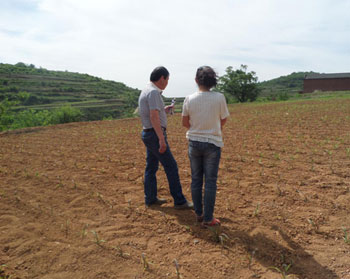
Observation of corn seedling growth in Changzhi County, Shanxi Province (file photo)
Changzhi County is a corn-growing area in Shanxi.
Because no-till methods are used in the cornfields here, planting can be completed in 3 days, and the autumn harvest takes only 3 to 5 days, while the yield per mu has risen from around 300 jin in the past to more than 1,000 jin at present.
After the household contract responsibility system was introduced, each household had very little land, and many farming households felt there was no need to spend the whole year farming, so they returned home only for spring planting and autumn harvest and chose to work elsewhere the rest of the time.
Even in early winter, the figures seen in the fields here are still mostly elderly people.
"This phenomenon is precisely the result of the improvement in China's agricultural productivity," said Zhang Xiaode, director of the Ecological Civilization Research Center at the Chinese Academy of Governance.
Does Chinese agriculture have to follow the American-style model of enterprise-based, capitalized, large-scale farming in order to achieve higher production efficiency? In China, this is still a proposition that requires practice to answer.
It cannot be denied that agricultural modernization is a weak link in China today. On the premise of ensuring food security, an inevitable choice is to accelerate the transformation of agricultural development modes and the pace of technological innovation.
Developing modern agriculture in an industrial way is becoming a new formulation. So how should agriculture draw on industry's experience while avoiding some of its drawbacks?
How to understand and draw on it
Rice-fish farming has a 2,000-year history in China. In Qingtian, Zhejiang, for example, the mutually beneficial symbiosis of rice and fish not only provides abundant and varied food but also helps protect agricultural biodiversity and the farmland ecological environment.
"Only the combination of traditional ecological wisdom and modern science and technology is the direction for modern agricultural development." Min Qingwen, deputy director of the Natural and Cultural Heritage Research Center at the Institute of Geographic Sciences and Natural Resources Research, Chinese Academy of Sciences, emphasized this when interviewed by our reporter.
For this scholar, who is particularly devoted to the protection of agricultural heritage, developing modern agriculture in an industrial way should in essence mean using science and technology from industrial development to equip agriculture and using management methods from industrial development to transform agriculture.
"The economic function of agriculture is often one aspect that people pay more attention to, but agriculture's ecological protection function, cultural inheritance function, and social stability function should not be ignored either," Min Qingwen said.
The reality is that for China, where mountainous areas account for nearly 70% of the country's land area and natural conditions are inherently unfavorable, emphasizing adaptation to local conditions and the diversity of agricultural development modes is undoubtedly a scientific development path.
The essence of traditional agriculture, such as rice-fish symbiosis, agroforestry, mulberry-dike fish ponds, and intercropping, combined with modern information technology, biotechnology, management concepts, and economic methods, and then developed into ecological circular agriculture, will play an important role in realizing agriculture's transformation from "non-point source pollution" to an "ecological barrier."
In Zhang Xiaode's view, the practice of the 30 years of reform has proved that the reason China has maintained many years of sustained grain growth is precisely this model, which saves labor, does not require more full-time agricultural labor, and at the same time can absorb agricultural machinery and agricultural science and technology to the greatest extent and at the greatest cost.
At the same time, quite a few scholars simply reason backward according to the theory of economies of scale, blaming the high cost of rural labor and low efficiency on the smallholder economy based on the family unit.
Regarding drawing on industrial methods to develop agriculture, Zhu Qizhen, director of the Institute of Farmer Studies at China Agricultural University, specially reminded of three points when interviewed by our reporter.
First, the laws of agricultural development must be respected. The most effective agricultural organizational form repeatedly proven by theory and practice is the farming household, not the factory. Farmers working for themselves are more efficient than working for enterprises. Some problems existing in household operation can only be solved through institutional innovation, not at the cost of negating the household operation system.
The way out to overcome the drawbacks of smallholder operation lies in developing family farms. The production of family farms is conducive to drawing on certain industrial methods, such as mechanization, industrialization, and industrial integration.
Second, the industrial mode of agricultural development is mainly reflected before and after agricultural production. Examples include the production, research and development, and sales of agricultural production materials such as the seed industry, chemical fertilizers, agricultural machinery manufacturing, and pesticides, as well as the storage, transportation, processing, and sales of agricultural products.
Third, a complete socialized service system is the most typical manifestation of developing agriculture in an industrial way. Modern agriculture is no longer small and self-contained agriculture. An important development direction is to realize large-scale agricultural operation based on household operation through complete socialized services.
For example, socialized services for agricultural machinery can provide family farms and large contracting households with socialized services such as plowing and harvesting; specialized plant protection organizations can provide farmers with pest and disease control services; and grain storage and transportation services provide farmers with drying, storage, and sales services.
Complete social services for agricultural production embody specialized division of labor and efficient standardized services, and are an important aspect of industry serving agriculture.
Zhu Qizhen believes that the development goals of agriculture and industry are different. What agriculture pursues is not the maximization of producers' interests, but the needs of consumers, that is, the country's agricultural security, and it pursues the sustainable development of agriculture. Agricultural products are not ordinary commodities that can be regulated through the market. "The industrial development mode of agriculture cannot be understood blindly and mechanically."
Existing drawbacks cannot be ignored
Because the industrialized agricultural development mode, which is pro-capital and aims at maximizing agricultural profits, has had a direct effect on the deconstruction of traditional villages and the smallholder economy, and the predatory development of land has also brought problems such as declining soil fertility, land pollution, and food unsafety, the West began reflecting on some drawbacks of industrialized agricultural production methods in the 1980s.
"I oppose developing modern agriculture in an industrialized way." In an interview with reporters, Zhang Xiaode expressed his view bluntly. In fact, what he worries about is precisely the various drawbacks that the industrialized development mode of agriculture is about to bring or has already brought.
In drawing on industrial development methods to develop agriculture, China has made many bold attempts in promoting land transfer and realizing large-scale operation. In Zhu Qizhen's view, much experience has been gained, but many problems have also been exposed.
For example, transferring land for the sake of transfer. In order to complete transfer tasks set by higher authorities, grassroots governments either force farmers to transfer land, artificially creating landless farmers, or induce farmers to transfer land by raising land rents, which greatly increases the cost of agricultural production and makes it difficult for the transferees of cultivated land to engage in agriculture, thereby creating large areas of large-scale abandoned land. The result is harm to agriculture, harm to farmers, and harm to agricultural investors.
Another example is scaling up for the sake of scaling up. As for why agricultural modernization should be pursued or what modernization is, the thinking behind local practices is not clear.
Some places propose that the industrial mode of agriculture means realizing factory-based agricultural production and turning farmers into workers. Their approach is to concentrate land in the hands of industrial and commercial capital, so that farmers can both receive land rent and work on farms for wages.
These practices share one common feature: under the concept of industrialized agricultural development, they exclude farmers' status as the main body of agricultural production, so some people call it a development mode that "wants land but not farmers."