Grain output increase is a great thing, but cost reduction still takes time
Original title: Twelve consecutive years of grain output increase: a joy but also a worry
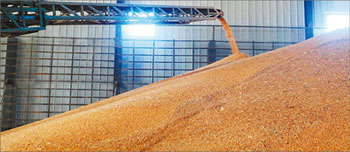
A drying plant in Heihe, Heilongjiang province dries newly harvested corn to ensure the new grain is stored dry. Photo by Wei Jianshun (People's Vision)
Data released by the National Bureau of Statistics on December 8 show that the national total grain output in 2015 was 621.435 million tons, an increase of 14.408 million tons over 2014, up 2.4%. China's grain output has achieved "twelve consecutive years of increase."
"Increasing output is necessary. As a major country, it is still very necessary to maintain self-sufficiency in staple grains," said Dang Guoying, director of the Macro Office of the Rural Development Institute at the Chinese Academy of Social Sciences.
With grain in hand, the heart is not anxious. In the eyes of many people, increased grain output is a great thing.
But Ren Jizhou, an academician of the Chinese Academy of Engineering, believes this is a "tragedy" - "Storing grain beyond the safety coefficient becomes a burden, and 'expensive grain hurts farmers.'"
Similarly, in the view of Zhu Qizhen, director of the Farmers' Issues Research Institute at China Agricultural University, this is "not a good phenomenon. Pursuing continuous output increases while farmers' incomes suffer is unsustainable agriculture."
Behind the high output, what problems actually exist in China's grain production that have triggered such pessimistic views?
Reasons for high output
This year the central government continued to increase support for strengthening agriculture and benefiting farmers, promptly allocating funds for various subsidies including direct grain subsidies and improved seed subsidies for 2015, stabilizing farmers' expectations for grain-growing income. Good weather, together with the support of policy, science and technology, created conditions for this year's grain output increase.
Hou Rui, a senior statistician at the Rural Department of the National Bureau of Statistics, said that the expansion of grain sown area also created foundational conditions for a bumper grain harvest. Data show that in some areas of the Jianghuai region, the reduction in cotton sown area was close to 30%. Nationwide, about 6.7 billion jin of grain was added due to the expansion of sown area, contributing 23.1% to the grain output increase.
Zhu Qizhen told our reporter that the reason for the grain output increase also lies in the fact that imported soybeans occupy a dominant position, while the area planted with domestic soybeans is shrinking, replaced by corn and rice.
In addition, another very important factor lies in the large-scale operation of recent years. Some bosses contracted land and used it predatorily, pursuing short-term high input and high output, which increased land output in a short period.
Unsellable, hard to sustain
At present, a current situation that cannot be ignored is this: imported grain enters the market, while domestic grain enters warehouses.
"Our cost price has no advantage at all compared with the landed price of imported grain. It is hard for farmers to sell grain, the state's burden of storing grain is heavy, and chemical fertilizers and pesticides cause soil and water pollution and food pollution," Ren Jizhou stressed in an interview with our reporter. "This burden can no longer be carried. Agriculture has reached the point where it cannot go on without reform."
Chen Zhangliang, vice chairman of the China Association for Science and Technology, is also deeply worried about this. This year he visited three provinces and eight cities to investigate and found that warehouses were full and the grain could not be sold, while what could be sold was imported grain. The three major staple grains imported from abroad are cheaper than domestic grain. The same is true for bulk agricultural products such as white sugar.
"Ten years ago we were still cheaper than others, and suddenly we are all more expensive than international prices. On the one hand, grain output increases; on the other hand, we can only import. Why has the competitiveness of Chinese agriculture suddenly declined? What has happened to Chinese agriculture?" Chen Zhangliang asked.
In fact, as far as staple grains are concerned, Chinese people do not need so much grain. Ren Jizhou explained that most of the grain consumed in China each year is used as feed, while giving livestock grass is more nutritious and more complete than giving them grain. Feeding livestock with grain is not economical. Chinese people's dietary structure is also changing, that is, more meat, eggs and milk are needed, and the production of meat, eggs and milk requires more support from grass feed.
This year, the Ministry of Agriculture issued a document proposing sustainable development and moderate pilot fallowing.
In Zhu Qizhen's view, on the one hand land is left abandoned, and on the other hand people pursue high input and high output on limited land. This squeezes the land and is an unsustainable agricultural model. A development path of high input of resources such as soil, water, fertilizer and power will lead to mutual damage to both ecology and production. In addition, large areas of abandoned land are also unsustainable.
Abandoning land and fallowing are two different things. Zhu Qizhen explained that fallowing means resting the land and is a process of increasing fertility. When land is abandoned and weeds and trees are allowed to grow, water conservancy facilities are damaged and soil fertility declines.
"Output should be moderate; it is not that the higher the output, the better. There were also problems in development concepts in the past," Zhu Qizhen said.
The structural direction should be adjusted
In Dang Guoying's view, while increasing output, reducing the cost of agricultural production is a challenge, and achievements in this area are insufficient.
Reform of the agricultural structure is urgent. To change the current awkward situation of agricultural development, Ren Jizhou pointed out that China should rely on grassland agriculture and grow more forage crops.
Experts believe that by arranging enough staple grain and using other land for grass-field rotation, the feed gap can be met and the demand for grain will also be greatly reduced. At the same time, water conservancy must be restored. This is not only a matter of understanding, but also a culture. The grassland agriculture system is a modern agricultural system that can satisfy modern people's food structure, take into account both ecology and production, and achieve sustainable development.
This year's No. 1 document also proposed rotation planting of forage grass. In addition, the state has established some demonstration zones for grassland agriculture, but Ren Jizhou believes the intensity is still insufficient, and from the perspective of projects it is also not systematic enough. "The thinking behind the structural reform of grassland agriculture is still not clear."
In Zhu Qizhen's view, in the future land should be given the opportunity to recuperate, and people should not pursue so-called high output before their eyes. Land should be fully used, but also used for reasonable output. We cannot adopt an agricultural operation method that kills the goose to get the eggs, and we must put the principle of sustainable development first in agricultural production.
In the future, agricultural mechanization is an effective means of solving the labor shortage. Zhu Qizhen proposed that not only large agricultural machinery should be developed, but also small machinery suitable for mountainous, hilly and semi-mountainous land. The vast mountainous, semi-mountainous and hilly areas are important production areas for specialty agricultural products. Raising the level of mechanization and land use in these areas is an important aspect of China's agricultural security.
"Breeding should be more localized. It cannot be that the same variety is used everywhere across the country. Differences should be encouraged, and localization, diversification and distinctive features should be highlighted, which is conducive to forming national brands and diversified agriculture and reducing vicious competition in homogeneous agriculture," Zhu Qizhen said.
"Through the promotion of soil testing and formulated fertilization technology, reducing the use of chemical fertilizers and pesticides is also very important." Zhu Qizhen believes that scientific agricultural organization forms should be used to protect cultivated land, achieve sustainable agricultural development, and through institutional safeguards avoid predatory land use, so as to achieve the goals of sufficient quantity, safe quality and reasonable prices in Chinese agriculture. (Our reporter Wang Hui)