How does the Fenlong deep-plowing technology achieve "storing grain in the land and storing grain in technology"?
Original title: Fenlong, helping store grain in the land
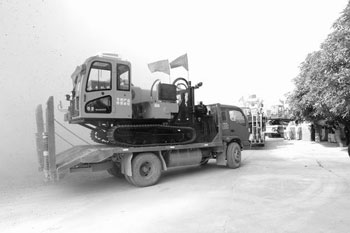
Trucks carrying the first batch of self-propelled Fenlong machines drove out of the factory gate amid the sound of gongs, drums and firecrackers.
Seedling-stage performance of Fenlong-grown yardlong beans versus the control in Binglang Village, Sanya City, Hainan.
Seedling-stage performance of Fenlong-grown winter wheat versus the control in Fuping County, Shaanxi.
On December 12, 2012, the 2015 China Industry-University-Research Cooperation Innovation Conference was held in Kunming, Yunnan. Among the winners of the "2015 China Industry-University-Research Innovation Achievement Award First Prize" was a result led by the Guangxi Academy of Agricultural Sciences, "Invention and Application of Fenlong, a New Farming Method," and this technology had previously also been rated as a "2015 Guangxi Technological Invention Award Second Prize." On December 16, the signing ceremony for the market launch of the first batch of self-propelled Fenlong machines from Guangxi Wufeng Machinery Co., Ltd. was held in Rong County, Guangxi. With the implementation of China's "strategy of storing grain in the land and storing grain in technology," Fenlong technology will play an increasingly important role.
Wei Benhui, a researcher at the Guangxi Academy of Agricultural Sciences and the main inventor of this technology, said in an interview with reporters after winning the award that "storing grain in the land" is an important strategic decision put forward by the Party Central Committee with Xi Jinping as General Secretary for agricultural development during the "13th Five-Year Plan" and for safeguarding food security. To implement this strategy well and do a good job in this major undertaking of land, in addition to strictly controlling the red line of arable land and scientifically regulating land use, there is another very important aspect: how to rely on scientific and technological innovation to transform existing arable land, upgrade fields, turn low-yield land into medium-yield land, medium-yield land into high-yield land, and make high-yield land even more productive. Fenlong technology will have great prospects.
Fenlong technology is attracting more and more attention
Fenlong is a new farming technology different from traditional cultivation methods. Its main innovations include two major aspects: "cultivation methods for dryland crops and rice using Fenlong, and Fenlong cultivation machinery." This has built a new agricultural production technology system. Through deep plowing to vitalize the soil and activate the soil's potential, it allows land and natural resources to deliver maximum productivity in crop growth, achieving scientific, simple, efficient and harmonious development of agricultural production. Fenlong is expected to become a rare new technology that can not only increase yield and improve quality through deep Fenlong plowing of fields, but also improve the ecological environment and benefit the public.
Reporters have long followed the progress of this technology. Six years ago, in Science Times (formerly China Science Daily), reporters first reported on this newly born technology under the title "Fenlong Opens Up a New World for Agricultural Development." Over the past few years, in addition to Guangxi, reporters also traveled south to Hainan and north to Hebei and Liaoning, and west to Ningxia, Gansu and other places to track, investigate and interview, witnessing the role of Fenlong technology in advancing China's grain yield increases and agricultural development.
In 2009, in a Fenlong cultivation trial of Chinese yam in Wuming, Guangxi, the average yield per mu was 3,779.1 kilograms, an increase of 30% over the control.
In 2010, in a Fenlong sugarcane cultivation trial in Guangxi, raw cane increased by 1.02 tons per mu, a yield increase of 27.35%.
In 2011, in a Fenlong rice cultivation trial in Beiliu City, Guangxi, yield per mu increased by 130 kilograms over the control, a yield increase of 23%. In October, in a "Fenlong cultivation of crops in the arid and semi-arid regions of Northwest China" trial in Dingxi, Gansu, the yield of Fenlong-grown potatoes increased by 35.42% over the control.
In 2012, in a Fenlong wheat cultivation trial in Huangchuan County, Henan, yield per mu was 264.4 kilograms, a yield increase of 26.25%.
In 2013, at the National Hybrid Rice Center's Nanfan base in Sanya, Hainan, under high-fertilizer and high-water conditions, the "super-high-yield Fenlong cultivation demonstration of hybrid rice" still increased yield by 6.7%.
The Institute of Agricultural Resources and Regional Planning of the Chinese Academy of Agricultural Sciences found, based on positioned trial yield results for five consecutive years (2011-2015) after Fenlong cultivation in Changtu, Liaoning and Wuqiao, Hebei in 2011, that under the one-crop-per-year spring maize condition in Changtu, Liaoning, average yield increased by 56.9 kilograms per mu each year, a yield increase rate of 10.5%; under the spring maize-winter wheat-summer maize three-crop-in-two-years condition in Wuqiao, Hebei, average yield increased by 110.5 kilograms per mu each year, a yield increase rate of 11.2%.
What is listed here is only part of the acceptance data from trial and demonstration projects. During interviews, an expert once told reporters that it is already quite good for a new technology to increase crop yield by 5%, while Fenlong technology has been trial-demonstrated in 20 provinces, municipalities and autonomous regions across the country, with 20 crops planted, and yield increases of more than 10%, some even as high as 30%. This cannot but amaze people.
However, Fenlong brings not only increased crop yields but also changes in agricultural production models, among which rice cultivation is the most prominent. "Rice, rice, without water there is no rice." Traditional rice cultivation requires one plowing, two harrowings and one leveling, which is labor-intensive and time-consuming, with great labor intensity. Using Fenlong technology, not only can cultivation be completed in one pass on dry soil, but seedlings can also be thrown in the field while wearing shoes; water and fertilizer are reduced, yet yield increases. In July this year, experts measured the yield of rice planted with this technology in Beiliu City, Guangxi, and the average increase was 126.07 kilograms per mu over the control, a yield increase of 25.51%.
Fenlong technology is attracting more and more attention from China's famous agricultural experts.
Yuan Longping, the father of hybrid rice and an academician of the Chinese Academy of Engineering, immediately sent experts to Guangxi for investigation after learning in July 2011 about Fenlong-grown rice, and later allocated special funds to support exploration of Fenlong cultivation at the National Hybrid Rice Center. In 2012, a rice Fenlong trial was carried out on sandy loam fields at the research base in Sanya, Hainan; in 2014, Fenlong rice trial demonstrations were launched in Yuanjiang City and Longhui County, Hunan. In November this year, Yuan Longping also made a special trip in Nanning to inspect Fenlong-grown sugarcane. In July 2014, when reporters interviewed him in Hunan, he spoke highly of Fenlong technology, believing that "this new technology can now be promoted nationwide."
Academicians including Dai Jingrui, Zhao Qiguo, Xie Hua'an and Li Peicheng also successively affirmed and supported this new technology. Academician Liu Xu, vice president of the Chinese Academy of Engineering, believes that this technology "is original and applicable to various crops"; Shan Lun, a dryland agriculture physiologist and ecologist and academician of the Chinese Academy of Engineering, said that Fenlong cultivation "has taken a key step in the reform of cultivation."
Fenlong technology is also receiving more and more attention from national and local leaders. On November 27, 2015, Ma Biao, vice chairman of the National Committee of the Chinese People's Political Consultative Conference, made a special trip in Nanning to inspect Fenlong-grown sugarcane and directionally ecologically cultivated Chinese yam; Peng Qinghua, secretary of the Party Committee of the Guangxi Autonomous Region, made special instructions on the demonstration and promotion of Fenlong machines; Chen Wu, chairman of the autonomous region, visited the Guangxi Academy of Agricultural Sciences not long ago for research and gave encouragement after on-site inspection of Fenlong cultivation and machinery; on November 23, at the national sugarcane mechanization conference held in Chongzuo, Vice Minister of Agriculture Zhang Taolin expressed affirmation after watching a demonstration of self-propelled Fenlong machinery.