Fertilizer use reaches zero growth in 5 years, crops go on a "diet" and move toward moderate prosperity
Original headline: China strives to achieve zero growth in fertilizer use by 2020
Crops cut back on "fertilizer," agriculture becomes more beautiful (New concepts lead new practices)
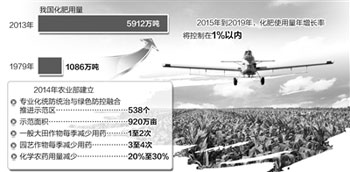
China has proposed the goal of achieving zero growth in the use of chemical fertilizers and pesticides by 2020 (Image source: Economic Daily)
The Fifth Plenary Session proposed: "To adhere to green development, we must uphold the basic national policies of conserving resources and protecting the environment, adhere to sustainable development, firmly follow the path of civilized development featuring developed production, prosperous living standards and a sound ecology, accelerate the building of a resource-conserving and environment-friendly society, form a new pattern of modernization in which humanity and nature develop in harmony, advance the building of a Beautiful China, and make new contributions to global ecological security."
China's grain production achieved another bumper harvest this year, and compared with previous years, this year's harvest carries more "green" significance. Thanks to the zero-growth action on chemical fertilizer and pesticide use carried out by agricultural departments and a series of supporting technical measures, China's fertilizer and pesticide utilization rates both rose steadily this year. The fertilizer utilization rate for the three major grain crops - rice, corn and wheat - was 35.2%, 2.2 percentage points higher than in 2013; urea use was reduced by 1 million tonnes in total, and farmers reduced production input by about 1.8 billion yuan. According to estimates, the reduced fertilizer input was equivalent to cutting nitrogen emissions by 478,000 tonnes and saving 1 million tonnes of coal for burning, and the production approach of heavy irrigation and heavy fertilization is now changing.
Can we get by with less fertilizer?
Wei Shilian, a large-scale grain farmer in Jinchuan Town, Xingan County, Ji'an City, Jiangxi Province, tasted the benefits of using less fertilizer this year. "In the past, fertilizing was a 'single big blast' - just a week after the rice seedlings were transplanted, all the fertilizer was spread at once; this year we switched to applying fertilizer in split doses and delaying application. The first application was only 60%, and the rest was applied in two more doses depending on the situation."
Why make this change?
Wei Shilian sounded like a technical expert, explaining it clearly: "Applying it all at once makes the seedlings grow fast early on, but they lack staying power later; splitting the application reduces the amount of fertilizer used, controls ineffective tillering, and improves the fertilizer utilization rate. Fertilizing this way also helps with pest and disease prevention and control - with fewer ineffective tillers, the ventilation and light conditions in the paddy field improve, and the chances of pests and diseases occurring are somewhat lower."
Old Wei did the math: fertilizing this way can save 30 jin of fertilizer per mu, and also save about 15 yuan on pesticides, amounting to a total cost saving of fifty or sixty yuan. Yao Yigen, director of the Xingan County Agricultural Technology Extension Center, said: "What we are mainly promoting this year is the 'three controls and one reduction' technique, namely controlling soil acidification, controlling the decline in soil fertility, controlling the amount of chemical fertilizer used and reducing the amount of pesticide used, so as to achieve green yield increases."
"I planted 1,000 mu of late rice this year, saved 30 jin of fertilizer per mu, and still added 60 jin of grain - the harvest was really good!" Wei Shilian told the reporter that one should not underestimate those 60 jin of grain: for large-scale growers with big planting areas, even an increase of 5 jin per mu is remarkable.
"A crop is a flower, and it all depends on fertilizer to thrive." Zhang Fusuo, a professor at the College of Resources and Environmental Sciences at China Agricultural University, told the reporter that chemical fertilizer is the "food" of crops, and research shows that its contribution rate to grain yield increases reaches 30%-50%. For example, vegetable crops generally have a short growing period but can yield more than 10,000 jin per mu; without enough fertilizer support, one season of crops would consume nutrients that the soil accumulated over many years, and a bumper harvest would be unimaginable. Therefore, chemical fertilizer must be viewed correctly, and scientific and rational use is the key.
"While recognizing the contributions of chemical fertilizer, we cannot avoid the problems brought by excessive and blind application of chemical fertilizers and pesticides," said Zeng Yande, director of the Department of Crop Production of the Ministry of Agriculture. With resource factors stretched tight, planting returns still relatively low, and the pressure on the environmental carrying capacity constantly increasing, a development model that relies on heavy resource input and environmental consumption can no longer be sustained, and the development model must be changed by vigorously promoting scientific fertilization and pesticide application. Against this background, China proposed the goal of achieving zero growth in both chemical fertilizer and pesticide use by 2020.
Specifically for chemical fertilizer, the zero-growth goal is to raise the fertilizer utilization rate to above 40% by 2020, 7 percentage points higher than in 2013, and strive to achieve zero growth in the amount of chemical fertilizer used on crops. "From 2015 to 2019, we will gradually keep the annual growth rate of chemical fertilizer use within 1%, and strive to achieve zero growth in chemical fertilizer use on major crops by 2020," Zeng Yande said. Reducing "fertilizer" does not simply mean cutting chemical fertilizer, but rather using various measures to subtract irrational fertilization and improve efficiency, which will not affect the security of agricultural product supply.
How big is the gap between China and other countries in fertilizer utilization rate?
So what is the current situation of chemical fertilizer use in China?
Statistics show that the country's annual chemical fertilizer use is more than 58 million tonnes, the highest in the world, while the fertilizer utilization rate is relatively low. Zeng Yande said that internationally, the nitrogen fertilizer use efficiency in the current season is generally used to reflect the fertilizer utilization rate. After chemical fertilizer is applied to the soil, it generally has three destinations: first, it is absorbed by the current season's crops; second, it remains in the soil and, as soil nutrients, can be absorbed and used by the next season's crops; third, it is lost to the atmosphere and water environment. At present, the nitrogen fertilizer utilization rate for grain crops in the United States is roughly 50%, and in major European countries it is roughly 65%, 15-30 percentage points higher than in China.
"China has a relatively large gap with other countries in fertilizer utilization rate, but the reasons must also be analyzed objectively," Zeng Yande said.
The gap first comes from differences in soil fertility. "Most of China's cultivated land is medium- and low-yield farmland, accounting for about 70%. Although the state has strengthened farmland infrastructure construction in recent years, due to industrialization and urbanization, the quality of cultivated land supplemented through the balance of occupied and reclaimed land is relatively poor, generally differing by 2-3 grades. At present, China's basic soil fertility contribution rate is about 50%, 20-30 percentage points lower than developed countries," Zeng Yande said. In China's finest black soil region in the northeast, the organic matter content is now only about 3%, 2 percentage points lower than the soil organic matter content of the "golden corn belt" around the Great Lakes in the central United States and the main corn-producing areas of the Amazon basin in Brazil.
Second is the difference in cropping systems. China's land and other resources are used with high intensity: some places in the south have multiple harvests a year, the Huang-Huai-Hai region has two harvests a year, and only areas north of the Great Wall have one harvest a year. In contrast, countries in Europe and the Americas mostly have one harvest a year, so soil fertility is better maintained.
Third is the difference in crop yield levels. China's national condition of many people and little land has led it to choose increased input to raise per-unit yields. Take rice as an example: China's rice yield per mu is nearly twice that of India, while its fertilization level is 67% higher; its yield per mu is 25% higher than Japan's, while its fertilization level is 30% higher.
Fourth is the difference in tillage and fertilization methods. Countries in Europe and the United States generally have a plow layer of more than 35 cm through deep ploughing and subsoiling and straw return, while in most places in China the plow layer is only 15-20 cm, with poor water- and fertilizer-holding capacity. In European and American countries, grain crops are mainly fertilized by deep mechanical application of chemical fertilizer, and fruits and vegetables mainly use integrated water and fertilizer application, while in some places in China fertilization is still done by surface application, broadcasting or a "single big blast."
Where is the difficulty in reducing chemical fertilizer?
Where is the difficulty in reducing agricultural "fertilizer"?
"The land is getting hungrier and hungrier now. I know using too much chemical fertilizer is not good, but I can't stop. The watermelons I grow yield on average only just over 6,000 jin per mu, and once fertilizer is reduced, the yield will certainly follow it down," said Gong Jinxing, a melon farmer in Jiangguantun Village, Zhaozhaizi Town, Gaotang County, Shandong.
Experts say that scattered household management makes it difficult to promote new techniques. Limited by awareness, capacity and other factors, scattered farming households lack the awareness of scientific fertilization. In addition, China has many types of agricultural products and many planting methods, technical reserves are relatively insufficient, and there are not yet many formula fertilizers and technical package services suitable for different agricultural products. These are the main difficulties facing agricultural "fertilizer" reduction.