Leizhou young man "Xi Gengtian" returns home to grow melons and make money
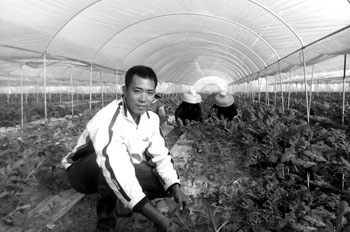
Chen Yuan inspects the growth of off-season watermelons in a greenhouse.
The TV drama "The Story of Xi Gengtian" was once all the rage. It mainly tells the story of a migrant worker named Xi Gengtian who, influenced by the state's policy of enriching farmers, decides to leave the city and return home to farm, and leads his fellow villagers in building a large-scale comprehensive agricultural company. In Shaoshan Village, Fucheng Town, Leizhou City, there is a post-80s college graduate named Chen Yuan, who resolutely gave up a generous salary in the big city to return home and develop high-efficiency agriculture, leading his fellow villagers toward prosperity. "I hope I can become a real-life Xi Gengtian!" Chen Yuan said with a smile when interviewed by our reporter recently.
Giving up city work to return to the "farm gate"
Chen Yuan, 27 this year, is a true son of a farming family. After graduating in 2007, relying on his solid professional knowledge, he found a relatively well-paid "respectable" job in Guangzhou, and many of his fellow villagers looked at him with envy.
Unexpectedly, he was doing smoothly at work, yet he made a baffling decision - to resign and return home. That was during the Spring Festival of 2012. Chen Yuan came home for the holiday and saw some villagers gathered at the small shop, idling away their time. When he asked why, the answer he got was that everyone had nothing to do and was just passing the time.
Shaoshan Village is located in the belly of Leizhou Dongyang. The local people mainly grow two crops of rice a year, and after the late-season harvest enters winter, the farmland is basically left idle. "If the land is not idle, then the people will not be idle either." So, despite his parents' opposition, Chen Yuan resolutely quit his job and returned home to develop agricultural planting.
"At the time, many people did not understand my idea, because for most of us farmers' children, being able to leave home and find our own space for development in the city is truly not easy." Chen Yuan admitted frankly that he is a "second-generation farmer," with his home in the countryside and his roots in the countryside. The vast countryside can also be a place to accomplish something. Leading his fellow villagers toward prosperity through his own practical actions and changing the village's bad habits is also a way to realize his life ideals.
Building a base to develop modern agriculture
Everything is hard at the beginning. Although he came from a farming family, for Chen Yuan, who studied mechatronics, agricultural planting experience was almost a blank slate. In 2012, he contracted 10 mu of farmland to grow cucumbers, rising early and working late every day, devoting himself carefully to managing the melon fields. Just as the cucumbers were about to enter the picking period, a typhoon struck unexpectedly. The sheds in the melon garden collapsed and the vines broke, and all his efforts were washed away.
The first planting attempt ended in failure, but Chen Yuan was not discouraged. In 2013, he scientifically arranged the cucumber planting time, cleverly avoided the typhoon-prone period, and experimented with greenhouse planting, finally achieving a bumper harvest, with more than 4,000 jin of cucumbers harvested per mu and a net profit of more than 50,000 yuan. Having tasted success, he did not stop moving forward. Last year he built steel-framed greenhouses, and the cucumber yield doubled, reaching 8,000 jin per mu.
As for crops such as muskmelons and peppers, Chen Yuan likewise first conducted trial plantings, and only after gaining relevant experience did he plant them on a large scale. Now, he has built a modern agricultural base of nearly 100 mu, carrying out greenhouse off-season melon and vegetable planting. "We all produce according to pollution-free standards and strictly control the use of chemical fertilizers and pesticides. To deal with pests, we spray physical sticky attractant onto plastic bottles and hang them at the top of the greenhouse to trap and kill flies and insects." Chen Yuan said.
This autumn, he contracted 40 mu of farmland in Yingshan Village, Fucheng Town, to grow off-season greenhouse watermelons. "The land rent here is very high, about 3,000 yuan per mu per year. But in order to learn the planting experience of Zhejiang melon farmers, I had to grit my teeth and rent it." Chen Yuan introduced that the off-season greenhouse watermelon planting technique of melon farmers from Taizhou, Zhejiang, occupies a monopoly position nationwide. For more than ten years, large numbers of Taizhou melon farmers have grown watermelons in Leizhou Dongxiyang and achieved relatively good economic returns. In order to "steal the master's skills," Chen Yuan specially rented land in their densely concentrated work area to grow off-season greenhouse watermelons in sync.
During the interview, our reporter found that Chen Yuan's plastic greenhouses are different from others. They all use steel pipes as frames, and the greenhouses are 3 m high and 5 m wide, showing a "tall, big and upscale" quality. This kind of greenhouse was designed by him himself, and the construction cost is high, about 5,000 yuan per mu, but building this kind of greenhouse can improve land utilization, and the space inside the greenhouse is large, which is more conducive to labor and crop growth.
Unchanged original aspiration, willing to bring prosperity to a region
After returning home to start a business for more than three years, Chen Yuan has gradually grown into a new type of modern farmer, but what has never changed is his original aspiration. Every time the base needs workers, he tries as much as possible to hire in the village, so that fellow villagers can work and earn money right at their doorstep.
According to Chen Yuan, his base employs about 8 people per day, and during busy farming seasons it needs more than 30 people. He pays each worker 80 yuan per day, which is a considerable income for villagers who have nothing to do at home. What delights Chen Yuan is that, under his leadership, many villagers in the village have also taken up melon and vegetable planting.
"This spring, more than 30 households in our village planted more than 700 mu of muskmelons, and the economic returns were much higher than growing rice. This strengthened everyone's confidence in developing melon and vegetable planting." Chen Yuan said with considerable comfort that as the melon and vegetable planting area increased, dealers came directly to the field to set up purchasing points, and there was no worry that the harvested melons and vegetables would not sell. And after seeing others make money growing melons and vegetables, other villagers followed suit one after another.
In Chen Yuan's view, Leizhou has a tropical climate, with high temperatures and sufficient sunlight all year round, while Leizhou Dongxiyang is even more a vast expanse of fertile fields, flat and boundless, with unique natural conditions for developing high-efficiency agriculture. "Using greenhouses to grow off-season melons and vegetables gives relatively high yields and can avoid the peak period when traditional melons and vegetables are concentrated on the market, achieving the goal of having what others do not and being better than others where they do. The returns are bound to rise accordingly." Chen Yuan told our reporter that next he will establish a melon and vegetable planting cooperative, explore the development model of "cooperative + farmers + supermarket," and lead more fellow villagers onto the broad road to prosperity through growing melons and vegetables.