IoT Security 863 Project Safeguards Agriculture
Original title: Zheng Lirong: Agricultural IoT Safeguards Food Safety
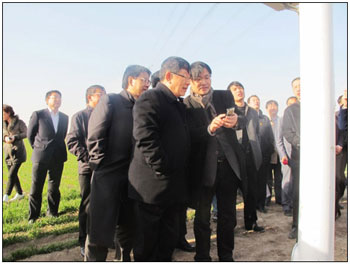
On April 8, 2013, Wan Gang (center), Vice Chairman of the National Committee of the Chinese People's Political Consultative Conference and Minister of Science and Technology, and his delegation inspected the implementation of the "Bohai Granary" project, rural informatization and agricultural IoT construction in Binzhou. During the visit, Zheng Lirong, Dean of the Wuxi Research Institute of Fudan University, reported on-site about the operation and application demonstration of the "Smart Scarecrow" developed by the institute. (Image source: China Science and Technology Network)
On May 7, 2013, staff at the Wudi Core Experimental Zone of the Bohai Granary inspected the "Smart Scarecrow" in the wheat fields. (Image source: China Science and Technology Network)
190 patent applications filed, 75 patents granted; 104 software copyrights obtained, 286 papers accepted/published, 2 monographs published; 325 graduate students and more than 400 practical talents trained; 25 national, local and industry standards submitted...
These are some of the achievements of the 863 Program project "Research on Agricultural IoT and Food Quality and Safety Control System." The project has formed a relatively complete technology and intellectual property system for the national agricultural IoT and food quality and safety control system.
"Building a nationwide interconnected food information traceability IoT platform provides a feasible approach to solving food safety problems," said Zheng Lirong, chief expert of the project and professor at Fudan University.
By studying advanced technologies such as distributed data networks and software-defined systems, researchers built a food safety IoT architecture and application service support platform featuring open services, unified standards, and independently controllable information content; developed open standard API interfaces and modular application sets, and through embedded electronic records and full-dimensional deployment simulation, ensured the openness of the public service platform, the security and credibility of business data, and the scalability of network deployment, reducing network deployment costs; developed parsing services and information traceability service systems oriented to multiple mainstream heterogeneous encodings, achieving data interconnection across heterogeneous networks and laying the technical foundation for building a nationwide unified food safety traceability IoT platform.
At present, the project results have been integrated, demonstrated and applied across platforms and regions in the Yellow River Delta, Yangling in Shaanxi, Inner Mongolia, Jiangsu, Zhejiang and other areas, producing significant ecological, economic and social benefits. In particular, through IoT technology, modern agricultural production has been integrated with food safety, brand building and even financial investment in photovoltaic technology, realizing full-chain value from field to table and from food to health, providing a business model worth promoting for the development of the comprehensive new rural industry. It is reported that these cases are described in detail in the monograph "IoT and Food Safety" recently published by Science Press.
As chief expert, Zheng Lirong has more thoughts on how to conduct scientific management of the project.
"The management function of the project lead unit over the topic undertaking units needs to be strengthened," Zheng Lirong said. At present, the project lead unit lacks an effective constraint mechanism for the participating units of each topic in terms of special fund allocation and financial account management, and there is no dedicated project management funding. Therefore, it is suggested to add a dedicated project management topic, led by the project lead unit with the participation of each topic lead unit, to ensure effective management of the project.
"It is necessary to strengthen exchanges with industry and internationally, and allow fine-tuning of project objectives," Zheng Lirong said. During project implementation, since both the industry itself and international technology are developing, it is possible to combine the opinions of relevant enterprises and experts, and on the premise of not lowering the overall project objectives and task requirements, allow applications to be submitted to the planning field office based on industrial development needs and the current state of domestic and international technology, making appropriate adjustments to certain system functions and indicators in the original plan, so as to better align with the market, improve industry chain solutions, pay in-depth attention to the timely and effective transformation and promotion of technological achievements, and lay a better foundation for the large-scale market application and promotion of the project's scientific research results in the future.
"It is necessary to strengthen the guidance of top-level experts in the planning field," Zheng Lirong said. Agricultural IoT involves interdisciplinary and multi-domain knowledge, and it is necessary to strengthen exchanges and cooperation among multidisciplinary and cross-professional personnel, so that the project research results are feasible and sustainable. Therefore, it is suggested that top-level experts in the planning field hear project reports annually, strengthen communication and contact between experts and the project team, promptly coordinate and plan the promotion and industrialization of project technologies, and jointly promote cooperation with other projects. (Reporter Ma Aiping)