A young couple from Nanchong, Sichuan return to their hometown to start a business farming giant salamanders
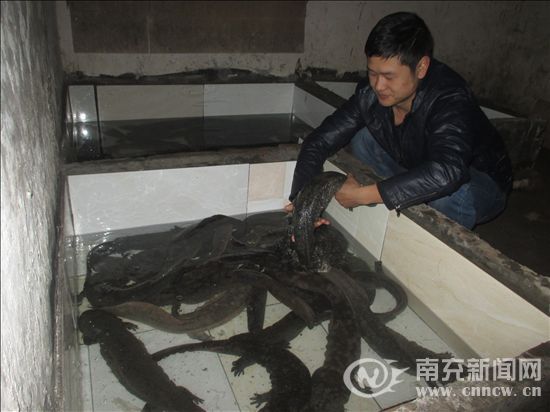
Feng Bing gently lifts a giant salamander from the breeding pond to check its growth
One breeding room, three breeding ponds, nearly a hundred giant salamanders (scientific name: Andrias davidianus)... This is the scene the reporter saw yesterday (the 22nd) at a giant salamander farm in Jialing District. "Giant salamander farming has very high technical requirements, and the selling price is not cheap, mainly targeting mid-to-high-end customers. Few people in Nanchong have ventured into this field," farm owner Feng Bing told the reporter, which is also an important reason why he and his wife Xiao Su founded this farm. Because he invested a large amount of funds into the farm, Feng Bing joked that he was "short of money," but he still looks forward to a bright future.
Farming is not easy: up before dawn and working until dark, changing the spring water twice a day
When the reporter met Feng Bing, he was crouching beside a breeding pond, gently lifting a giant salamander with his hands to check its growth. "From late November each year to March of the following year is the hibernation period for giant salamanders; they do not eat and do not gain weight. Because they often shed their skin, I have to change the fresh spring water twice a day," Feng Bing told the reporter. To be safe, spring water is generally used to farm giant salamanders. During the non-hibernation period, they are fed twice a day, at 6 a.m. and 9 p.m., and the water must be changed before feeding.
"When the fry grow to 5 to 7 cm, my husband buys them for farming. At that time, the water had to be changed every two hours, and red worm larvae were used as feed; the survival rate could reach 80 percent," Xiao Su told the reporter. After half a year, when the giant salamanders grow to more than 18 cm, small fish, small shrimp and small loaches are used as feed, and the survival rate can approach 100 percent. After 4 years, when they grow to about 2 kg, that is the stage when giant salamander meat is at its most delicious and also when sales are best.
When his career hit rock bottom, his fiancee served as his guide
A few years ago, Feng Bing went to Shaanxi to try his luck. After several investigations, he took a liking to the idea of raising chickens, but for various reasons it ultimately ended in failure. "At that time, my career was at a low point, and my fiancee Xiao Su served as my guide, and we began trying to farm giant salamanders. Her family home in Hanzhong, Shaanxi has a long history of giant salamander farming and mature technology," Feng Bing told the reporter. Once he made up his mind, he went to the competent authorities to complete the relevant procedures, learned while doing, and soon mastered the complex farming techniques.
"A giant salamander is all treasure, and its meat is especially delicious; making soup is a very good way to eat it," Xiao Su introduced. The feet and liver are very tasty and nutritious parts of the giant salamander. "There is a long-standing dietary custom when cooking giant salamander - do not kill it with a knife, but scald it with boiling water. This makes the whole body enter a state of congestion, and then it secretes a kind of mucus, which not only has remarkable effects in beauty care, but is also very effective in dealing with knife wounds and gunshot wounds."
"There is also an interesting saying about giant salamanders. From birth to half a year old, if a giant salamander is frightened, it will stop growing once it reaches half a jin," Feng Bing told the reporter. Giant salamanders mature after about 10 years of growth, and artificially raised ones can live for more than 100 years at most.
Looking to the future: starting family-style farming and doing something practical for fellow villagers
"Not long ago, while checking the breeding pond, I found that one giant salamander had white wrinkles all over its body, suspected of having 'vitiligo.' I quickly took it out and kept it alone in a basin, but unexpectedly several others also showed similar symptoms," Feng Bing said. At the time he was truly startled. After draining the water, he spread medicine over all the fish in the pond for disinfection and thoroughly cleaned the breeding pond before the situation was prevented from causing greater losses.
"Giant salamanders have weak resistance to disease. Once infected, if disinfection is not timely, they can easily die," Feng Bing introduced. The normal body colors of giant salamanders are black, white-yellow and dark yellow; most other body colors are signs of illness. Normally, giant salamanders can only be fed live food, otherwise they are prone to respiratory infections or anorexia. Foot and head ringworm is the disease that giant salamanders are most susceptible to and that causes relatively great harm, and it spreads between the fish through the air. "Farmers are generally not allowed to enter another household's breeding room, much less touch another person's breeding pond or giant salamanders with their hands, to avoid spreading foot and head ringworm," Feng Bing told the reporter.
"After the steel-frame shed breeding base is built, I will move all the fish over, hire workers for family-style farming, and also do something practical for my fellow villagers," Feng Bing said. When talking about his future plans, Feng Bing was full of hope, "If you are eager to learn and dare to take risks, there will always be a way out. As long as you have a dream, you must act on it, otherwise it will always remain just a dream."