Wang Haizhi of Jinhua, Zhejiang: A Post-85s Entrepreneur Raising Loaches to Build His Dream
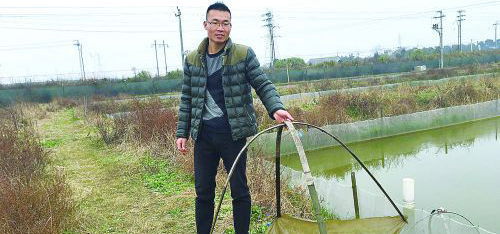
Wang Haizhi at his loach pond
Profile
Name: Wang Haizhi
Entrepreneurial team: Qiuhai Family Farm in Wucheng District
Entrepreneurial field: Ecological agriculture
Entrepreneurial dream: Ecological safety, a taste of the wild
Entrepreneurial goal: To build China's number one loach breeding enterprise and produce China's best loach fry
Entrepreneurial motto: Strive to be a qualified new farmer
At the intersection of Baitang Xiaxian and Haosen Road in Wucheng District, Jinhua City, Zhejiang, there is a quiet farm where the splashing of loaches leaping at the water's surface can occasionally be heard from the ponds. By the pond stands a tall, slender figure observing the water quality and the growth of the loaches.
He is the founder of Qiuhai Family Farm in Wucheng District, a young man from Jinhua born in 1987 named Wang Haizhi. This young man, who grew up in the city without any agricultural background, chose to venture into agriculture. Two years later, he has his own farm with an annual output value of 1.8 million yuan. His loach fry breeding technology ranks among the best in the country, and he even offers training courses for farmers who come from various places.
Taking an Unconventional Path to Entrepreneurship
Wearing glasses, Wang Haizhi appears gentle and shy. But he says he is now a farmer through and through.
After graduating from junior college, Wang Haizhi changed jobs many times - car sales, taxi company management, writing copy for others - all in office buildings sheltered from the elements. He says he has the restlessness and impulsiveness of the post-85s generation, but also their passion and persistence. Unwilling to settle for mediocrity, he chose to start his own business.
When people generally talk about post-85s entrepreneurship, they think of e-commerce, information technology, or the restaurant and clothing industries. Wang Haizhi's parents once suggested he open a shop in the city selling fruit or general merchandise, but he insisted on taking an unconventional path, diving headfirst into the countryside.
Why choose agriculture? Wang Haizhi says: "Most young people think farming is undignified, has no future, and is too hard. But I feel agriculture is changing. It has a broad scope and a large market, enough for an individual to develop."
Through on-site investigation and analysis, Wang Haizhi decided to specialize in loach breeding and farming. He found that loach prices have been relatively stable year-round, with no worry about finding buyers. If he could hatch and breed loach fry himself, he could also greatly reduce farming costs. Currently, no enterprise in China has fully mature loach breeding technology - loach fry cultivation is a recognized challenge in the aquaculture industry. This allowed him to sniff out a business opportunity and see prospects.
At the beginning, Wang Haizhi knew nothing about the trade. Upon learning that Anhui, Jiangsu, Guangzhou and other places offered specialized loach hatching and breeding courses, he traveled city by city to study, covering nearly half of China.
In 2012, after completing his studies, Wang Haizhi raised 300,000 yuan in capital and set up his first farm in Bailongqiao Town, Wucheng District, covering about 15 mu. The hardships of starting out are now difficult to put into words. Due to lack of experience and improper handling, he once caused the death of over 2 million eggs, suffering heavy losses. He also encountered the strange phenomenon of bred loach fry disappearing entirely after being placed in ponds for just over 10 days. He tried repeatedly despite failures, never losing heart. All the rough work, heavy work, and delicate work - Wang Haizhi did it all himself.
This plot of over 60 mu near Baitang Xiaxian is the second loach breeding base Wang Haizhi has invested in and built. In addition to breeding loach fry, his farm now features ponds that integrate earthworms, loaches, and rice field eels with environmental ecological restoration, as well as aquatic plants such as water caltrop and lotus roots. This is his exploration of a new model of energy conservation and emission reduction through three-dimensional farming. In the past two years, the farm has turned losses into profits.
"Digging for Gold" in the Mud Pond with Great Prospects
Now, Wang Haizhi has not only found his own path to prosperity but has also opened training classes to teach fry breeding and farming techniques, helping dozens of nearby farming households get rich together. He proudly says that the complete set of techniques he has mastered can greatly improve the breeding success rate. Currently, his yield of one-inch fry can reach 300,000 per mu, with a market price of 800 yuan per 10,000 fry. They can grow into one-inch fry ready for sale in 1.5 months. Two to three batches can be produced per year.
Wang Haizhi is very optimistic about the market prospects for loaches. He told reporters that loaches are delicious and nutritious, high in protein and low in fat, and can help lower blood lipids and blood pressure. They are both a delicacy and a food for the masses, long enjoying the reputation of "turtle dove in the sky, loach on the ground" and "ginseng of the water."
He says that due to changes in farming methods, wild loach production has sharply declined. Loach farming is a new industry, and in Jinhua, his is currently the only enterprise-scale operation. Domestic market demand for loaches reaches 300,000 to 400,000 tons per year, but the market can only supply 200,000 to 250,000 tons - a huge shortfall that has driven market prices up year after year. Currently in Jinhua's markets and supermarkets, ordinary local green loaches sell for 50 to 60 yuan per kilogram. International market demand for Chinese loaches is also rising year by year, with orders increasing annually, especially from South Korea, which has the largest demand.
Next, Wang Haizhi plans to plant fruit trees around the loach ponds and offer recreational activities such as fishing, barbecuing, and catching loaches. In the near future, he also wants to create an industrial chain integrating loach breeding, farming, and deep processing. He wants to open a loach experience store in the city where residents can see live loaches growing, watch the breeding process through live video, showcase the "ecologically safe, taste of the wild" farming process, and add a tasting area. Since loaches are small and troublesome to clean, some people don't buy them regularly to cook at home. To address this shortcoming, he also plans to gut the loaches, vacuum-package them, and bring them to market.