Giving up a high income to return home and develop farming to help villagers get rich
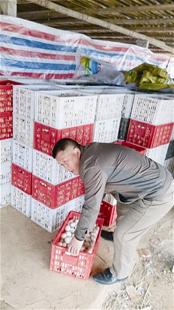
Chen Shimin carrying the duck eggs collected that day
On one side is the beautiful vision of leading fellow villagers out of poverty toward prosperity; on the other is the funding bottleneck encountered in expanding the scale of the business. Facing both his dream and his confusion, 42-year-old Chen Shimin, a villager from Zoumagang Village, Tiemengang Township, Macheng City, still sticks to the choice he made back then: he has always firmly believed that the path of poverty alleviation through industry is a broad one, and he does not regret giving up his thriving business in a southern city to return home and start a business.
Giving up generous pay to return home and start a farming business
Six years ago, seeing that his hometown, with its mountains and water, was still not prosperous, Chen Shimin gave up his high income from contracting a university cafeteria in Guangdong and returned home to contract the township's Shaqiu Reservoir and the adjacent Liyuan Mountain.
At that time, the grass here was taller than a person, and there was no road, no electricity and no water. It was a stretch of barren slope. "Five or six bosses came before, and every one of them left as soon as they saw it. In the end, almost no one was willing to come again," said Lu Chuanfu, Party secretary of Zhouqian Village.
After careful investigation and analysis, Chen Shimin found that this barren slope and barren water had great development potential. "The water source is good, the water area is large, and it is suitable for farming and for developing ecological agriculture."
To develop it, he first had to clear the wasteland. After making up his mind and signing the contract, a movement to "transform" the "barren slope and barren water" thus began.
Building houses, putting up sheds, repairing roads, reinforcing the reservoir, connecting water and electricity... He set to work as soon as he decided. After two years of effort, he led his family in turning a stretch of "grassland" into a "treasure bowl": the high places were cut down, the low places were filled up, the weeds were removed, the "grass slope" was opened up into "planting land," and the "barren water" was transformed into a "golden pond." "Clearing wasteland is not only hard work, it also takes money to pave the way. I spent more than 600,000 on road repair alone." In this way, after "using up millions in savings and wearing off several layers of skin," he initially established a farming base.
In 2012, he began raising fish and ducks and began to see returns, with annual output value reaching 300,000 yuan. Later, he also began raising cattle and sheep, and the scale expanded further. Today, he raises more than 23,000 ducks alone, as well as over a hundred cattle and sheep, with annual output value reaching 1.8 million yuan. "At peak times, I can collect forty or fifty baskets of duck eggs in a single day."
Gradually expanding the scale to lead villagers to prosperity together
"Being rich alone does not count as being rich; only when everyone is rich does it count as being rich." Chen Shimin has always kept this saying firmly in mind. Whenever any family has difficulties, he always finds a way to help and insists on giving the greatest possible benefits to his fellow villagers.
Helping the poor and the weak is Chen Shimin's first goal. As the scale gradually expanded, the farming base needed more and more workers, and he left most of the opportunities to "poor households" and "sick and weak households." "More than 10 people in the village have already been working here year-round, all from families that are not very well off. At peak times, the number of people employed here reaches more than 50," Lu Chuanfu said.
Li Huaxiang is a villager from a village near the farming base. Her family has elders above and children below, and she always worried about going out to work. After coming to work at Chen Shimin's farming base, all her problems were solved. "I used to work in Wuhan and earned only more than 2,000 yuan a month. Now I work here and can earn three or four thousand yuan a month. Not only do I earn more than before, I can also take care of my family. I really thank Boss Chen." As she chatted, Li Huaxiang's gratitude was evident in her words.
To further increase the momentum of poverty alleviation, since the beginning of this year Chen Shimin has been cooperating with the village to promote the "company + farmers" model, calling on farmers to "share in dividends by investing" or "share in dividends by fostering livestock." "Villagers can invest and share in the company's dividends, or they can raise cattle on my behalf. I pay a 'fostering fee' of 1,500 yuan per head per year. The more they raise, the more they earn." In this regard, Lu Chuanfu said this is a good opportunity to get rich and a good practice for promoting "targeted poverty alleviation" and advancing "poverty alleviation for all."
Looking out across Chen Shimin's farming base, ducks splash freely in the water, and cattle and sheep leisurely graze on dry grass. It already looks somewhat like an "ecological farm."
Planning to build an ecological agriculture demonstration site and hoping for financial support
Chen Shimin wants to turn this place into an agriculture, forestry, fishery and livestock entrepreneurship park: raising chickens, cattle and sheep in the mountain forest, raising fish and ducks in the water, and planting rice in the fields, promoting a three-dimensional planting and breeding model so that more villagers can become prosperous. "Look at this reservoir. The water quality is good and it looks lovely. It would be a pity to only raise fish here. I plan to open a fishing park in the southeast corner and build a farmstead. The shed north of the reservoir is a duck house, and its current breeding capacity is nearly 20,000 ducks. In the forest land behind it, more than a dozen pig houses will soon be put up. I plan to push toward a breeding scale of 10,000 pigs. That open plot in the northwest corner will be used to grow organic vegetables, fruit and rice." Chen Shimin said as he walked along.
Chen Shimin's development direction is very clear: make full use of the reservoir and forest land resources and follow an ecological agriculture model of green, circular and low-carbon development. Ducks and azolla are raised in the rice fields; duck manure and azolla become fertilizer for the rice, and the ducks eat insects in the rice fields. Pig manure and duck manure produce biogas for use by the company and surrounding farming households. Biogas slurry and biogas residue are used to raise fish, and the mud in the reservoir is used as fertilizer for fruit and vegetables. When tourists come, they not only have food, entertainment and lodging, but when they leave they can also pick some vegetables and fruit with their own hands and take them away.
But the reality is that Chen Shimin has already invested 3.8 million yuan to build this farming base. Under the situation of increasing downward economic pressure, his working capital is stretched thin, and he has difficulty even maintaining development, let alone further increasing investment. "If the funds can be secured, I will step by step build the farming base into a demonstration site for ecological sightseeing agriculture. By then, people will be able to stay, play and eat here, and it will definitely attract more people to come and experience life here." As he spoke, Chen Shimin was full of confidence. He said that livestock farming and ecological agriculture have good prospects for development, and that he has already submitted applications to the government and financial departments respectively, hoping to receive financial support.