A "road to prosperity" flower blooms in his hometown: Chen Jun forges a path to wealth by growing flowers
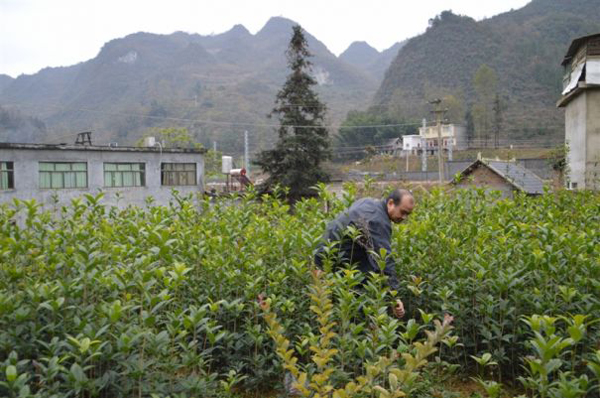
Chen Jun pruning osmanthus seedlings at the base
In Longchang Village, Lao'aba Township, Nayong County, there is such a person: he gave up his life as a boss in Nayong County town and even in Guiyang, and resolutely decided to return to his old home of Longchang Village, turning old houses that had been idle for years into a farmhouse restaurant and planting economic forest on his long-abandoned private plot. This made him an "oddity" in the eyes of the villagers. He is Chen Jun.
In the three years since returning home, through his own efforts, his farmhouse restaurant has basically taken shape, and the economic forest is beginning to take form. As his next step, he will take the farmhouse restaurant as the center, vigorously develop planting and breeding industries, and use the professional cooperative he has already established to lead the villagers to get rich together and strive for a moderately prosperous life.
Rich but not showy
Never forgetting to give back to society
In 2003, Chen Jun left his old home of Longchang Village and came to Nayong County town to make a living. When he first arrived in Nayong, he mainly did small business, and later running a general merchandise store earned him his first pot of gold in life. Because he had experience running a general merchandise store, he wanted to start his own company, shipping semi-finished products made in Zhejiang back to Nayong, such as dishwashing liquid, laundry detergent, and soap, and then processing and selling them.
Although Chen Jun's idea was good, because the environmental protection procedures for this project were not approved, the idea of starting a company was forced to be declared "bankrupt." In 2009, Chen Jun left Nayong and came to Guiyang, where he smoothly opened a daily necessities sales company, and business was booming. He also became the "big boss" of Longchang Village.
Chen Jun spent more than ten years making his way outside. Although he earned quite a lot of money and became a "wealthy man" in the eyes of his fellow villagers, even with money he never forgot to give back to society.
"I've made some money doing business outside for so many years, and I just wanted to do something for my hometown, even if it is insignificant, but looking back I feel very gratified," Chen Jun said.
During the years he was doing business, almost every Double Ninth Festival, Chen Jun would go to the Lao'aba Nursing Home to visit the elderly, each time bringing 3,000 to 4,000 yuan worth of rice, meat, white sugar and other daily necessities. He also donated a total of 90 sets of desks and chairs at 90 yuan per set to Longchang Primary School, and brought students schoolbags, pens and other school supplies. In 2007, he provided more than 20 tons of fertilizer to Longchang Village, and asked the Lao'aba Township government to survey the villagers of Longchang Village, with the fertilizer distributed to people whose families were in difficult circumstances.
Hard entrepreneurship
Effort finally shows results
In 2013, after learning that a railway was going to be built in his old home of Longchang Village, Chen Jun unhesitatingly chose to return home and joined the great "wave" of returning-home entrepreneurs.
Returning to his old home, everything had to start over, and pressures and difficulties from all sides came one after another, but Chen Jun did not flinch because of this. He first tidied up the old houses, then bought out more than 3 mu of land around his house at a price of 28,800 yuan per mu, and then spent more than 100,000 yuan building courtyard walls. Just like that, the sign "Chen Laosan Farmhouse Restaurant" was put up at the gate of his courtyard wall.
The farmhouse restaurant has already taken initial shape and can bring in a certain income, but the customer base is still relatively small, mainly workers building the railway and leaders who come to visit and give guidance at the railway station. "Since the house used to open the farmhouse restaurant and some of the ingredients needed are all from my own home, expenses are relatively low, and in a year I can earn more than 30,000 yuan," Chen Jun said with a smile. But no matter how much money the farmhouse restaurant can earn, for Chen Jun it is a good thing, at least it can provide financial support for him to develop other industries.
While opening the farmhouse restaurant, Chen Jun also developed planting and breeding industries. Breeding is mainly based on raising chickens, ducks and fish, but it has not yet reached scale. In terms of planting, so far more than 4 mu of osmanthus have been transplanted, with more than 10,000 osmanthus seedlings successfully grown and more than 3,000 ginkgo seedlings.
Integrating resources
Developing a distinctive farmhouse restaurant
In the two years since Chen Jun returned home, he has been named a leader in getting rich in Lao'ao Township, a farmer lecturer, and has served as vice president of the Nayong County Food Safety Association. In order to better lead the villagers to prosperity, Chen Jun established the Nayong County Ecological Breeding Professional Cooperative, using the cooperative to let more people participate in industrial development.
Chen Jun's more than 10,000 osmanthus seedlings and more than 3,000 ginkgo seedlings would require a great deal of manpower, material resources and financial resources if transplanted. Chen Jun had long had a plan in mind to solve this problem. "One person being rich is not called being rich; only when the whole village becomes rich is it called being rich. After the osmanthus seedlings can be transplanted, I plan to let other farming households participate. They contribute the land, and then we share the profits. Ten years from now the osmanthus trees will bring returns. If one osmanthus tree is calculated at producing one jin, and the market price is 800 yuan per jin, if all survive, in a year it can bring in more than 8 million yuan. This will be a considerable income," Chen Jun said.
"Relying on the railway station and freight station, with convenient transportation and a large floating population, we will integrate resources and develop ecological breeding, ecological planting and ecological tourism, thereby driving the development of the farmhouse restaurant." As we left Chen Jun's home, he introduced his plans to the reporter one by one, and his thinking was very clear.