Danyang Rice Tycoon's High Yields All Thanks to a Local Expert
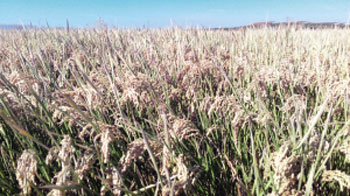
The rice ears in the field plot guided by Ma Suobao are extremely dense.
Patent acceptance notice.
With the autumn harvest over, Ma Suobao, who lives in Xinggong Tangxiang Village, Yanling Town, Danyang City, is overjoyed. That is because, following the "new technique" he developed, the rice grown by villagers reached a yield of over 650 kg per mu, at least 50 kg more than fields planted using traditional methods. Keep in mind this was sown only after the floods (July 3), more than half a month later than in a normal year.
Ma Suobao, now 61 years old, worked out his new rice-growing method 3 years ago. After trial planting by himself and his neighbors, it not only produced high yields but also required less chemical fertilizer and pesticide, and the rice quality was good. In June this year, he filed a patent application for his "Dryland and Paddy Direct-Seeding Cultivation Method for Rice."
In the Busy Season
While Others Transplant Seedlings, He Rolls Them
A few days ago, when reporters visited Xinggong Tangxiang Village in Yanling Town, they saw that the field plot where Ma Suobao serves as technical advisor had rice growing vigorously, with abundant and dense ears, no weeds visible in the field, and thick, sturdy stalks, while rice in nearby plots had lodged in patches.
"These rice plants were sown late. If they had been sown at the right time, they would be growing even better!" said Ma Qiugui, a 74-year-old farmer from the village who strolled over along the field ridge. Last year, he used the method taught by Old Ma and achieved a yield of 730 kg per mu. "High yield, no weeds, and you can save thirty to forty jin of chemical fertilizer per mu. Old Ma's technique clearly has advantages."
Reporters learned that the direct-seeding method invented by Ma Suobao includes the steps of deep plowing the previous crop's straw, soaking seeds to promote germination, sparse sowing to grow strong seedlings, field cultivation, and field management. The field cultivation step is the most unusual: when the seedlings grow to the four-leaf-one-heart stage, apply 25-30 kg of 40%-50% high-concentration compound fertilizer per mu, then use a rotary tiller to roll the seedlings into rows (first rolling crosswise once, and after a week when the soil has set, rolling lengthwise once), retaining 25%-35% of the seedlings to continue growing.
"The anti-slip wheels of a small rotary tiller are about 14 cm wide. During the rolling process, the squeezing by the anti-slip wheels causes the seedling roots to move to varying degrees, equivalent to traditional transplanting. This greatly reduces labor while avoiding the root damage caused by traditional rice transplanting, promoting good rice growth. The 65%-75% of seedlings rolled into the soil can directly serve as organic fertilizer. At the same time, the rolling improves the aeration of the seedling field and carries the applied fertilizer into the soil, promoting the rice's absorption and utilization," Ma Suobao explained.
Another special feature of the direct-seeding technique is that the field is kept at a deep water level throughout, only draining water in the late grain-filling stage. Ma Suobao said the benefits are: weeds do not easily grow in the field, so no herbicide needs to be sprayed, because the deep water deprives small weeds of oxygen and makes it hard for them to grow, while the rice tillers early and "drowns" the larger weeds; the rice grows quickly and is well nourished. In addition, by controlling the timing and amount of fertilizer application, the use of chemical fertilizer and pesticide is reduced, so the rice has high yields, glossy grain quality, and relatively good taste.
Keen on Figuring Things Out
High Yields in Wheat and Rapeseed Too
Ma Suobao, who returned to farming after graduating from junior high school, has been obsessed with studying and researching agricultural planting techniques for many years. He said that out of 365 days a year, he spends 300 days pondering farming. In 1990, when selling hybrid rice, the grain management office said after inspection that his rice was "special-grade rice." In 1998, while driving a transport truck at a construction site in Danyang, he brought wheat seeds to the site to sprout them in order to research high-yield wheat techniques.
As the rice harvest period gradually delays, wheat in the Jiangnan region suffers yield losses due to late sowing. Thanks to his seed-soaking and germination technique, Ma Suobao advanced the wheat growing period by one month. Similarly, in the twelfth lunar month he used farm machinery to "open furrows" in the wheat field, controlled "large ear formation" through precisely timed fertilization, and prevented wheat from getting fusarium head blight... As a result, the wheat he grows reaches a yield of 425 kg to 450 kg per mu, while wheat grown without this technique yields only 350 kg per mu.
Ma Suobao also has a "knack" for growing rapeseed: he uses the "sparse planting method," controlling row spacing and plant spacing; while others scatter chemical fertilizer in the field, he dissolves it in water and pours it on; while others need to water 3 times for seedlings to survive, he needs only one watering... In recent years, his rapeseed yields have all been above 300 kg. "In 2013, I planted over 6 mu of rapeseed and harvested over 4,000 jin of seeds. That is extremely rare."
Ma Suobao also clearly remembers that earlier, when he first drove a tractor to roll the seedlings, the operator said nervously, "The villagers are going to call us crazy." A grain tycoon mocked him, saying "his brain is no good." His mother also chased after him scolding, "Why are you rolling good seedlings to death?" Now, many villagers, seeing that it truly increases yields, have turned from doubt to belief and are coming to ask him for advice. Last autumn, after seeing his direct-seeding method, agricultural technicians from the Danyang City Agriculture Committee also agreed it was indeed good, estimating a yield of no less than 700 kg.
After this year's land transfer, Ma Suobao no longer farms himself but serves as a professional "technical advisor," responsible for guiding the cultivation of over 170 mu of farmland for 3 grain tycoons. Not long ago, Xu Fatang and several other grain tycoons, who have contracted nearly 600 mu of farmland in townships such as Baoyan in Dantu and Yanling in Danyang, made a special trip to "seek his expertise." After an on-site inspection, Xu Fatang said with emotion that this "local expert" has put his heart and soul into it. He has farmed for over 30 years and feels ashamed he cannot compare. Next year he plans to promote Master Ma's technique.