Ostrich eggs sell for 150 yuan each: a post-90s couple in Yunyang District raise ostriches deep in the mountains
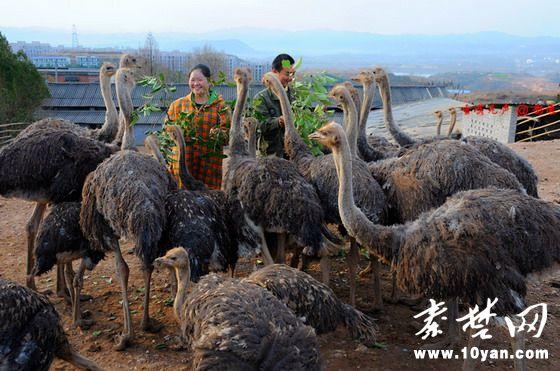
Deep in the mountains of Muchanggou in Chengguan Town, Yunyang District, a post-90s couple has set up an ostrich farm. The two spend their days in the company of ostriches, watching over their dream.
Raising ostriches for the first time: more than 20 died in one night
"Don't fight, don't fight, there's enough for everyone!" On the morning of the 18th, on the mountainside of Muchanggou in Chengguan Town, Yunyang District, two young people fed fresh grass to dozens of ostriches, each taller than a person, while chatting with the birds.
The couple are Yu Xiang and Zou Fangru, both 21 this year, one from Qingqu Town in Yunyang District and the other from Chengguan Town. They met in elementary school, fell in love after graduating from vocational school, and married in November this year.
While most young people rush off to big cities to make a living, why did this post-90s couple choose to raise ostriches deep in the mountains? Yu Xiang said he has loved animals since childhood and often followed various farming information online.
Earlier this year, by chance, Yu Xiang learned that raising ostriches could be profitable, so he drove to an ostrich breeding base in Xi'an, where he studied for free for more than a month. Then he scraped together 60,000 yuan and bought 55 young ostriches from this base, transporting them to his hometown of Hongmenpu Village in Qingqu Town to raise.
"My parents were strongly opposed at first, but seeing how confident Yu Xiang was, they gradually came around to supporting us," said his wife Zou Fangru. Ostriches like a well-ventilated, dry environment. More than a month ago, because the farm was damp and it rained, more than 20 ostriches died overnight, which devastated them.
The couple dried their tears and found a plot on the mountainside of Muchanggou in Chengguan Town, Yunyang District. After leveling it, they fenced it in with bamboo poles and rented more than ten mu of nearby land to plant fresh grass for feeding the ostriches.
In the company of ostriches: the couple is tired but happy
On the morning of the 18th, at the ostrich farm, the reporter saw that the largest of these ostriches was more than two meters tall, and the smallest was more than 1 meter tall, with legs more than ten cm in diameter. When Zou Fangru was seen holding fresh grass, the ostriches rushed over in a flock and surrounded her.
Standing outside the fence, the reporter tried to stroke an ostrich with his hand, but it suddenly stretched out its neck and nearly pecked the reporter's hand.
"Ostriches are very strong. With strangers, besides attacking with their beaks, they can also knock a person down. Now that we know each other well, we've become good friends." Zou Fangru smiled as she stroked an ostrich's neck. At first, her face was attacked by an ostrich, but over time, as soon as this group of ostriches sees Zou Fangru and her husband, they run over and circle around them.
"Ostriches are afraid of the cold at night, so the lights must be kept on in the pen, and sometimes we have to get up in the middle of the night to check on them," Yu Xiang said. Staying with his wife deep in the mountains and in the company of ostriches, though very tiring, makes him quite happy inside.
Optimistic about the Shiyan market: carving out a place of their own
"We mainly feed them bran, corn and fresh grass every day," Yu Xiang said. In a single day, fresh grass alone takes more than 100 kg, all hauled by vehicle from Qingqu. In addition, they have to buy other food to feed the ostriches, which costs hundreds of yuan a day. So far, they have invested 120,000 yuan.
"When we bought them, each ostrich weighed only two or three jin, about the size of a chicken. After more than half a year of feeding, the biggest has grown to more than 60 kg, and the smaller ones weigh more than 20 kg," Yu Xiang said. The ostrich growth cycle is two and a half years, and by 2017 this batch of ostriches will be able to lay eggs.
"Ostrich eggs are ivory white, about 15 cm wide and about 25 cm long, averaging 3.5 jin each. One ostrich can lay an average of 80 eggs a year, and each egg sells for 150 yuan, which is a sizable income," Yu Xiang said. He plans to bring in another batch of chicks after the New Year to expand the scale of the farm. "Soon I will go to places with mature practices, such as Hebei, to inspect and learn."
"Ostrich meat is fairly tender and tasty. If any restaurant is willing to buy, we can sell it too," Zou Fangru said. In addition, ostrich manure can also be used as fertilizer.
That morning, several businesspeople drove to the farm to learn about the situation. Some said they wanted to learn ostrich farming from Yu Xiang and his wife, and others wanted to buy a few ostriches to place at the entrance of their hotels for display.
"Young people definitely have to venture out. As long as you work hard, you will succeed," Yu Xiang said. He and his wife plan to stay deep in the mountains for the long term. Although conditions are rather hard, the effort is worth it, "because I believe that developing ostrich farming in Shiyan has very good market prospects."