Sturgeon King Lan Zeqiao: A Legend of Hubei's Aquaculture Industry
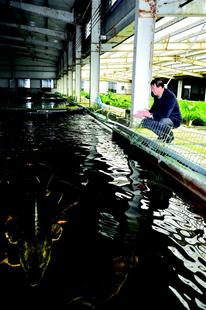
Pictured: Lan Zeqiao gazing affectionately at the miraculous sturgeon.
The sturgeon, an ancient species, a miraculous fish. Lan Zeqiao, a legendary figure in Hubei's aquaculture industry, a leading figure in China's fishery enterprises.
When Lan Zeqiao met the sturgeon, it was destined that an extraordinary story would unfold.
After 7 years of hardship, the Tianxia sturgeon farming model that Lan Zeqiao painstakingly pioneered began to attract attention from all walks of life.
A legendary man
Lan Zeqiao, 63 years old this year, dresses simply, lives frugally, and speaks plainly. At first glance, he is a genuine fisherman, not at all like a big boss. He is currently the world's largest artificial sturgeon farming operator, with over 5,000 tons of adult sturgeon in his ponds, each sturgeon worth 60,000 to 70,000 yuan. The caviar he produces is supplied directly to European royal families. Each kilogram of caviar is priced between 5,000 yuan and 8,000 yuan, truly worthy of being called soft gold.
Lan Zeqiao was originally the manager of the Hubei Provincial Mechanized Fish Farming Company. In 1991, he led a group from the company quietly southward and established 7 fishery bases along the southeastern coast. They bred 22 famous, special, and superior varieties, with annual fry output of over 12 million, and adult fish per-mu yield and output value about 100 times higher than pond farming. In 1992, they cooperated with Zhaoqing, Guangdong to conduct large-scale cage farming of American channel catfish, achieving the miracle of 90,000 kg per mu, causing a sensation in the domestic and international aquaculture industry.
During this period, he first came into contact with sturgeon.
The sturgeon is a species from the same era as the dinosaurs. The dinosaurs long ago disappeared, yet the sturgeon still swims freely in great rivers and seas.
As he learned more, Lan Zeqiao discovered that sturgeon have very remarkable characteristics: an individual sturgeon can grow to over 3 tons, yet its entire body is cartilaginous with no bones; unlike other fish, the sturgeon's spinal marrow is solid; sturgeon cartilage does not boil soft even after long cooking, sturgeon meat does not fall apart after long cooking, and sturgeon liver becomes softer the longer it is cooked; after injury, the sturgeon's self-healing ability is especially strong.
The miraculous sturgeon ignited boundless imagination in Lan Zeqiao. But unfortunately, in 1993 Lan Zeqiao was framed and imprisoned, acquitted and released the following year, and donated the full amount of state compensation. After gaining his freedom, Lan Zeqiao remained unswerving, led a group of fellow sufferers, and plunged headlong into the Qing River in Yidu, devoting himself wholeheartedly to sturgeon for 20 years.
A miraculous model
The upright taro leaves are as large as banana leaves, and the curled cores emerging from the floating roundleaf peperomia stretch upward. Although the Start of Winter has already passed and the chill outside is growing stronger, inside this 40,000 sq m enclosed workshop in Honghuatao, Yidu, spring still prevails. Bubbles oxygenate the water, natural currents are simulated artificially, and the water murmurs softly. Fish leap in the ponds, inadvertently reminding people that this is a modern sturgeon farming workshop. "What a big fish, this one weighs a full 300 jin." Looking at these robust sturgeon, visitors exclaimed again and again, marveling at the magnificence of underwater husbandry and even more at the innovation of using ground temperature and recirculating water for farming. "Each pond is 2.5 m deep and can raise 10 to 15 tons of adult fish. Using ground temperature, the water body temperature can be naturally regulated between 13°C and 18°C, which is the most suitable temperature for sturgeon growth." "Water-saving, land-saving, energy-saving." As Lan Zeqiao led us on the tour, he also did the calculations for us: through microbial treatment and plant absorption and utilization, the waste produced by farming can be completely eliminated, saving over 90% of water; the farming density is 5 to 10 times that of cage farming, saving over 90% of both land and labor, and the groundwater temperature remains around 18°C year-round, allowing sturgeon to grow all year.
Does such a model have room to be replicated? Not far away in Yangjiafan Village, Honghuatao Town, is the Changsheng Sturgeon Industry Professional Cooperative. In more than 5 mu of underground cement ponds, the sturgeon are lively and nimble. Above ground is a somewhat rudimentary enclosed plastic steel-frame greenhouse, with black heat-insulating cooling shade cloth on the roof.
Cooperative chairman Deng Daiquan introduced that 18 households with 28 shares had invested a total of 2.3 million yuan in fixed assets, with a farming water volume of over 3,200 cubic m, capable of raising 100 tons, and currently 70 tons in the ponds. Farming began in 2009, and output value of 9 million yuan has already been achieved, with the cooperative distributing dividends twice totaling 1.2 million yuan. This year's investment can be fully recovered. "At the time we wanted to save money and built it somewhat rudimentarily. We plan to increase investment next year to raise the standard."
Zou Jun of Yuyangxi Village, when building a new house, followed the Tianxia model and invested 120,000 yuan to build a 130 sq m basement, with one-third of the water area planted with grass and the rest used to raise sturgeon. The elderly Lu Wuchang in the household, in his seventies, tends the sturgeon for less than 30 minutes each day, and earns 80,000 yuan a year from sturgeon farming. Zou Jun runs a farmhouse restaurant, selling full sturgeon banquets, with an annual income of 40,000 yuan. Upon learning we had come to interview them, Zou Jun warmly brought out oranges to treat us, and when we were leaving did not forget to have us take a few along.
After investigating Hubei Tianxia Company, the "Three Rural Issues" research group of the Central Party School evaluated it as follows: the "Tianxia model" grafts the concept of capital operation onto agricultural product circulation, successfully uniting farmer professional cooperatives, joint-stock cooperative enterprises, and farming households to raise sturgeon, forming a farming and deep-processing industry. It is an innovative practice that guides farmers to prosperity and increases their income.
After learning of this, Vice Governor Xu Kezhen issued instructions: the simultaneous development of farmers, rural housing, and aquaculture achieves multiple benefits at once. This development model for a new countryside and new industry is worth promoting and worth studying. Some policies should be allowed to be tested, allowed to be innovated, allowed to be broken through. We should proceed from reality, and the ways and methods conducive to changing the rural landscape and helping farmers become prosperous should be boldly tried.
An industry in urgent need of support
Lan Zeqiao farms sturgeon for the eggs inside the sturgeon's belly, used to produce caviar. From juvenile fish to sexual maturity, a sturgeon takes more than 8 years. In this process, male sturgeon must be constantly culled, and it is basically a process of net investment, with a long capital recovery cycle and a need for strong financial backing.
Before 2006, Lan Zeqiao used cages in the Qing River to farm sturgeon. Unexpectedly, the high profits of sturgeon farming attracted large numbers of farmers to participate. The cages in the Qing River became too dense, and combined with that year's high temperatures and insufficient upstream inflow, water pollution caused massive sturgeon deaths and heavy losses.
Starting in 2006, he began farming onshore, where water temperature and water quality can be controlled and sturgeon quality can be controlled, making the quality of the produced caviar and sturgeon products completely reassuring. Now he wants to make the sturgeon industry bigger, bringing in large capital, but land is needed. Whether the land is agricultural land or commercial land makes a huge difference in cost, and flexible support from local government is still required. This is also the key to whether Lan Zeqiao's Tianxia sturgeon industry can grow bigger. Digging several meters down to build industrial fish-farming workshops requires investments often counted in tens of millions of yuan. For a private enterprise still in the growth stage, this is also a matter of life and death. Without government and financial support, growing bigger is difficult, and becoming stronger is even more difficult.
In farming onshore, Lan Zeqiao also has a beautiful wish: to drive farmers out of poverty and toward prosperity by developing indoor sturgeon farming. Farmers investing in building basements requires no small amount of funds. If relying purely on their own funds, many farming households have the will but not the means. This also cannot be separated from the support of local government.
Promoting the Tianxia model is a systematic project. Tianxia Company has a technical advantage in sturgeon farming, but it is still in the initial stage and faces many difficulties. Whether support can be given in land use planning; whether, on the premise of complying with the overall land use plan, and in conjunction with new urbanization construction and industrial development, underground farming ponds can be built as supporting facilities when farmers (residents) build houses to promote the Tianxia model; whether classified management by use can be explored for the underground sturgeon farming ponds built and the housing built above ground; and whether enterprises can be encouraged to issue special "debt-loan combination" bonds to solve construction funding. These are the answers Lan Zeqiao is most urgently seeking.