Lan Shunming of Deyang returns home to grow edible fungi and leads his fellow villagers to prosperity
In Shengfeng Village, Chengbei Subdistrict, Jingyang District, dozens of greenhouses and factory buildings are arranged in a neat, staggered pattern, growing various edible fungi, wood ear mushrooms and more. This is Lan Shunming's 120-mu planting base. At present, it mainly grows more than ten varieties of organic vegetables, including termite mushrooms, pig tripe mushrooms, morel mushrooms, abalone mushrooms, daylily buds and asparagus.
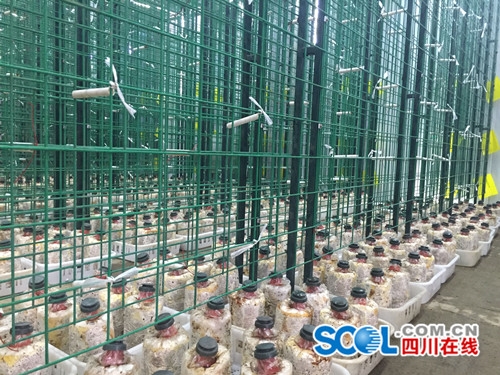
In the greenhouse, Lan Shunming is directing the workers to pack and box the freshly picked pig tripe mushrooms, ready to be shipped to Beijing. In the processing room in the distance, the workers are not idle either, busy bagging and shelving the mushroom spawn.
In 2013, Lan Shunming, who had mainly been engaged in edible fungus cultivation, returned home from Beijing and started his business anew. He has now developed more than 1,000 mu of rare edible fungus cultivation. By the end of 2014, Lan Shunming's enterprise had an annual output value of nearly 20 million, and while making himself prosperous, Lan Shunming also led the local people to prosperity together.
Not long ago, at a conference held in Deyang on migrant workers and farmer entrepreneurs returning home to start businesses, Lan Shunming also won a Rising Entrepreneur award through a speech on his entrepreneurial project. This award also filled Lan Shunming with even more drive for the future.
Lan Shunming is inspecting the growth of the pig tripe mushrooms
The edible fungus business rose and fell three times before shifting to Beijing
In 1988, after graduating from high school, Lan Shunming did not continue his studies and began running a general merchandise business. Once he met a person from Jianyang carrying a sack of wood ear mushrooms to sell, and they were bought out as soon as they were set on the ground.
"It was probably about 35 jin, and it sold for more than 400 yuan." Lan Shunming said that seeing how popular the wood ear mushrooms were, he felt it was a good way to get rich, so he went to Jianyang to look into the local situation.
However, Lan Shunming did not choose wood ear mushrooms. Later, through newspapers, magazines and other publications, he learned about enoki mushrooms, so he made up his mind to learn the techniques in this area. Afterwards, Lan Shunming went to agricultural colleges and research institutes in Shanghai, Fujian, Hubei and other places to learn edible fungus cultivation techniques.
In 1989, Lan Shunwu returned after completing his studies, taught edible fungus cultivation techniques to the local farmers, and then distributed the spawn he had brought back to the farmers to grow. He then bought back the edible fungi the farmers grew and sold them to the local cannery to make canned goods.
"At that time, the domestic market for edible fungi was not large, so they were generally made into canned goods for export." Lan Shunming said. Unexpectedly, not long afterwards, for international reasons, the canned goods could not be sold, and the cannery owed him more than 200,000 yuan, while he also owed the farmers more than 100,000 yuan.
Lan Shunming's first venture thus ended in failure.
In 1992, the edible fungus market picked up. Lan Shunming rallied again and began to lead farmers in growing edible fungi, and the scale reached 400 mu. Three years later, the scale doubled again, reaching 800 mu. Unexpectedly, in 1996 he encountered the Asian financial crisis, and the edible fungus business was affected as well.
"I lost more than 2 million yuan, still owed the farmers more than 1 million, and was left with more than 200 tons of edible fungi that could not be sold." Lan Shunming said. He had originally been a millionaire, and all at once became a penniless debtor.
In 2000, China's catering industry began to boom, and the domestic market for edible fungi gradually improved, giving the more than 200 tons of edible fungi a market. After selling them all, he just managed to pay back the money he owed the farmers.
However, this also earned Lan Shunming a reputation for integrity. Lan Shunming set up a company and began to develop his edible fungus business. In 8 years, the planting scale reached 3,000 mu, but in 2008 it was destroyed by the earthquake.
Lan Shunming said that after the earthquake, the construction industry became hot, and many people went to build houses and were unwilling to engage in edible fungus cultivation. Therefore, he took his team of more than 50 people to Beijing to develop.
Workers are bagging the mushroom spawn
Returning to Deyang to develop and lead the villagers to prosperity together
In Beijing, Lan Shunming led his team to begin his entrepreneurial journey. In 2009, in cooperation with a local listed company in Beijing, he built a 300-mu edible fungus leisure industrial park, with an annual output value of more than 10 million yuan.
Beijing's market is broad, with a large and rapid flow of information, but as a native of Deyang, Lan Shunming always had his hometown on his mind and wanted to contribute to its development and help the local people become prosperous.
"It happened that an agricultural products fair was held in Beijing, and I met the Deyang leaders who had come to Beijing to attend it. They invited me to return home and start an enterprise." Lan Shunming, who had always wanted to return to his hometown, saw the Deyang leaders extend an olive branch, which made him even more determined to return home. "The government is very enthusiastic, and it has issued many policies to support migrant workers and farmer entrepreneurs in returning home to start businesses."
In 2013, Lan Shunming returned to Deyang, and the local government quickly processed the relevant certificates for him. In October, Lan Shunming founded Deyang Mingrun Agricultural Development Co., Ltd., engaged in the cultivation of edible fungi, asparagus, wood ear mushrooms and more.
Not long ago, Lan Shunming's company was listed by the Deyang Municipal Science and Technology and Intellectual Property Bureau and the Jingyang District Science and Technology Bureau as a science and technology innovation demonstration base, and by the Ministry of Agriculture as a demonstration base for the construction of a standardized demonstration park under the Ministry of Agriculture's Vegetable Basket Project.
Now, Lan Shunming's base mainly grows more than ten varieties of organic vegetables, including termite mushrooms, pig tripe mushrooms, morel mushrooms, abalone mushrooms, daylily buds and asparagus.
"At present, our products are mainly shipped by air to the Beijing, Shanghai and Guangzhou areas for sale." Lan Shunming said that in the future he will adopt a company plus farmers model to build a 400-mu rare edible fungus production base, with organic vegetables reaching 5,000 mu, an annual output of agricultural products reaching 10,000 tons, realizing sales revenue of about 300 million yuan and profit of 40 million yuan, driving 4,000 farming households to increase their income, with an annual income reaching 50,000 yuan, while also driving the development of related industries such as packaging and cold-chain transportation, comprehensively utilizing more than 100,000 tons of straw annually, and effectively improving the local ecological environment and soil structure."