Leymus chinensis, a forage crop with super-strong stress adaptability
Original title: Leymus chinensis: The counterattack of a native forage crop
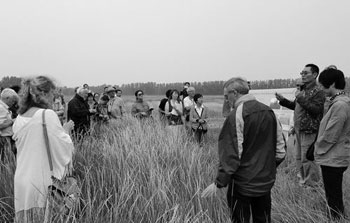
Domestic and international experts visit the large-scale Leymus chinensis breeding base in Gansu.
Leymus chinensis resource nursery at the Beijing Botanical Garden. Photo by Liu Gongshe
Grain-to-feed conversion, grassland agriculture, herbivorous animal husbandry, grass-based livestock farming... In recent years, the state has placed the role of the grass industry in agricultural and rural economic development in an important position. However, with economic and social development, especially in animal husbandry, the shortage of forage supply has become increasingly obvious. How to further leverage the role of the grass industry in safeguarding national food security and economic and social stability is an important topic facing the agricultural science and technology community.
Our reporter has learned that the team of researcher Liu Gongshe at the Institute of Botany, Chinese Academy of Sciences, after more than 20 years of cumulative research centered on Leymus chinensis germplasm resources, published Volume 1 of "Research on Leymus chinensis Germplasm Resources" in 2011, and recently published Volume 2 of "Research on Leymus chinensis Germplasm Resources." Using abundant genetic information, they established the world's first Leymus chinensis genome database, laying the foundation for understanding the stress adaptation mechanisms of China's native grasses, and also providing new stress-resistance gene resources for the molecular improvement of crops such as wheat and corn.
What advantages does the native plant Leymus chinensis have? What level is China at in Leymus chinensis research? What issues should be noted in its future industrialization? With these questions, the reporter interviewed industry insiders including Liu Gongshe's team.
Domestication of native plants
"Building the ecological Great Wall of northern China and developing herbivorous animal husbandry is one of the important ways to solve China's food source problem, and the biggest problem in developing herbivorous animal husbandry in the north is the insufficient supply of feed."
This strategic vision put forward by Li Zhensheng, academician of the Chinese Academy of Sciences, led Liu Gongshe to shift his research direction from sunflowers to forage grasses. Following his suggestion, he chose the high-yield, high-quality, and highly adaptable native plant Leymus chinensis, and carried out systematic research and development from the perspective of resources.
In the view of Nan Zhibiao, academician of the Chinese Academy of Engineering and professor at the College of Pastoral Agriculture Science and Technology, Lanzhou University, the domestication, selection, and utilization of native plants has always been an important part of scientific research and production practice. "In a sense, the history of agricultural development is also the history of understanding, domesticating, selecting, and utilizing wild animals and plants."
In recent years, sustainable development has become the theme of the times, and how to fully exploit and utilize the excellence of native plants is an area of great concern and active research for scientists in various countries.
To this end, the United States founded the journal "Native Plants," comprehensively reflecting the achievements and trends in this field.
Nan Zhibiao introduced that the work carried out by various countries mainly focuses on two aspects: First, domesticating wild native plants with excellent characteristics into cultivated varieties to directly serve agricultural and pastoral production. For example, New Zealand scientists utilized the tannin-containing characteristics of wild Plantago (plantain) to domesticate it into a cultivated variety, as one of the components of ryegrass-white clover mixed pastures, used to overcome bloat in grazing livestock.
"On the other hand, scientists from various countries are working hard to tap the excellent gene resources of native plants to improve forage or crop varieties, and good progress has also been made," said Nan Zhibiao.
According to the first national grassland survey data, there are more than 6,700 species of forage plants. Among the forage varieties that have been bred in China so far, domesticated and selected native grass species account for about one-third.
In the view of the academic community, Leymus chinensis is one of the native grass species with particularly excellent traits in China, and is widely distributed across northern China.
The high-quality characteristics of Leymus chinensis
"Leymus chinensis is a representative native species of the grasslands of northern China, and Leymus chinensis grasslands are excellent natural grazing grounds and mowing grounds, occupying an important position in developing animal husbandry and protecting the ecological environment of the north," Liu Gongshe told our reporter.
The characteristics of Leymus chinensis, such as wide adaptability, strong stress resistance, high yield, and good forage value, have long received high attention from the scientific and industrial communities.
In the 1950s, scholars from Northeast Normal University, Inner Mongolia University, and the Comprehensive Survey Commission of the Chinese Academy of Sciences and other institutions carried out continuous research on Leymus chinensis and Leymus chinensis grasslands. Since the 1980s, scholars from Inner Mongolia Agricultural University, the Grassland Research Institute of the Chinese Academy of Agricultural Sciences, the Jilin Provincial Institute of Biology, and other institutions have successively domesticated and bred 6 varieties that were approved by the National Grass Variety Approval Committee.
As a key species of the grasslands of northern China, Leymus chinensis has indeed received continuous attention from the academic community. "However, its perennial habit, low seed set, and large and complex genome make research work difficult and slow to progress," said Liu Gongshe.
The reporter learned during the interview that after more than 20 years of exploration, Liu Gongshe's team has established a practical and efficient technical route for the exploration of Leymus chinensis germplasm resources, namely: germplasm resource collection - phenotypic research - genome analysis - germplasm innovation - new variety breeding. On this basis, they have collected more than 1,000 accessions of Leymus chinensis germplasm resources from home and abroad, and bred new Leymus chinensis varieties "Zhongke No. 1," "Zhongke No. 2," and "Zhongke No. 3" with high yield, high quality, and stress resistance.
It is understood that the United States, Japan, South Korea, the Netherlands, Russia, Mongolia and other countries also pay close attention to the ecological and germplasm resource development and utilization of Eurasian Leymus chinensis. "But their research is relatively scattered, with only some academic papers and survey reports, and no systematic research and development monographs on Leymus chinensis germplasm resources have been published," said Liu Gongshe.
In October of this year, Liu Gongshe's team officially published Volume 2 of "Research on Leymus chinensis Germplasm Resources." The publication of this book has also attracted industry attention. Nan Zhibiao commented: "This book represents the current research level on the important native grass species Leymus chinensis both domestically and internationally, has important value in the fields of plant gene resource research, grass science, animal husbandry, and ecology, and has reference significance for the development and utilization of forage and native grass species at home and abroad."
Industrialization must rely on technological support
After obtaining this book, the reporter found that compared with Volume 1, Volume 2 added some industrialization elements, such as the last five chapters focusing on Leymus chinensis's resistance to herbicides, response to water, water and fertilizer demand characteristics, sexual reproduction, and the impact of fertilization on seed production.
In fact, China is a major country in grassland resources in the world. But the reporter learned during the interview that domestic demand for natural forage has always been in a tense state, and the momentum of large-scale ranches competing with pastoral areas for grass is becoming increasingly obvious. Compared with developed countries in grassland animal husbandry, the level of livestock product production per unit area is only equivalent to 1/80 of New Zealand, 1/20 of the United States, and 1/10 of Australia.
In Nan Zhibiao's view, making full use of and giving play to the advantage of abundant grassland plant diversity, and improving degraded farmland and grassland, is an important task for China's scientific and technological workers, and also a rapid way to treat degraded land resources.
In 2012, the central government implemented the "Action to Revitalize the Dairy Industry through Alfalfa Development," providing support in units of 3,000 mu, with 500,000 mu promoted in the first year. That year, more than 130 enterprises entered the industry, some of which had production experience.
In 2012, the total area of forage seed fields nationwide was 1.786 million mu, and in 2013, 7,500 mu of seed fields were added. In 2014, relevant national seed engineering projects further supported the development of forage seed production, and China's forage seed production area continued to increase. "But it is still difficult to meet market demand. The main reason is that forage seed yield is low and seed production efficiency is low, causing forage seeds to remain one of the main factors restricting the development of the forage industry," Zhang Yingjun, chief scientist of the National Forage Industry Technology System and professor at the College of Animal Science and Technology, China Agricultural University, once told our reporter.