Cracking the Rice Code to Add More Weight to Yield Increases
Original title: The "Code" Regulating Rice Yield Has Been Cracked
If the results are transformed and applied, China's rice output could increase by 23 million tons per year
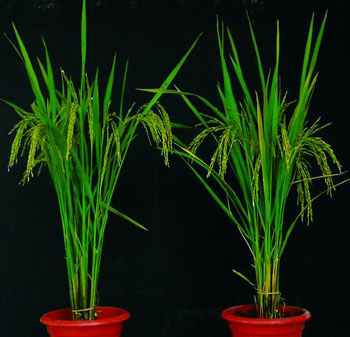
Three scientific research teams separately formed by scientists including Li Shaoqing of Wuhan University, Zhao Mingfu of the Fujian Academy of Agricultural Sciences, Chu Chengcai and Li Yunhai of the Institute of Genetics and Developmental Biology of the Chinese Academy of Sciences, and Zhu Xudong of the Chinese Academy of Agricultural Sciences recently discovered a new molecular module that regulates rice grain size and yield. Three independent papers from the three research teams were published online on December 22 in this week's academic journal Nature Plants.
According to the research results, the three research teams used different methods to make growth-regulating factors inhibited by the small RNA molecule miR396, and the two together control the size and number of rice grains, indicating that they may be the key to significantly increasing crop yields in the future.
There are usually two ways to increase rice yield: one is to increase the number of flowers or panicles on the plant, thereby increasing the number of grains; the other is to increase the size of each rice grain. Li Shaoqing and his research team found that in hybrid rice the expression of miR396 is inhibited, which in turn causes the expression of growth-regulating factor 6 (GRF6) to activate the biosynthesis and signaling of a plant hormone that promotes rice panicle formation.
In the research of the other two scientific research teams, the researchers found that two forms of growth-regulating factor 4 (GRF4) can both significantly increase grain weight. They found that both forms of growth-regulating factor 4 contain mutations that make them insensitive to inhibition by miR396. Chu Chengcai and his research team found that increased expression of growth-regulating factor 4 activates another type of plant hormone response, thereby further enhancing grain development and increasing grain size. Li Yunhai and his research team found that growth-regulating factor 4 also increases grain size and weight through interaction with transcriptional coactivators (proteins that help activate gene expression).
All three research teams found that the module of miR396 and growth-regulating factors regulates grain yield through multiple molecular pathways. The researchers said that although both growth-regulating factor 6 and growth-regulating factor 4 are regulated by miR396, the two increase grain yield in different ways, which will help guide the future breeding of high-yield rice varieties.
Zhao Mingfu introduced that rice yield is determined by three elements: tiller number, grain number per panicle, and grain weight. However, in actual breeding work, there is a very strong negative correlation among these three. That is to say, when one element increases, the other two components tend to decrease, which is also a major problem faced by rice breeding. Through methods such as physiology, biochemistry, and genetics, the research team studied in detail the molecular mechanism by which GL2 regulates rice grain size, discovered a specific branch pathway by which an important plant hormone, brassinolide, regulates grain size, explained the molecular mechanism regulating rice grain size, and broke through the breeding problem that the three elements determining rice yield (grain weight, tiller number, and grain number per panicle) simultaneously have positive effects, providing very rare breeding materials and genetic resources for high-yield rice breeding. If this achievement is transformed and applied on a large scale, based on an average plot yield increase of 11%, it is estimated that the annual yield increase potential will increase China's rice output by 23 million tons and global rice output by 80.74 million tons. (Reporters Wang Yi and Xie Kaifei, correspondent Huang Xianguang)