Internet Plus makes water management foolproof, making farming easier
Original title: What will Internet Plus agriculture change?
-- The Beijing Academy of Agriculture and Forestry Sciences' exploration of integrated water and fertilizer management
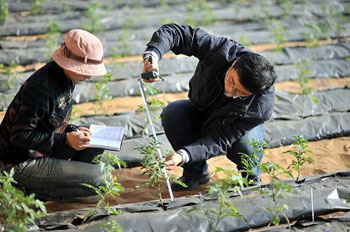
Dr. Guo Wenzhong (right) and colleagues observe vegetable growth in a desert greenhouse. (File photo)
172 projects, 26 billion cubic meters, over 78 million mu.
These are the three figures proposed at the State Council executive meeting last year. Specifically, during 2014, 2015 and the "13th Five-Year Plan" period, the 172 major water conservancy projects included in the plan will be built in stages, achieving an agricultural water-saving capacity of 26 billion cubic meters and increasing irrigated area by over 78 million mu.
"More people, less land, scarce water" -- as is well known, China's agriculture faces severe challenges. How to resolve these difficulties has become an urgent task for ensuring agricultural security.
At the Beijing Academy of Agriculture and Forestry Sciences, researcher Guo Wenzhong, director of the Facility Engineering Department of the National Engineering Research Center for Intelligent Agricultural Equipment, believes that integrated water and fertilizer management is one of the important paths for modern agriculture to break through. For many years, he and a group of experts have been working to raise the intelligent level of integrated water and fertilizer management in China.
"Three accounts" firm up the research path: not making a simple "time controller"
To explain the current state of integrated water and fertilizer management in China, Guo Wenzhong calculated "three accounts" for the reporter.
The first account: the "savings account" of integrated water and fertilizer management.
"Integrated water and fertilizer management is a globally recognized highly efficient water-saving and fertilizer-saving technology. It mainly works by using irrigation equipment to supply water and nutrients uniformly, accurately, and in timed and quantitative amounts to crops, based on soil characteristics and crop growth patterns," he said. "Compared with traditional water and fertilizer management methods, this technology can increase yield by 15%-25%, save water by 30%-40%, and save fertilizer by 40%-50% on facility vegetables."
The second account: China's "water and fertilizer usage account."
"Annual agricultural water use is about 360 billion cubic meters, with a shortfall of over 30 billion cubic meters. Irrigation water productivity is 1 kg/cubic meter, only 1/2 that of the United States, Israel and other countries. China's annual chemical fertilizer use exceeds 54 million tons (pure nutrient basis), ranking first in the world, with an average utilization rate of only 30%, more than 20 percentage points lower than developed countries."
The third account: each country's "proportion of integrated water and fertilizer management application account."
Israel's application rate of integrated water and fertilizer management exceeds 90%. In the United States, 25% of corn, 60% of potatoes, and 32% of fruit trees use integrated water and fertilizer management. Currently, China's integrated water and fertilizer management (drip irrigation and micro-sprinkler irrigation) area accounts for only 0.13% of the irrigated area.
"We still have a considerable gap. In practical applications, we generally import foreign equipment. But due to differences in soil environment, agricultural needs and so on, this equipment may not necessarily suit local actual production conditions," he said. "Many foreign devices, when applied domestically, actually only have a simple 'time controller' as the control strategy. For example, when it rains and the farmland doesn't need that much water, if no one manually intervenes to shut down the system, it will still execute water and fertilizer supplementation at fixed times and amounts."
"Not making a simple time controller," he said. "Persisting in intelligent, localized integrated water and fertilizer management control strategies and equipment research and development is the direction of our efforts."
Providing systematic management solutions: making machines truly smart
"We want to buy smart machines from abroad, but after spending hundreds of thousands of yuan on imported equipment, we discover upon using them that they aren't really smart," Guo Wenzhong said.
He analyzed: "The reason for this is not that foreign researchers aren't smart. Agricultural research takes time and effort, and varies greatly across different regions. Foreign integrated water and fertilizer management is mostly done by companies, and it's impossible for them to put in that much effort to come to China and conduct surveys in various places. So the equipment they sell us has many functions that aren't brought into play, lacking systematic management solutions tailored to China's actual production needs."
Different soil environments require different water-to-fertilizer ratios; different crops grown also determine that the functions of integrated water and fertilizer management equipment cannot be singular; different sunshine hours and evaporation levels mean water and fertilizer naturally cannot adopt the same strategy; different regions with different numbers of harvests per year also require different plans.
"Many people think integrated water and fertilizer management is uncouth and doesn't involve much technology. Actually, this is a misunderstanding. Too many complex factors make integrated water and fertilizer management very difficult to implement," he said. "Everyone talks about intelligence, but there are many challenges in this area. If equipment operation is too complex, farmers won't know how to use it; if operation is simple, the functions are too limited."
Both intelligent and simple. To achieve this goal, experts at the Beijing Academy of Agriculture and Forestry Sciences continuously collect data in fields. At the same time, they coordinate with meteorological, agricultural and other departments across various regions, obtaining large amounts of timely and accurate information.
"With this data, we can build a relatively complete system. At this point, we serve as a platform, implementing remote control and continuously upgrading. Farmers just need to turn on the device, and they don't need to worry about much else," he said.
Internet Plus water management Plus agriculture: making "foolproof" operation a reality
"Improving the traditional flood irrigation model, precisely calculating crop water and fertilizer requirements." Guo Wenzhong said that in Yinchuan, Ningxia, a project called "Digital Tanglai Canal" is combining Internet technology and computer technology in an expert decision-making system that can intelligently and automatically manage the irrigation process.
As the head of research and development for the project's intelligent decision-making system, he said: "The overall design scheme of Internet Plus water management Plus agriculture allows people to quickly obtain irrigation system information without leaving home."
In his view, "intelligence" must achieve "foolproof operation," allowing users to easily carry out precision management without barriers.
"Designing an intelligent decision-making system that integrates models, formulas and data for comprehensive analysis and processing to derive the optimal irrigation and fertilization scheme. Designing an irrigation control system based on the Internet of Things that collects soil information and environmental information in real time, remotely controls water supply, and precisely measures irrigation volume. The irrigation control system combines with the intelligent decision-making system to carry out reasonable irrigation. Crops receive good water and fertilizer supply, and yield is increased," he said.
"On the premise of ensuring high yield, it is expected to save water by over 30%, save fertilizer by over 20%, increase the per capita management area by more than 3 times, and increase the irrigation management response speed by more than 10 times." In his view, "this turns farmers who don't understand the principles into experts." (Correspondent Cai Wantao, Staff Reporter Han Yilei)