Cattle farmer in Fengtai gets rich raising yellow cattle on crop straw
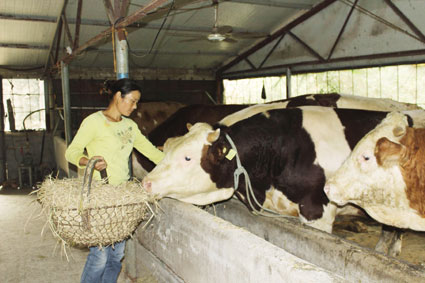
Photo: Han Zhenyan's wife feeding the cattle
Recently, Han Zhenyan, a large-scale cattle farmer in Hanhu Village, Yangcun Town, Fengtai County, has been busier than ever. With Spring Festival just over a month away, the dozens of beef cattle he has raised to plump, sturdy condition at home will soon be sold, and a year of hard work will soon pay off. At the same time, he still has to plan next year's breeding and is preparing to find time to go to Northeast China to buy calves. Of course, more importantly, he wants to expand the scale of his operation. He is discussing with the village about building another cattle shed, and because land is scarce, the plan is to use abandoned ditches, fill them with soil and build there. Although Han Zhenyan feels physically exhausted, he is happy inside.
In the past, Hanhu Village was poor and backward, and villagers had no choice but to leave home to work elsewhere. Like local teenagers, Han Zhenyan, who had no way to make a living, went out to seek work in his teens. The first time he left home, he went with more than 20 people from his own village and nearby hometowns all the way to Shanxi to do underground odd jobs for a coal mine outsourced team. Because he had no skills, he could only start as a laborer earning just 30 yuan per shift. In order to earn money, he gritted his teeth and worked hard for a period of time. After that, Han Zhenyan went to Tianjin, and through an introduction from a friend, found a job at an automobile factory, mainly responsible for logistics, applying primer and paint to cars. He worked there for four or five years. Although he later led a team and became a person in charge, the pay was low, and the working environment for the painting job was poor. This was not his choice either, so he once again gave up the job.
The experience of working away from home gave Han Zhenyan a lot of insight. Without skills, all he could do elsewhere was the dirty and tiring work that local people were unwilling to do, and he could never realize his ideal of starting his own business and developing it. To improve, he had to learn skills. During this period, Han Zhenyan learned through his family about the rural ban on straw burning. He thought that if he could develop a breeding business, it would both solve the problem of having nowhere to put the straw and respond to policy by improving breeding efficiency, killing two birds with one stone! At the same time, the elderly and children at home also needed him and his wife to care for them. Han Zhenyan immediately decided to end his long years of hard wandering away from home and return to his hometown to do something.
After returning to Fengtai, Han Zhenyan began planning to build a cattle shed and introduce breeding cattle. He then contacted another cattle farm and went with them to other places to survey the market, learn about prices, study techniques and ask for advice and experience. Soon, everything was ready. In February 2013, Han Zhenyan braved the severe cold and traveled thousands of li to Harbin, where he made his first purchase of 11 Simmental calves from Northeast China. After nearly a year of careful feeding, these cattle grew plump and sturdy. When they were sold after the 2014 Lunar New Year, the net profit per head reached 5,000 yuan. After selling the beef cattle in 2014, Han Zhenyan again went to Northeast China and bought more than 20 calves. They have now grown up and will soon be sold.
At present, Han Zhenyan's greatest wish is to build a new cattle shed as soon as possible, because he will buy calves after the New Year, and only by increasing the shed area can he expand the scale of his operation. He plans to buy 50 calves this year and strive to develop to a scale of 200 head within a few years, so that this "win-win" industry, which both consumes straw in an environmentally friendly way and allows him to start a business in his hometown and increase his income, can build a brand and become an important industry driving local economic development.