Fighting Wild Boars in the Snowy Forest: A Battle Between Man and Pig
He cleared land and planted trees hoping to make a fortune, only to run into a wild boar disaster. Seeing his investment of over a million yuan at risk of going up in smoke, he resolved to turn the tables: he bought a young male pig and taught it to woo wild sows. Watch how Wei Shubo of Linjiang, Jilin, pits his wits against wild boars in the mountain forests and achieves annual sales revenue of nearly ten million yuan!
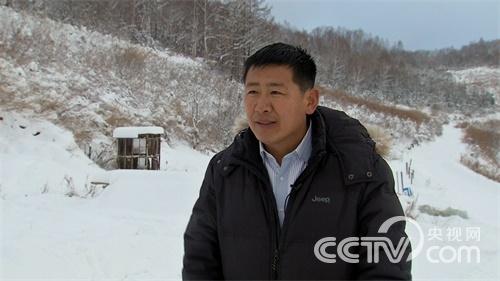
The heavy snow had been falling for six days straight without stopping. Yet today, more than 40 backpackers were still going to brave the snow and head into the mountains.
The place the backpackers were heading to is called Tianhugou. Once the vehicle got this far, there were still 8 kilometers of mountain road to walk.
Tourist: Giddy-up, go faster.
The mountain road was too steep for the bus to climb, so the backpackers could only walk or switch to ox-drawn sledges.
The backpackers rode a bus for one hour, then walked another hour and a half, all to see at Tianhugou something rare even by local standards.
Wei Shubo: Come on, come on...
When they arrived at the Tianhugou base, the base owner Wei Shubo insisted that everyone come see his proudest pig.
This pig had tusks, thick sturdy limbs, and was several times the size of the other pigs. Wei Shubo said the other pigs had also been raised for a full year and a half and weighed at least 300 jin. But next to Wei Shubo's prized pig, they all looked especially small. Just how heavy was this pig?
Backpacker: 800 jin, 1,000, it's definitely over 1,000. I say 800, 1,200, 900.
Previously, Russia had captured a wild boar of over 1,000 jin, which drew crowds of netizens to watch. And pigs raised elsewhere that exceeded 1,000 jin were all treated as wonder pigs.
The backpackers all guessed this pig weighed around 1,000 jin. Were their guesses accurate? Wei Shubo fetched a scale from the storage room to weigh the big boar in public.
This was a 400-jin scale, and Wei Shubo added three weights that could each weigh 200 jin. Everyone wanted to see whether this big boar really weighed 1,000 jin. But the big boar circled a few times and simply refused to get on the scale. Everyone's cheering and goading suddenly angered the big boar.
Backpacker: Its wild nature is coming out.
Backpacker: Terrifying, absolutely terrifying.
Because the big boar was too large and too wild, Wei Shubo could only have the workers shut it into the pen. Inside the pigpen, the big boar had to stand sideways just to fit. Having failed to weigh it, Wei Shubo was determined to find a way to show the reporter just how big this pig was.
Wei Shubo: 1.16 meters, 1.16 meters tall, 1.88 meters long, 68 wide. This pig is big enough. I estimate around 1,000 jin. It's definitely 1,000 jin.
Reporter: 1,000 jin? Its body is only 1.8 meters long, can it really weigh 1,000 jin?
Wei Shubo: It's all muscle all over. 1.88 meters.
Wei Shubo told the reporter that three years earlier he had tried to weigh this big boar. At that time the big boar was tightly bound and ten workers together heaved it onto the scale, but the moment it got on, it broke the 800-jin scale.
Currently, this big boar has been raised for 7 years. In Wei Shubo's hands, this big boar brings him nearly ten million yuan in revenue each year. How did Wei Shubo do it?
In 2002, on a heavy snow day when few people went out, Wei Shubo, who had been working away from home, quietly returned to his hometown of Tianhugou with his wife, each carrying a hemp sack. No one knew that inside these two hemp sacks was 1.5 million yuan in cash.
Wei Shubo: My wife and I carried them into the house, dumped them down, and I just laughed. Is this money? Is this money? That feeling.
Wei Shubo's family was one of the poorest in this mountain valley. How did they suddenly have so much money? Even Wei Shubo himself couldn't believe it, because this money had come too fast.
After graduating from high school, Wei Shubo went out to work, trading grain, and after a few years he finally saved up several hundred thousand yuan. In 2000, he seized an opportunity, invested 700,000 yuan, and did a soybean futures deal. Three months later, he made a clean profit of 1.5 million yuan.
Wei Shubo bought a house and a car in Linjiang city and suddenly became a rich man in the eyes of the villagers back home. But no one expected that this rich man would return to the mountain valley. Even less expected was that two years later, this rich man Wei Shubo would start borrowing money from people everywhere, and even his cousin far away in Changchun got a call from Wei Shubo asking for a loan.
Cousin: You call me from so far away, and you're this desperate over borrowing 2,000 yuan. I said, what happened? I was worried the money had been swindled.
Not only that, many of Wei Shubo's friends also received calls asking for loans. Everyone was puzzled.
Friend 1: Really puzzled. You're rich now, such a big boss, and you don't have money? Borrowing five hundred or six hundred.
Reporter: What's the smallest amount you borrowed?
Friend 2: The smallest was ten or eight yuan.
A big boss who once carried back two sacks of money in one go, how could he sink so low as to borrow money everywhere, even asking people for ten or eight yuan? Where did all Wei Shubo's money go?
It turned out that this 1.5 million yuan had been earned too quickly, and Wei Shubo felt very uneasy. Day and night he thought about how to hold on to this money. To keep this sudden wealth from going down the drain, he wanted to do something in real industry.
After returning to his hometown of Tianhugou in 2002, Wei Shubo took out 1.1 million yuan and contracted 294 hectares of barren mountain land. He also spent over 300,000 yuan planting 300,000 Korean pine saplings. To make a living, he also cleared over a hundred mu of farmland and planted corn. Wei Shubo moved into his old family house, watching over several great mountains, and lived that way for 7 years.
Wei Shubo: There wasn't even a TV, and before electricity was hooked up, while others watched the Spring Festival Gala at home, I read newspapers.
Reporter: You read the newspapers pasted on the walls.
Wei Shubo: I read the newspapers pasted on the walls. Every New Year I'd paste newspapers once, and pasting them once was like celebrating the New Year; the room would look bright and new.
Contracting barren mountain land was not so simple. In the great mountains, winter was the hardest to endure; the old house leaked wind everywhere, and water froze into ice. Planting trees was a long-term project, all investment in the early stages with no output, and Wei Shubo's days were so tight he couldn't even produce 10 yuan. Even more unexpected, Wei Shubo maintained these vast mountain forests so well that it actually attracted a disaster. And the disaster happened right in this cornfield.
In the autumn of 2009, Wei Shubo's corn was about to ripen. He was especially happy and went to the field for a look every day. But one evening, before he even reached the edge of the field, he heard unusual sounds.
Wei Shubo: I heard snap-crack, snap-crack, like corn being snapped off, a mess all over the field, scattered every which way.
When it let out a roar, a hum, I knew right away, this was a wild boar. I walked further and looked, oh my, a big wild boar, its snout so long, its tusks so long, ears standing straight up, a whole group, too many to count.
The big wild boars not only gnawed down the corn, they even rooted up all the roots underground.
To let the reporter see with his own eyes just how destructive the pigs were, Wei Shubo did an experiment.
Wei Shubo: It's incredibly strong. If you don't believe me, I'll demonstrate for you.
Wei Shubo dug a pit more than half a meter deep, then dragged over a bag of cabbage, but that wasn't all.
Reporter: Is this a rock from the mountain?
Wei Shubo: Yes.
Reporter: You're going to put such a big rock on top? Come on, let's try.
Wei Shubo: Can we do it? Come on.
Reporter: One, two, three, no. One, two, three, no. How heavy is this rock?
Wei Shubo: Over 100 jin.
Reporter: I can't even lift it.