Bajiaxing's Fine Vegetable Processing Helps Farmers in Wangcheng Get Rich
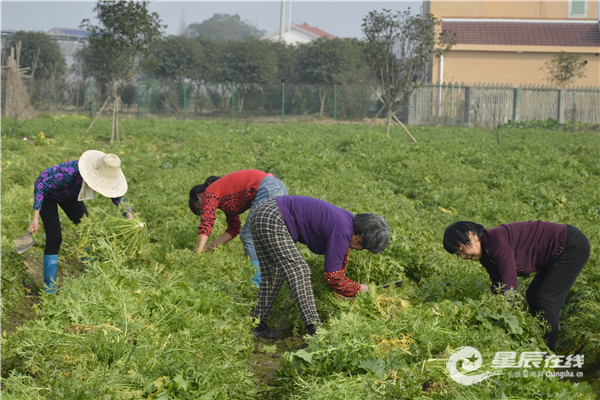
Farmers are working in the fields in twos and threes, and patches of potherb mustard are growing well, lush and lovely.
Xiong Yuming (second from right) is looking at this year's vegetable growth together with the villagers.
Villagers are sealing the cellar pits with soil. In a few more days, the pickled vegetables here will reach the dining tables of thousands of households.
On the last day of 2015, with bright sunshine, at the vegetable base of Bajiaxing Agricultural Technology Co., Ltd. in Getang Town, Wangcheng District, Changsha, farmers were working in the fields in twos and threes, and patches of potherb mustard were growing well, lush and lovely.
"There is security in working here, right at our own doorstep, and the wages have never been delayed. It is about 3,000 yuan a month, which adds up to more than 30,000 yuan a year, much better than working elsewhere," villager Yuan Zhengbin told reporters happily.
Two plantings a year: bringing idle winter land to life
Like Yuan Zhengbin, local major grain grower Yang Jianjun also found employment at his doorstep. Last year, he contracted more than 200 mu of land to plant rice, "and later transferred another 80 mu to Boss Xiong. With two harvests a year, each mu brings in more than 4,000 yuan extra. The potherb mustard they grow never has to worry about sales, and it is easy to manage, so everyone's income can increase."
The Boss Xiong Yang Jianjun mentioned is Xiong Yuming, chairman of Hunan Bajiaxing Agricultural Technology Co., Ltd. Xiong Yuming introduced that Changsha currently has 5.5 million mu of rice planting, mainly double-cropping rice, supplemented by single-cropping rice. "Before November every year, all the rice has been harvested, and spring plowing production does not begin until April of the following year. Every year, winter rice fields sit idle for 5 months, which we deeply regret."
In September 2015, Bajiaxing signed minimum-price purchase agreements for vegetables (potherb mustard) with more than a dozen vegetable planting enterprises, including the Wangcheng District Ten-Thousand-Mu Vegetable Demonstration Zone and Ningxiang County, as well as more than 30 major grain and vegetable growers.
"After harvesting the rice, cooperatives and major grain growers plant potherb mustard according to our technical requirements. Seedlings are raised at the end of September, transplanted from October to November, and depending on the temperature, potherb mustard can be harvested in 2 to 3 months," Xiong Yuming said. "In this way, we not only make full use of the idle winter land, but also help the villagers get rich. Why not do it?"
Returning home to start a business: a 3,000-mu base drives employment for more than 400 people
In 2009, Xiong Yuming, who had originally been engaged in wholesale business at Changsha Gaoqiao Grand Market, saw the market prospects in rural areas and decisively returned home to start a business. "When I was a child, I was bent on leaving the countryside. Now, looking back, I have realized that whether in terms of national policies or personal affection, the prospects for starting a business in my hometown are very broad."
In 2011, Xiong Yuming registered capital of 20.11 million yuan and founded Hunan Bajiaxing Agricultural Technology Co., Ltd. "This year, the contracted planting area with major grain growers has reached more than 3,000 mu, and what you see here is only a small part of it." Talking about the patches of green potherb mustard before him, Xiong Yuming could not contain his excitement. "At present, through various forms, we have driven employment for more than 400 people nearby."
Xiong Yuming calculated his economic account for reporters. "At present, villagers plant potherb mustard on their own land, and when it is harvested, we purchase it at a minimum price of 0.8 yuan per jin. As long as it is planted according to our technical requirements, the yield per mu can reach at least 5,000 jin. In this way, the idle winter rice fields can generate at least 4,000 yuan in income each year."
Xiong Yuming said, "We also have to pay farmers more than 1,000 yuan per mu in rent each year. Calculated this way, one mu of land can increase farmers' income by more than 5,000 yuan in one winter. If a major grain grower has 10 mu of land, that is 50,000 yuan, which is very considerable for local villagers." He told reporters, "Starting next year, our winter vegetable purchase plan will expand to more than 10,000 mu."
Fine processing: bringing fresh, crisp side dishes to the dining tables of thousands of households
Next to the Bajiaxing vegetable base, rows of greenhouses caught the reporter's attention. "That is our deep-processing base. One greenhouse contains more than 200 cellar pits."
In one of the greenhouses, we happened to meet several villagers who had come to work. They were sealing the tops of the cellar pits with soil. "This can ensure that air does not get in." Villager Peng Zuyou was carrying a load of soil, ready to pour it onto a cellar pit that had just been covered with plastic film. "A cellar pit like this can hold 45,000 jin of potherb mustard."
This figure astonished the reporter. A cellar pit of less than 20 cubic meters can hold such a large amount. Xiong Yuming introduced, "This is the charm of fine processing. Fresh vegetables just put in definitely cannot fit this much." Pointing to the fresh vegetables delivered that morning, he said, "There are two truckloads, 6,000 jin per truck. One cellar pit cannot hold it all, and it sticks out more than half a meter. In less than two weeks, once the microorganisms ferment, it will settle down, and even 4 more truckloads would be no problem."
Xiong Yuming said that this is where crisp pickled vegetables are made and then packaged and sold. "Both bagged and canned are possible. You could say we have opened up an integrated chain of production, processing, and sales. In a few more days, the pickled vegetables here will reach the dining tables of thousands of households."