To strengthen agricultural informatization, it is necessary to strengthen the three pillars
Original title: Strengthen the "three pillars" of agricultural informatization
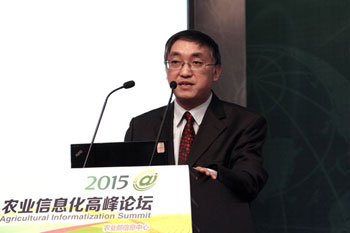
Wang Xiaobing, Deputy Director of the Department of Market and Economic Information of the Ministry of Agriculture, delivers a keynote speech (file photo)
The Party Central Committee and the State Council attach great importance to the development of the Internet economy. In 2015, the State Council successively made arrangements for developing e-commerce, advancing the "Internet Plus" action, and promoting big data development. The Fifth Plenary Session of the 18th Central Committee of the Party clearly proposed that during the "13th Five-Year Plan" period, we must vigorously implement the strategy of building a cyber power, implement the "Internet Plus" action plan, develop the sharing economy, and implement the national big data strategy. The Central Rural Work Conference and the National Agricultural Work Conference held before the New Year both made further deployments and arrangements for vigorously developing agricultural informatization. We must deeply understand and implement them well, strengthen the "three pillars" of "Internet Plus" modern agriculture, agricultural and rural big data, and agricultural information security assurance, and provide impetus and guarantee for achieving marked progress in agricultural modernization.
At present, agricultural modernization and informatization have formed a historic convergence, providing a major opportunity for agriculture to achieve transformation, upgrading, and leapfrog development. In planning and advancing agricultural informatization, it is necessary to accurately grasp the four characteristics presented by agricultural informatization: First, it is everywhere. The future will be a world where everyone is connected, all things are connected, and all industries are connected. The Internet, like water and air, is indispensable to everyone and will certainly be integrated into every industry and field of agriculture. Second, it creates something out of nothing. The online world breeds infinite possibilities. In the future, agricultural IoT, agricultural big data, agricultural e-commerce, and agricultural information services will give rise to many new industries, new business forms, and new business models. Third, it is considerate in every possible way. At present, market competition is shifting from being product-centered to being service-centered. Whether relevant enterprises provide various services to farmers or sell agricultural products to urban and rural residents, they must enhance service awareness and provide considerate, high-quality services. Fourth, it has boundless prospects. "Internet Plus" modern agriculture, agricultural and rural big data, as well as agricultural IoT and agricultural e-commerce, have huge development potential and infinitely bright prospects.
At the same time, from the strategic height of implementing the spirit of the Fifth Plenary Session of the 18th Central Committee of the Party, adapting to and leading the new normal of economic development, and building a moderately prosperous society in all respects, we must fully understand the enormous role of agricultural informatization. First, accelerate the transformation of the development model. It is conducive to accelerating the realization of intelligent agricultural production, networked operations, efficient management, and convenient services, relying on scientific and technological progress and the improvement of laborers' quality, promoting the transformation of the agricultural development model, and taking a new path of agricultural modernization with Chinese characteristics featuring efficient output, safe products, resource conservation, and environmental friendliness. Second, accelerate structural adjustment. It is conducive to advancing supply-side structural reform in agriculture, accelerating the establishment of an agricultural industrial system, operational system, and production system oriented by consumer demand, promoting precise matching of supply and demand, and meeting personalized and diversified consumer demand. Third, accelerate the promotion of balance. It is conducive to accelerating the onlineization and datafication of agriculture, improving the mechanism of "speaking with data, making decisions with data, managing with data, and innovating with data," enhancing the level of macro decision-making and management based on data, and promoting balance in the total quantity and structure of agricultural product supply and demand. Fourth, accelerate the strengthening of weak links. It is conducive to accelerating the gathering of technology flows, material flows, capital flows, and talent flows into rural areas led by information flows, accelerating the process of agricultural modernization, promoting the integrated development of the primary, secondary, and tertiary industries, boosting targeted poverty alleviation and targeted poverty eradication, and filling as soon as possible the weak links of agricultural modernization, especially in impoverished rural areas, in building a moderately prosperous society in all respects.
It is necessary to follow the deployment requirements of "synchronization of the four modernizations," implement the development concepts of innovation, coordination, green development, openness, and sharing, solidly carry out all key work in agricultural informatization, and provide new elements and new impetus for accelerating the construction of agricultural modernization. At present, the key is to strengthen the "three pillars."
The first pillar is implementing the "Internet Plus" modern agriculture action. This is the "operating system" for developing agricultural informatization. It is necessary to accelerate the development of agricultural e-commerce, focus on solving problems such as information asymmetry, high circulation costs, unclear profit models, and an incomplete credit system, strengthen the connection between agricultural production and operation entities and e-commerce platforms, and expand pilots for direct delivery of fresh agricultural products, agricultural materials to the countryside, and leisure and sightseeing agriculture e-commerce. Vigorously implement the agricultural IoT experimental demonstration project, accelerate scientific and technological breakthroughs, increase the application of cost-saving and efficiency-enhancing agricultural IoT models, and strive to take the lead in achieving economies of scale in fields such as livestock and aquaculture and high-efficiency facility agriculture. Accelerate the advancement of information into villages and households, continue to expand scale, gather service resources, strengthen risk prevention and control, improve market-oriented operating mechanisms, accelerate the online operation of the national platform for information into villages and households, and ensure that public welfare services, convenient services, e-commerce, and training experiences are implemented at village-level information service stations. Increase efforts to cultivate new farmers, incorporate village-level information officers, e-commerce, and information technology applications into training projects for new-type professional farmers and college student village officials, implement mobile phone application skills training for farmers, organize national competitions, and cultivate and support a group of new farmers who understand both the Internet and agriculture.
The second pillar is developing agricultural and rural big data. This is the "central processor" for advancing agricultural informatization. Accelerate the datafication transformation of agriculture, vigorously promote data integration, sharing, and orderly openness, fully leverage the predictive function of big data, and deepen innovative applications of big data in agricultural production, operation, management, and services. It is necessary to consolidate the foundation for the development and application of agricultural and rural big data, build a national agricultural data center, promote data sharing and openness, give play to the functions of various types of data, and improve the agricultural data standards system. It is necessary to grasp the key areas for the development and application of agricultural and rural big data, support intelligent agricultural production, implement precise monitoring of agricultural resources and the environment, carry out forecasting and prediction of agricultural natural disasters, strengthen monitoring and early warning of animal diseases and plant pests and diseases, realize full-process traceability of agricultural product quality and safety, realize traceable information query across the entire industrial chain of crop seed industry, strengthen data support for monitoring and early warning of agricultural product production and sales information, serve innovation in agricultural operation systems and mechanisms, advance the sharing of data resources for agricultural scientific and technological innovation, meet the personalized needs of farmers' production and operation, and promote efficient and transparent agricultural management.
The third pillar is ensuring network information security. This is the "firewall" for consolidating agricultural informatization. It is necessary to achieve simultaneous planning, simultaneous construction, and simultaneous operation and maintenance of informatization construction projects and information network security. Improve the security assurance system for websites and important information systems, scientifically plan and build disaster recovery centers, improve network security management standards, strengthen security protection measures such as virus prevention, vulnerability management, intrusion prevention, information encryption, and access control, and enhance network security monitoring and protection capabilities. Formulate, improve, and strictly implement network security systems such as information security level protection and risk assessment, clarify the scope boundaries, responsible entities, and specific requirements of network security assurance in all links such as data and information collection, transmission, storage, use, and openness, strengthen supervision and inspection, ensure that organization is in place, measures are in place, technology is in place, and responsibilities are implemented, and ensure network information security. (Author: Wang Xiaobing, Department of Market and Economic Information, Ministry of Agriculture)