Hongjiang oranges hit their thirties, achieving an e-commerce miracle in the agricultural reclamation area
Original title: Thirty years of "polishing" to create a Hongjiang orange
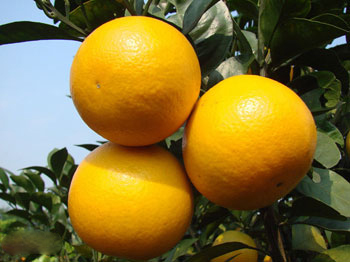
Hongjiang orange, produced at Hongjiang Farm in Guangdong Province, the "Hometown of Hongjiang Orange in China," is hailed domestically as the "Peach of Immortality on Earth" and crowned abroad as the "King of Chinese Oranges." (File photo)
At the turn of the year, the reporter came to the Zhanjiang reclamation area in Guangdong, at the southernmost tip of the Chinese mainland. Besides the endless sugarcane fields and rubber plantations, there are also the Hongjiang oranges that have been rising in popularity in recent years. In its core growing area, Hongjiang Farm, the citrus trees planted in continuous stretches are laden with golden-yellow oranges. After 30 years of continuous selection and breeding, the Hongjiang orange has become a "calling card" for the farm's industrial revival and a "treasure" for farm workers to increase their income and become prosperous.
Walking through the orchard, the reporter explored the "past and present" of the Hongjiang orange; under the orange trees, listening to the New Year plans of the people of Hongjiang - comprehensively enhance the competitiveness of the Hongjiang orange industry, make the farm more beautiful, and make the farm workers richer.
He discovered the Hongjiang orange
--Scientific and technical personnel represented by Zhong Jiacun spent 30 years breeding it, contributing a new variety to China's citrus family
There is a story to tell about the discovery of the Hongjiang orange.
One day in October 1971, Zhong Jiacun of Hongjiang Farm rode his bicycle to the orchard to look at the oranges as usual. When passing the orange orchard of Team 19, he found that one orange tree had almost no fruit hanging on it. "The fruit from this tree is especially delicious; it was all picked and eaten by everyone before it even ripened." The farm workers explained it this way.
The phrase "especially delicious" aroused great interest in Zhong Jiacun. In the long years that followed, Zhong Jiacun and other scientific and technical personnel carried out research, forgetting food and sleep. "I ran to the orchard every day and plunged into the grove every day." Zhong Jiacun said.
Thirty years to sharpen a sword; after many years of cultivation and purification, the Hongjiang orange finally became the finest among oranges.
"A true Hongjiang orange not only has a unique flavor, but its appearance is also different from others. The most obvious feature is that some Hongjiang oranges have a thin red line on their peel." Jie Yuxin, deputy farm director, told the reporter that it is said this kind of orange with a red line is something you can only encounter by chance, not by seeking; whoever encounters it is a fortunate person.
They "raised" the Hongjiang orange
--Through large-scale planting and industrialized operation, the people of Hongjiang let farm workers taste the sweetness of increasing income
Hongjiang Farm has 28,000 mu of arable land. Its 8,000 mu of Hongjiang oranges account for more than 1/4 of the total arable land, which shows the important position of Hongjiang oranges in the farm's industry. But looking across the whole country, 7,000 mu is negligible; without output, there are no sales.
"Because output is limited, Hongjiang oranges are often completely absorbed within Guangdong Province." said Wen Shanghua, a senior engineer in the Production and Science and Technology Division of the Zhanjiang Agricultural Reclamation Bureau. Things are precious when they are rare; a premium-grade Hongjiang orange still sells out even at 20 yuan each.
However, the precious Hongjiang orange once also experienced the troubles of "growing up." Beginning in the 1990s, Hongjiang oranges suffered from long-term infestation by huanglongbing, and the entire industry suffered a devastating blow.
"Developing a new variety is not easy, and making this new variety remain evergreen is even harder." Wen Shanghua said that through the efforts of scientific researchers, the Hongjiang orange industry has now entered a recovery period. In 2012, Hongjiang Farm established a standardized production demonstration park for tropical crops; in December 2014, the first batch of Hongjiang oranges from the demonstration area went on the market. "After going through a painful period, the Hongjiang orange is now emerging from the trough and ushering in a 'red' era."
Farm workers broke old ideas and used standardized technology for planting, and tree after tree of orange trees turned into "money trees."
"I planted 5 mu of Hongjiang oranges. Based on current market conditions, the income can reach 200,000 yuan." Farm worker Liao Xinglong said that there are now counterfeit Hongjiang oranges on the market, and he hopes protection of authentic Hongjiang oranges from the place of origin can be strengthened and the brand built up.
Having tasted the sweetness of increased income, the farm workers hope to establish a cooperative with the farm's support, and through working together to develop, open up broader market space.
"Next, we plan to build a Hongjiang orange distribution center to ensure the oranges come from an authentic origin; to ensure orange quality, we will establish a quality traceability system as soon as possible. At the same time, we will build an online and offline sales system, and plan to open 200 retail stores in Guangzhou and other Pearl River Delta areas within the next two years, continuously expanding the sales coverage of Hongjiang oranges." said Yao Ximeng, general manager of Zhanjiang Guangken Agricultural Technology Company.
He let the Hongjiang orange "travel" farther
--Post-90s college student Zheng Junqi went from campus to orchard, and through e-commerce promoted Hongjiang oranges across the country
For a long time, Hongjiang oranges were sold through traditional wholesale. Because output was not high, they were basically all sold locally at ordinary prices and did not enter the national market. Many people from other places had heard of them many times but never seen one. In addition, due to insufficient brand protection over the years, cases of counterfeit Hongjiang oranges and passing off inferior ones as good were common on the market.
This situation urgently needed to change, and Hongjiang Farm realized the importance of brand building. To let Hongjiang oranges travel farther, it naturally could not do without the new thinking of new farmers and new channels such as "Internet Plus."
In 2013, Zheng Junqi, a young man born in the 1990s who had just graduated from university, came to Hongjiang Farm, "just wanting to go to China's grassroots to strive and start a business." In November of that year, Zheng Junqi ate the first Hongjiang orange of his life, and it was extremely delicious. "But Hongjiang oranges should not be limited to the local area; they can travel farther."
Therefore, Zheng Junqi decided to use the power of the internet to promote and publicize Hongjiang oranges to the outside world, determined to spread the good taste of Hongjiang oranges throughout the country. In 2013, he successively opened the official Weibo and WeChat public account of Guangdong Hongjiang Farm; at the end of that year, the Hongjiang Farm Taobao store officially launched. As a brand promoter, he told the farm's story through self-media, promoted the Hongjiang orange brand, and began online marketing.
Speaking of 2016, Zheng Junqi described his New Year plans: next, he hopes that with the farm's support, large-scale warehouses will be gradually established, integrating intelligent grading machines, cleaning and packaging machines, a professional picking team, and an e-commerce sales team, reducing the cost, time, and errors of manual sorting, and putting Hongjiang oranges on the path of modern processing and sales. (Reporter Mai Tian of this newspaper)