Who to help, who helps, what to do: lifting 70 million out of poverty in 5 years
Original title: Work hard and tackle challenges head-on, lift 70 million out of poverty in 5 years
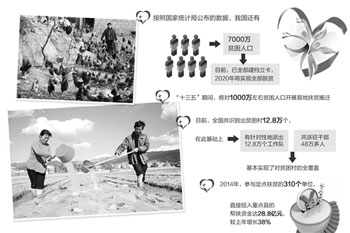
Top image: Baokang County in Hubei Province vigorously develops free-range chicken farming under forest canopies, increasing local farmers' income by more than 34 million yuan per year. Photo by Yang Tao; Bottom image: Weishan County in Dali, Yunnan Province, through policy support, material subsidies, technical guidance and other means, guides farming households to develop plateau specialty industries such as vegetables and red snow pears. Photo by Zhang Shulu
The bugle call for the battle against poverty has already sounded! The Central Conference on Poverty Alleviation and Development held not long ago proposed: we must resolve to move mountains like the foolish old man, fix our sights on the goal, work hard and tackle challenges head-on, resolutely win the battle against poverty, and ensure that by 2020 all poor areas and poor people enter a moderately prosperous society in all respects together. So, in the next 5 years, how will targeted poverty alleviation be carried out?
Whom to help --
Accurate identification, registration and filing
"I thought I was destined to live in a mud-brick house all my life. I never expected to live in a red-brick house with large tiles and use a solar water heater." Sitting in the tidy and spacious main room of her new house, Zhang Caixia looked at the photo of her old, crumbling, dilapidated mud-brick house and could not help but sigh with emotion.
Zhang Caixia is from Tuoxiang Village, Zhangyi Town, Yuanzhou District, Guyuan City, Ningxia. Before reform and opening up, Tuoxiang was a well-known begging village. Every year during the lean season, of the village's more than 600 households, more than 300 went out to beg. Compared with other villagers, Zhang Caixia's family was even worse off, because her husband suffered from a severe stomach illness and had no ability to work, and 3 children were still in school. In 2014, after preliminary assessment by Tuoxiang Village, review by Zhangyi Town, and approval by Yuanzhou District, and after public notification and announcement, Zhang Caixia was identified as an extremely poor household and was among the first to be registered and filed. Subsequently, according to the unified standards of the autonomous region, the government helped her demolish the dangerous house and build a new 54-square-meter house.
The tremendous change in the life of Zhang Caixia's family is thanks to the nationwide work on accurate identification and registration and filing of poor people that China has carried out comprehensively since the end of 2013.
"For a long time, China's poverty alleviation and development has had problems such as an unclear number of poor people, unclear circumstances, weak targeting, and inaccurate direction of poverty alleviation funds and projects. To ensure the effectiveness of the battle against poverty, we must solve the problem of 'whom to help, ' make sure the truly poor people are identified, and make clear who the poor people are, how poor they are, and why they are poor, so that policies can be tailored to each household and each person." said Liu Yongfu, director of the State Council Leading Group Office of Poverty Alleviation and Development.
Identifying poor households is the basic work. The screening baseline is an annual per capita household income of less than 2,300 yuan, which is the latest poverty line announced by China on November 29, 2011. Thereafter, it is converted by adding the inflation rate to the constant-price 2,300 yuan of 2011, and by the second half of last year it was about 3,000 yuan. Ningxia divides the identification of poor people into a ten-step method: household application, group nomination, household visit and verification, village preliminary assessment, township review, county approval, three public notifications, one announcement, system management, and dynamic adjustment. For example, the so-called household visit and verification means that after farmers apply and village groups nominate, the village committee organizes personnel to conduct household visits and fill in household survey forms.
What is the basis for the survey?
"First look at the house, second look at the grain, third look at whether the labor force is strong, fourth look at whether there is a child in school." In the villages of poor areas in Ningxia, as soon as the jingle for identifying poor households is mentioned, everyone can say it without thinking. It is understood that according to central requirements, when identifying poor households, all localities must go through the procedure of "three reviews, two public notifications, and one disclosure, " and in specific operations there are generally "four looks."
"The first look at the house means looking at the housing conditions of ordinary people. In fact, it is not only about housing, but also about their property conditions. The second look at the grain means looking at people's basic production and living conditions. If a family cannot even afford food, of course it counts as a poor household. The third look at whether the labor force is strong mainly means looking at the labor force situation in people's households, whether there are disabled people, whether there are people with long-term illness, and so on. The fourth look at whether there is a child in school. Education is often an important burden for farmer households, and in the long run it is also where the hope of escaping poverty lies." said Hong Tianyun, deputy director of the State Council Leading Group Office of Poverty Alleviation and Development. According to the procedure of "three reviews, two public notifications, and one disclosure, " nationwide screening and aggregation totaled more than 89 million poor people.
"The figure of more than 70 million poor people published by the National Bureau of Statistics is sample survey data, while more than 89 million is our poverty alleviation departments' working data. The government work report proposed reducing the poor population by 10 million each year. From our working level, the extra 19 million poor people all need to be truly lifted out of poverty." Hong Tianyun said. At present, all of these 89 million poor people have been registered and filed.
Who will help --
Government-led, participation from all sectors
The great mountains are silent, with mist and rosy clouds. Luo Yuke, a villager from Pingsheng Village, Fuyan Township, Zheng'an County, Guizhou Province, lives in the mountains. Because natural conditions were harsh, he could barely make ends meet, and although he was over thirty he still could not find a wife. Fortunately, with the help of the village-stationed work team, Luo Yuke shook off poverty by raising free-range chickens and growing ecological peppers, built a building of more than 100 square meters, and got married. It turns out that, according to the idea of "one synchronized moderately prosperous work team for each village, one responsible person for poverty alleviation and prosperity for each household, " Guizhou Province selected 55,864 village-stationed team members from government departments at the provincial, municipal, county, and township levels, and stationed synchronized moderately prosperous work groups in all 9,000 poor villages across the province.
In targeted poverty alleviation, the Party and the government bear an unshirkable responsibility. The Central Conference on Poverty Alleviation and Development held not long ago required: party committees and governments in areas with heavy poverty alleviation tasks should treat poverty alleviation as the top priority and the first livelihood project during the "13th Five-Year Plan" period, persist in using poverty alleviation to guide the overall economic and social development; sign poverty alleviation responsibility statements and make military-style pledges level by level; establish annual poverty alleviation reporting and inspection systems, and strengthen inspection and accountability; take actual poverty alleviation performance as an important basis for selecting and appointing officials, assess and identify officials on the front line of poverty alleviation, and encourage officials at all levels to display their talents on the battlefield of poverty alleviation; organically combine consolidating rural grassroots party organizations with poverty alleviation, select good top leaders, and strengthen leadership teams. According to Liu Yongfu, as of now, a total of 128,000 poor villages have been identified nationwide. On this basis, 128,000 work teams have been dispatched in a targeted manner, with more than 480,000 officials stationed, basically achieving full coverage of poor villages. Take Pingsheng Village as an example. Among the several village-stationed officials, Zhang Shun came from the county poverty alleviation office, Yu Fang came from the township party and government office, and Zheng Zhouliang came from the township economic crop development office. They are both familiar with policy direction and understand market demand, and the suggestions they put forward based on village conditions are all very valuable. For example, the village-stationed officials suggested developing cool-climate vegetables and ecological agriculture, which achieved remarkable results. Last year, Luo Yuke earned seventy or eighty thousand yuan just by raising free-range chickens and growing ecological peppers.
"Poverty alleviation and development is the responsibility of the whole Party, the whole country, and the whole society. We must widely mobilize the forces of all sectors of society to participate actively, strive to form a powerful joint force for poverty alleviation and development, and constantly improve the work pattern of major poverty alleviation. We must fully give play to the demonstrative and guiding role of designated poverty alleviation and East-West poverty alleviation cooperation in social poverty alleviation, widely mobilize enterprises, social organizations, and individuals to participate in poverty alleviation, guide the effective allocation of social resources from all sides to poor areas, and create a good trend of the whole society helping the poor and those in difficulty and uniting in mutual assistance." Liu Yongfu said.