Guangdong State Farms strengthens weak links across the whole industrial chain, with stunning e-commerce performance
Original title: Guangdong State Farms: Revitalizing the Reform Chessboard Through the Whole Industrial Chain
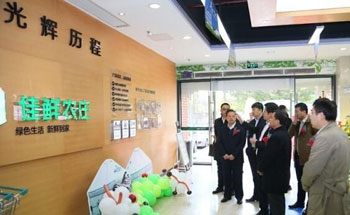
Jiaxian Farmstead Guangzhou Yueken Flagship Store (file photo)
At the end of the year, within one week, two marketing "carnivals" featuring high-quality specialty agricultural products from state farms kicked off in succession in Guangdong. On December 12, 2015, the Hongjiang orange, renowned as the "King of Chinese Oranges," bore its first heavy fruit of the 2015 picking season at Hongjiang Farm under Guangdong State Farms; on December 18, products from Inner Mongolia Hulunbuir State Farms "captivated" citizens with their authentic quality at the "Jiaxian Farmstead" flagship store on Yueken Road in Guangzhou. The two events brought a complete finale to the "2015 symphony" of Guangdong State Farms' grand vision of revitalizing the reform chessboard of "farm corporatization, reclamation area groupization, and equity diversification" through building the whole industrial chain.
In recent years, while further consolidating the foundation of traditional advantageous industries such as rubber, dairy, and sugar, Guangdong State Farms has also been actively seeking new economic growth points in animal husbandry, grain and oil, and green agricultural products. By targeted efforts to shore up weak links in every stage of "production, supply, and sales," the continuous improvement of product efficiency has gradually transformed its massive land resources into high-quality capital oriented toward the market.
The workers at Hongjiang Farm have deeply experienced the benefits of breaking through the marketing bottleneck. A veteran worker told reporters that Hongjiang oranges have been cultivated for more than 40 years, but due to weak sales channels and the impact of disease, "everyone was once holding a golden bowl while waiting for food." Today, through a series of combined moves in brand building, especially with the help of "Internet Plus" platforms such as Taobao and WeChat, the value of Hongjiang oranges has multiplied. "In the past they were sold by the jin and by the box; now they are sold by the piece," one worker said. "20 yuan each, four times the previous price."
As the most important chain brand under Guangdong Guangken Green Agricultural Products Company, Jiaxian Farmstead's goal of "cooperating with livelihood e-commerce to jointly build a B2C, O2O, and B2B e-commerce platform covering state farms nationwide" carries the great ambition of the people of Guangdong State Farms. Following the idea of "determining production by demand," Guangken Green Food Company began calmly "placing pieces" in the production sector. Through equity participation, joint-stock partnership, and acquisition, Guangken Green Agricultural Products Company has built nearly 12,000 mu of migratory vegetable bases in Zhanjiang, Guangdong, Qingtongxia, Ningxia, and other places, and plans to expand the scale to more than 100,000 mu within 3 years, influencing and driving more than 200,000 mu of cooperative production bases.
Guangdong State Farms is paying increasing attention to entering from the middle and lower reaches of the industry, closer to the demand side, and reallocating factors. In 2005, the first rubber processing plant was completed in Satun Province, Thailand, marking the first step of Guangken Rubber's "going global" strategy. After that, Guangken Rubber successively established more than 20 rubber planting, processing, and trading enterprises in Thailand, Malaysia, Indonesia, and other countries, basically achieving full coverage of the natural rubber industrial chain. At present, Guangken Rubber's overseas farms have an annual production capacity of 500,000 tons, with a planned rubber planting area of about 3 million mu, making it a multinational enterprise with the largest overseas natural rubber planting and processing base in China. With agriculture and forestry as the leader, product processing as the backbone, and modern commercial circulation models such as "Internet Plus" as the platform, an all-round, multi-level industrial pattern is continuously extending in depth and breadth across multiple business segments of Guangdong State Farms.
"Following the whole industrial chain model, with horizontal alliances and vertical clustering, we will build cross-border supply chains for production and trade, finance, infrastructure, talent, and public services, and promote the integrated development of the primary, secondary, and tertiary industries." In the eyes of Lei Yongjian, Party Secretary and Chairman (Director) of Guangdong Provincial State Farms Group Company (State Farms Bureau), the whole industrial chain is not only a product chain, but also a talent chain, capital chain, and technology chain. Only when every chain has undergone repeated tempering can the tow rope twisted from them together drag the great ship of reform forward through the waves. (Author: Fu Wei)