Red sorghum grown in black soil, high tannin content makes better and more aromatic liquor
Original title: How to grow red sorghum well in black soil?
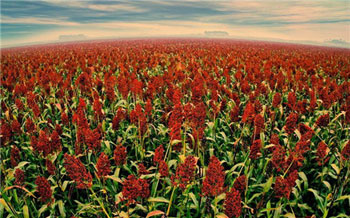
Growing red sorghum for brewing in black soil (file photo)
Some farmers in Nenjiang County, Heilongjiang Province, got a taste of success growing sorghum last year. Yield was 1000 to 1300 jin per mu, with an order price of 0.8 yuan per jin and a market price of 0.9 yuan, and income per hao was more than 3000 yuan higher than that of corn. How was this done?
The secret of "tannin"
Jiao Shaojie, deputy director of the Breeding Institute of the Heilongjiang Academy of Agricultural Sciences and a scientist in the National Sorghum Industry Technology System, told reporters that what farmers grow is sorghum specially for brewing, and the reason it sells well is its high tannin content.
"Tannin is a type of anthocyanin, an active substance, but it forms complexes during animal digestion and affects protein absorption, so from a nutritional standpoint it is not a good thing." Jiao Shaojie said, "In the era when sorghum was a staple grain, everyone had the experience that eating too much red sorghum easily led to stomach problems, and this was caused by tannin."
But in the brewing industry, tannin is a treasure. Sorghum containing tannin produces classified compounds during fermentation, forming a special aroma, and this is the secret of the fragrance of Chinese-style baijiu. Domestic high-end baijiu must involve sorghum in fermentation, and all domestic sorghum also enters the brewing and vinegar-making industry.
Jiao Shaojie said: "The outstanding feature of Heilongjiang red sorghum is its high starch content and moderate tannin content. The environmental characteristic of large day-night temperature differences in the later growth stage of Heilongjiang sorghum is conducive to starch synthesis and accumulation, and high starch lays the foundation for a high liquor yield. Sorghum kernels also contain 1.5% tannin, which through process fermentation forms special aromatic compounds and polyphenolic substances during fermentation, giving baijiu its unique aroma.
Sorghum is the only plant among cereal crops that contains tannin. In international markets, sorghum is mainly used in the feed industry, and how to reduce tannin content and improve protein absorption rate has become an important standard in variety breeding; low tannin content has become the standard by which foreign countries measure sorghum quality. "In China, sorghum is mainly used for brewing, while sorghum produced abroad has low tannin content and is not suitable for making liquor. This particularity in use makes it very difficult for foreign sorghum to enter China's brewing raw material market." Jiao Shaojie said.
In Nenjiang County, the sorghum grown by the Honggu Sorghum Professional Cooperative was packed into special sorghum bags for the Wuliangye Group and sent by the truckload to Yibin, Sichuan. The person in charge of the cooperative said: "We took samples to the manufacturer, and the manufacturer appraised it and said our variety is the most suitable brewing variety, first-grade grain. This year we planted more than 2000 mu of 'Longza 17' sorghum, and next year we will continue to expand the planting area."
The opportunity for sorghum
Jiao Shaojie told reporters: "We have already bred a new brewing-specific sorghum variety suitable for mechanized planting, 'Longza 17'. This is currently the earliest-maturing hybrid sorghum variety registered and promoted nationwide, suitable for mechanized cultivation and suitable for brewing. This year is the first year of large-scale promotion and planting across the province, with an area of more than 200,000 mu. Planting sorghum reduces input by more than 2000 yuan per mu compared with corn, and the purchase price is 0.2 yuan per jin higher than corn, so the comparative benefit of planting sorghum is considerable."
Nenjiang County Hongliang Seed Industry Company joined with professional cooperatives to develop sorghum planting, providing seeds to cooperative farmers and carrying out cultivation guidance. In 2015, the county's brewing sorghum planting area was more than 50,000 mu, with the highest yield reaching 10 tons per hao. They also signed orders with farmers to purchase sorghum at a floor price of 0.8 yuan per jin, and then sold it to liquor factories in the south through the Internet.
Hailun City Tiansheng Family Farm planted 60 hao of sorghum this year, with a yield of more than 1200 jin per mu. Farm owner Tian Sheng said: "I never expected to get a bumper harvest in the first year with expert guidance. Roughly calculating, it earns more than 3000 yuan per hao more than planting corn."
According to reports, the sorghum planting area in Heilongjiang has for many years been concentrated between 45° and 49° north latitude, located in the famous Songnen Plain. Because of year-round wind and sand, drought, relatively low soil fertility, and much salinity and alkalinity, this gives full play to sorghum's characteristics of drought resistance, waterlogging tolerance, saline-alkali tolerance, and tolerance of barren soil, and under the premise of comparative benefit, enables medium- and low-yield fields to create relatively high yields and better economic returns. Through a survey of 400 soybean-growing farmers in major soybean-producing counties such as Nehe, Keshan, and Hailun, it was learned that the number of farmers planting sorghum is increasing year by year. The reason is mainly that the comparative benefit of planting soybeans is relatively low, and farmers have a strong desire for structural adjustment. In addition, the breeding and promotion of mechanized sorghum cultivation varieties and the fact that the machinery and equipment for planting soybeans are suitable for planting sorghum have also promoted the expansion of sorghum planting areas into soybean-producing areas.
The difficulties facing sorghum
Industry insiders believe that the lack of necessary support puts sorghum in a disadvantaged position. Sorghum is a minor coarse grain crop, does not have a leading impact on the local economy, and there are no clear task indicators in the assessments at all levels of government. Therefore, in practice it has received almost no government attention or policy support. Agricultural subsidy policies implemented by the state, such as improved seed subsidies and direct grain-growing subsidies, do not include sorghum. Therefore, in sorghum production, farmers generally plant major crops on good land, and because cultivation guarantees seeding but not emergence, guarantees emergence but not harvest, and guarantees harvest but not high yield, this has caused instability in sorghum production.
The reporter learned that because sorghum is classified as an economic crop, in some reclamation area farms the land rent price is more than 1000 yuan per hao higher than for grain crops, and there is still no subsidy at all.
Zou Jianqiu, chief scientist of the National Sorghum Industry Technology System, director of the National Sorghum Improvement Center, and director of the Sorghum Research Institute of the Liaoning Academy of Agricultural Sciences, believes that Heilongjiang Province is a major grain-producing province in China and has a huge impact on national agricultural production and food security. At present, corn in the region is growing too fast and the planting structure is single, so there is an urgent need to adjust and optimize the crop farming structure, make full use of existing land and climate conditions, combine planting and raising, build a reasonable crop rotation system, give play to comparative advantages, and achieve stable grain output and increased income, improved quality and efficiency, and sustainable development.
At present, Heilongjiang Province still has no corresponding support policies to promote the development of sorghum production. Zou Jianqiu suggested that the government include sorghum planting in the scope of agricultural subsidies, provide special financial support for the construction of raw material bases, create a relaxed and preferential policy environment for sorghum deep-processing enterprises in terms of funds, taxes, loans, and land, vigorously support farmers' professional cooperative organizations for sorghum planting, and encourage cross-regional operation of agricultural machinery in reclamation areas to improve the level of mechanization, scale, standardization, and scientific and technological content of sorghum planting. (Author: Liu Weilin)