New prospects open up for growing Dictyophora indusiata under Phyllostachys pubescens forests
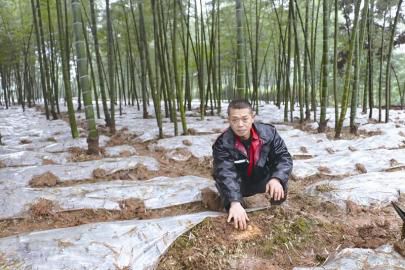
The mycelium is growing beautifully.
On January 4, the author walked into the Dictyophora indusiata cultivation base in Huihu Village, Baijie Town, Naxi District, Luzhou City, and saw that on the open spaces among the dense Phyllostachys pubescens forest, patches of white agricultural film could be seen everywhere covering beds of newly planted Dictyophora indusiata.
"The spawn sown only in late September 2015 has already produced 98% mycelium, excellent." The owner Xian Ligui said after casually lifting the film to check, "We adopted the method of digging pits in the bamboo forest for fixed planting cultivation." In June 2015, under the guidance of technicians from the Naxi District Forestry Bureau, he transferred 150 mu of Phyllostachys pubescens forest in the village to grow Dictyophora indusiata on a large scale, and in late September he padded the pits with rice husk, then spread the Dictyophora indusiata spawn in proportion, and then covered it with soil and laid plastic film, and that was it.
Baijie Town is the core area of the ten-thousand-mu Phyllostachys pubescens base in Naxi District, providing broad space for interplanting Dictyophora indusiata under the forest. Before growing Dictyophora indusiata, bamboo and bamboo shoots were the main income of the villagers here. After interplanting Dictyophora indusiata under the Phyllostachys pubescens forest, Phyllostachys pubescens is no longer the main source of income for bamboo farmers, and Dictyophora indusiata will become another "treasure" for increasing villagers' income after winter bamboo shoots.
"Growing Dictyophora indusiata under the forest not only saves land, but also saves costs and promotes farmers' income growth." Chen Yongfu, an expert from the Naxi District Forestry Bureau, told the author that this year, Naxi District began large-scale interplanting of Dictyophora indusiata under Phyllostachys pubescens forests, which will effectively solve the "mushroom-field conflict" in edible fungus production. He said that current artificial cultivation of Dictyophora indusiata is generally mainly shed cultivation in open fields, requiring the construction of shade sheds, and Dictyophora indusiata cannot be continuously cropped; generally, fields that have been planted must be rotated with other crops for more than 3 years before they can be used as Dictyophora indusiata cultivation land, which to a certain extent causes a waste of cultivated land resources. However, interplanting Dictyophora indusiata under bamboo forests not only saves cultivated land resources and the labor of building shade sheds, but also significantly increases efficiency. At the same time, the spent mushroom substrate after cultivation returns to the forest land, which can increase the organic matter of the forest land, improve soil structure, and achieve mutual benefit between forest and fungi and circular utilization of resources.
In 2015, Xian Ligui transferred 150 mu of Phyllostachys pubescens forest land for interplanting Dictyophora indusiata. He said that according to the technology for interplanting Dictyophora indusiata under Phyllostachys pubescens forests successfully explored elsewhere, 1 mu of forest land can yield 350 kg of fresh Dictyophora indusiata and 70 kg of dried Dictyophora indusiata. Calculated at 400 yuan per kg of dried Dictyophora indusiata, each mu can generate an income of 28,000 yuan, and bamboo farmers can obtain a net profit of about 15,000 yuan.
"Although the economic value of Dictyophora indusiata is high, the cost of growing it is also very high. The cost of 1 mu of land is nearly 10,000 yuan, which may make some bamboo farmers hesitate." Xian Ligui said that based on this situation, he will adopt the "company (cooperative) + farmers" model to develop Dictyophora indusiata cultivation. "Because there is a habit in Dictyophora indusiata cultivation, that is, once it is planted in the first year, it cannot be planted again in the second year. Therefore, in the next step, when driving villagers to cultivate it, I will combine under-forest chicken raising and Chinese medicinal herb cultivation to develop together, give play to the maximum economic benefits of the bamboo forest, and let more forest farmers embark on a new path of increasing income by 'living on bamboo and eating from bamboo' as soon as possible."